
If you’ve been shopping for firewood, you’ve probably come across the term “rick” — and maybe found it confusing. Sellers use it loosely, dimensions vary by region, and pricing can feel all over the place. This guide cuts through the confusion with clear pricing, size comparisons, wood species breakdowns, and practical tips to make sure you get your money’s worth.
A rick of wood typically costs between $75 and $200 in 2025. Most homeowners pay around $100–$150 for a rick of seasoned hardwood. Softwood ricks run cheaper at $80–$120, while premium hardwoods like oak or hickory can reach $200+.
$75–$200
Typical rick price range
~42 cu ft
Average rick volume
⅓ cord
Rick = approx. one-third of a full cord
How Much Wood Is in a Rick?
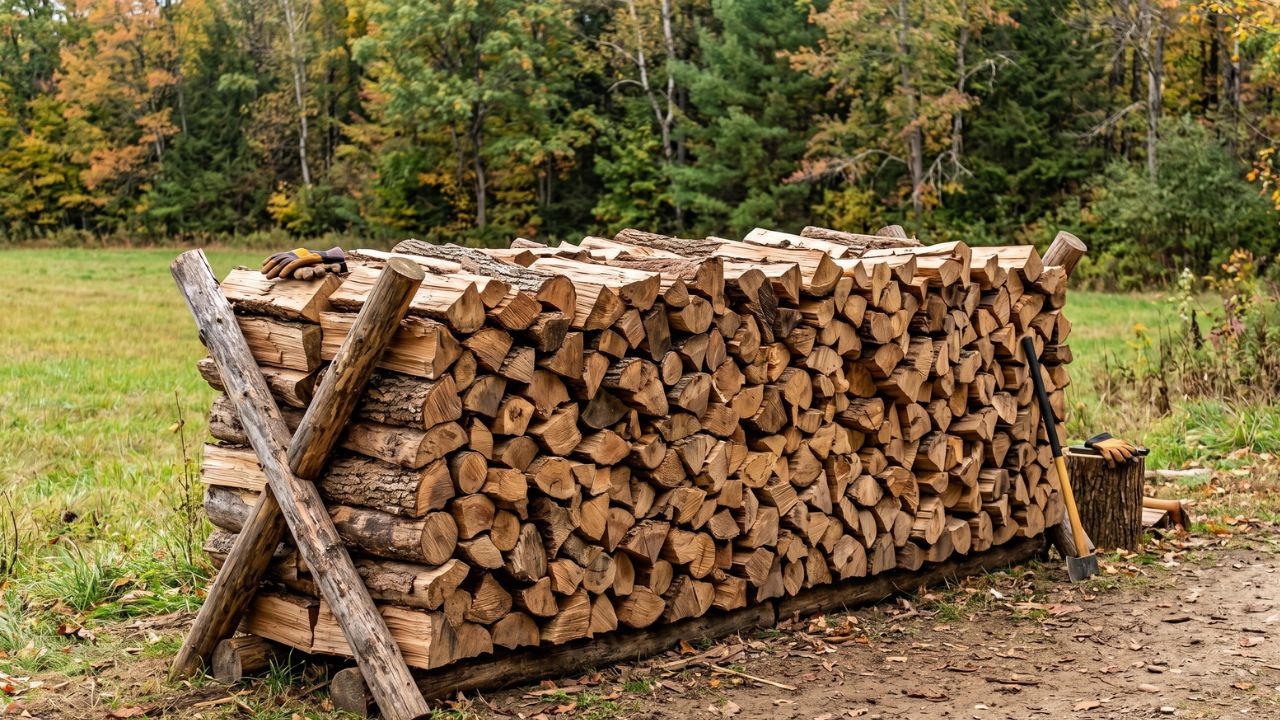
A rick of wood is a measurement of stacked firewood rather than a specific weight. In most parts of the United States, a standard rick measures 4 feet high and 8 feet long, while the depth depends on the length of the firewood pieces.
Because the depth varies, the amount of wood in a rick can vary as well. Most firewood is cut into logs that are 16 to 18 inches long, making a typical rick approximately 42 to 48 cubic feet in volume.
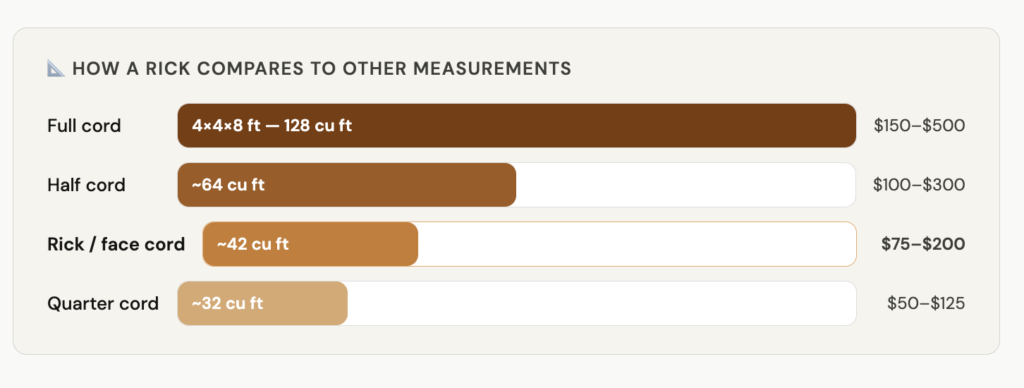
For comparison, a full cord of wood measures 4 feet high × 8 feet long × 4 feet deep, which equals 128 cubic feet. This means a typical rick contains about one-third of a cord of wood.
Typical Rick Sizes
| Log Length | Approximate Rick Volume |
|---|---|
| 12 inches (1 ft) | 32 cubic feet |
| 16 inches (1.33 ft) | 42.7 cubic feet |
| 18 inches (1.5 ft) | 48 cubic feet |
| 24 inches (2 ft) | 64 cubic feet |
Since there is no universally enforced legal definition of a rick in many states, always verify the stack dimensions before purchasing.
What exactly is a rick of wood?
A rick of wood — also commonly called a face cord — is a stack of firewood measuring 4 feet high by 8 feet long. The depth, however, is where it gets variable: it depends on the length each log is cut to, typically 12 to 18 inches.
This variability is important. Because depth isn’t standardised, two sellers can both call their product a “rick” while selling meaningfully different volumes of wood. Always ask for the log length when buying a rick — it directly determines how much wood you’re actually getting.
Rick of wood price by region
Where you live makes a significant difference to what you’ll pay. States with abundant forests and mild winters tend to have more competitive firewood markets. Cold northern states see sharp price spikes in winter months as demand surges. Here are typical 2025 ranges by region:
| Region | Rick price range | Season impact |
|---|---|---|
| Northeast (NY, MA, VT, ME) | $120 – $200 | High seasonal spike |
| Midwest (OH, MI, WI, MN) | $90 – $160 | High seasonal spike |
| Southeast (NC, GA, TN, VA) | $75 – $130 | Moderate |
| Pacific Northwest (OR, WA) | $100 – $170 | Moderate |
| Mountain West (CO, UT, ID) | $100 – $175 | High seasonal spike |
| South/Southwest (TX, AZ, FL) | $75 – $120 | Low seasonal impact |
Delivery charges typically add $25–$75 on top of these prices, depending on distance. Some local suppliers include delivery within a certain radius; others charge by the mile. Always confirm before ordering.
Price by wood species
The type of wood in a rick is one of the biggest price drivers. Hardwoods cost more upfront but burn hotter, longer, and cleaner — often making them better value per hour of heat than cheaper softwoods.
🔥 Premium hardwood
Oak ($150 – $200 / rick)
The gold standard of firewood. Slow-burning, high heat output, minimal smoke. Worth the premium for primary heating.
🔥 Premium hardwood
Hickory ($160 – $200 / rick)
Highest BTU output of common firewoods. Burns long and hot. Excellent for wood stoves and outdoor cooking.
🌿 Mid-range hardwood
Maple / Ash ($120 – $170 / rick)
Excellent all-rounders. Easy to split, good heat output, burns cleanly. Popular choices for fireplaces.
🌿 Mid-range hardwood
Cherry / Birch ($100 – $150 / rick)
Pleasant aroma and attractive flame. Moderate heat output. Great for occasional use and ambiance fires.
🌲 Softwood / budget
Pine / Fir ($80 – $120 / rick)
Cheap and widely available. Burns fast and hot but produces more creosote. Best used as kindling or mixed loads.
🌲 Softwood / budget
Mixed / unknown ($75 – $110 / rick)
Often the cheapest option. Quality varies widely. Ask what species are included before buying.
Seasoned vs. green wood: does it affect price?
Yes — and significantly. Seasoned firewood (dried for 6–18 months) burns efficiently, produces more heat per log, and generates far less creosote buildup in your chimney. It costs more but delivers better value per fire.
Green wood (freshly cut, high moisture content) is cheaper upfront but burns poorly, producing more smoke and less heat. It also requires additional storage time before it’s usable. Unless you’re buying green wood to season yourself over the next 12 months, seasoned is almost always the smarter purchase.
⚠️ Watch out for short-measure ricks. Because “rick” has no legal definition in most US states, some sellers use the term to sell smaller-than-standard stacks. Always confirm the exact dimensions — height, length, and log depth — before paying. A legitimate rick is 4 ft × 8 ft × log length.
How long will a rick of wood last?
This depends on how often you burn and what you’re burning in. As a practical rule of thumb for a standard open fireplace:
| Usage pattern | Estimated duration |
|---|---|
| Occasional fires (1–2 evenings/week) | 6 – 10 weeks |
| Regular use (3–4 evenings/week) | 3 – 5 weeks |
| Daily burning (primary heat source) | 1 – 2 weeks |
| Efficient wood stove (regular use) | 4 – 8 weeks |
Wood stoves are significantly more efficient than open fireplaces — the same rick will last considerably longer in a stove than in an open hearth. If you’re using wood as a primary heat source through winter, plan on needing at least 3–5 ricks (roughly a full cord or more) for the season.
Rick vs Cord vs Face Cord
Many people use the terms rick, face cord, and cord interchangeably, but they are not always the same.
- Rick (Face Cord): Usually 4 ft high × 8 ft long with variable depth.
- Full Cord: 4 ft high × 8 ft long × 4 ft deep (128 cubic feet).
- Half Cord: Approximately 64 cubic feet.
- Bundle of Firewood: Small packaged bundles sold at gas stations, campgrounds, and grocery stores.
In practical terms, a standard rick with 16-inch logs contains roughly one-third of a full cord. Therefore, if a full cord costs $300–$450, you can expect a rick to cost approximately $100–$150, depending on wood species and location.
Tips for getting the best deal on a rick of wood
💡 Buyer’s tips
- Buy in late summer or early autumn. Firewood prices spike 20–40% in winter as demand surges in cold regions. Buying in August or September locks in off-season rates and gives you time to store properly.
- Always ask for exact dimensions. Confirm the height, length, and log depth before paying. A seller who won’t give you specific measurements is a red flag for a short-measure load.
- Buy a full cord with a neighbour. Splitting a cord with a neighbour often works out cheaper per rick than buying smaller quantities — and many suppliers offer free delivery for full cords.
- Check that the wood is seasoned. Properly seasoned firewood has visible cracks at the log ends, feels lighter than green wood, and makes a hollow “clunk” rather than a dull thud when two pieces are knocked together.
- Source locally. Local wood is cheaper (no long-distance haulage fees), often fresher, and avoids the risk of importing invasive tree pests. Many states actively restrict transporting firewood across county or state lines.
- Compare at least 3 suppliers. Prices for the same wood species in the same region can vary by 30–40% between sellers. A quick round of calls or a Craigslist check before committing can save real money.
The bottom line
A rick of wood costs $75 to $200 in most parts of the US in 2025, with the sweet spot for seasoned mixed hardwood sitting around $100–$150. Premium species like oak and hickory push toward the top of the range; softwoods like pine come in at the lower end. The most important things: confirm exact dimensions before buying, insist on properly seasoned wood, and shop in late summer to avoid winter price spikes. A little planning goes a long way when it comes to firewood.