
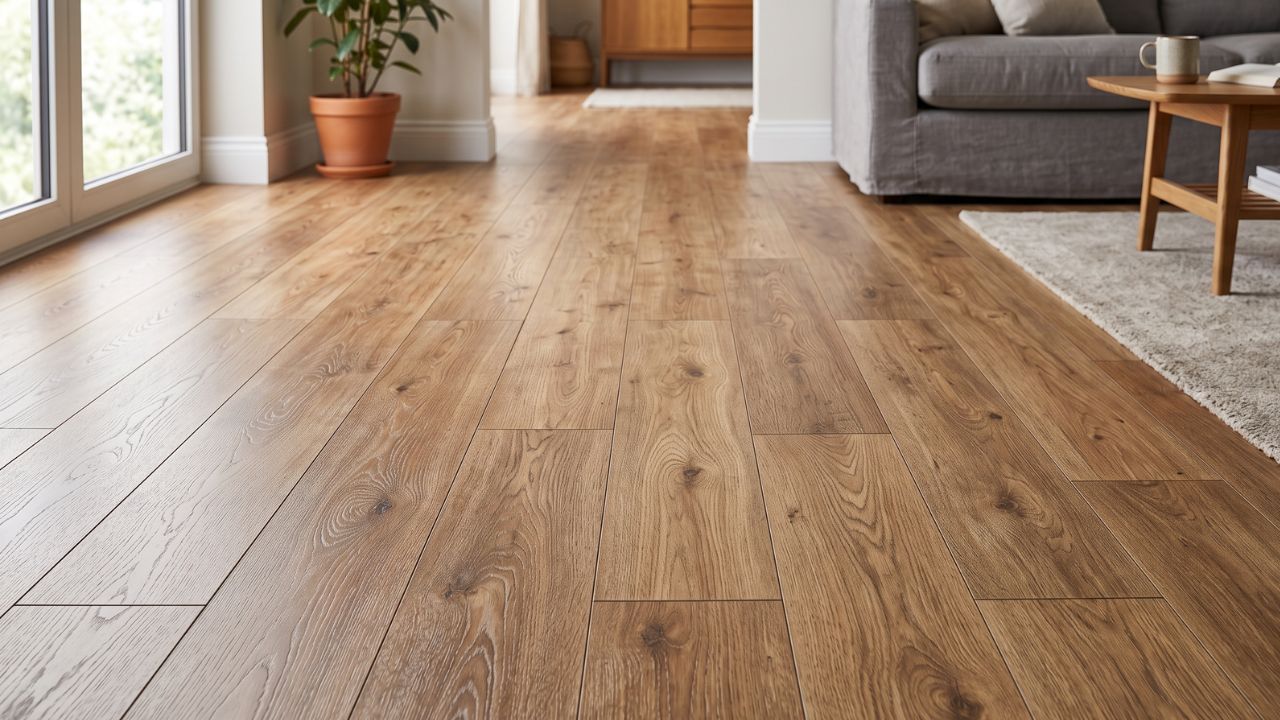
Walk into almost any home improvement store today and you’ll find entire aisles dedicated to laminate wood flooring — dozens of styles, colors, and textures all promising the warm, elegant look of real hardwood at a dramatically lower price. But what exactly is laminate wood? Is it real wood? Is it durable? And is it really worth choosing over solid hardwood, engineered wood, or luxury vinyl?
As a wood expert, I get these questions constantly. Laminate is one of the most misunderstood flooring materials on the market — people either swear by it or dismiss it entirely, usually based on incomplete information. This guide will give you the full picture: what laminate wood is made of, how it’s manufactured, its strengths and limitations, and how it compares to every major flooring alternative — so you can make a genuinely informed decision.
What Is Laminate Wood? The Simple Definition
Laminate wood (also called laminate flooring) is a multi-layer synthetic flooring product designed to simulate the appearance of real wood — or sometimes stone or tile — without using solid natural wood in its construction. Despite being called “laminate wood,” it contains little to no actual solid wood. Instead, it’s an engineered composite product made primarily from wood byproducts and high-pressure resins.
The name “laminate” comes from the manufacturing process: multiple distinct layers are bonded (laminated) together under high heat and pressure to create a single rigid plank. The result is a floor that looks like wood but is fundamentally different from it in composition, performance, and care requirements.
Laminate flooring was invented in Sweden in 1977 by Perstorp AB under the brand name Pergo. It arrived in North America in the 1990s and has since become one of the best-selling flooring types in the world — and for understandable reasons.
What Is Laminate Wood Made Of? The 4-Layer Structure
Understanding laminate flooring starts with understanding its construction. Every laminate plank is built from four distinct layers, each serving a specific function:
Layer 1 — The Wear Layer (Top)
This is the outermost surface of the plank — the part you walk on. It’s a clear, hard, transparent coating made from aluminum oxide, one of the hardest naturally occurring compounds on earth (rated 9 on the Mohs hardness scale, just below diamond). The wear layer protects everything beneath it from scratches, scuffs, stains, UV light, and daily foot traffic.
The thickness and quality of the wear layer is the single biggest factor in how long a laminate floor lasts. Budget laminates may have a wear layer as thin as 6 mil (0.15mm), while premium laminates use 12 mil (0.3mm) or thicker. Thicker wear layers resist scratching longer and maintain their surface gloss further into the floor’s lifespan.
Layer 2 — The Design Layer (Decorative Layer)
Directly beneath the wear layer sits a high-resolution photographic image printed on paper or resin film. This is what gives laminate its visual appearance — the grain patterns, knots, color variation, and texture of whatever species or material it’s simulating. Modern laminate design layers use advanced digital printing technology that can replicate the look of oak, walnut, maple, hickory, stone, ceramic, and even exotic species with remarkable accuracy.
Some premium laminates go further by adding embossed texture to the wear layer above the design layer — a technique called Embossed-in-Register (EIR) — which aligns the tactile texture of the surface with the printed grain pattern below, making the plank feel genuinely wood-like underfoot as well as look it.
Layer 3 — The Core Layer (HDF/MDF Board)
This is the structural heart of the laminate plank, and the most important layer for understanding its performance characteristics. The core is made from High-Density Fiberboard (HDF) — sometimes Medium-Density Fiberboard (MDF) in budget products — which is manufactured by compressing wood fibers, sawdust, and wood pulp with adhesive resins under intense heat and pressure.
HDF is extremely dense and dimensionally stable, giving the plank its rigidity and impact resistance. However, this layer has one critical vulnerability: it absorbs moisture. When the HDF core gets wet, it swells, causing the planks to buckle, warp, and separate at the seams — damage that is typically permanent. This is why laminate has traditionally been unsuitable for bathrooms, laundry rooms, and other high-moisture areas (though waterproof laminate variants are now available — more on that below).
Layer 4 — The Backing Layer (Balancing Layer)
The bottom layer of the plank is a backing board — usually made from melamine resin or a similar moisture-resistant material. It serves two purposes: it balances the structural forces in the plank (preventing warping due to uneven expansion), and it provides a slight moisture barrier against vapor rising from the subfloor. Some premium laminates integrate a pre-attached foam or cork underlayment into this layer for added sound absorption and comfort underfoot.
How Is Laminate Wood Manufactured?
Laminate flooring production is a highly controlled industrial process. Here’s how those four layers become a finished plank:
- Wood fiber preparation: Wood waste — sawdust, wood chips, leftover scraps from lumber mills — is collected and broken down into fine fibers. This is what makes laminate a relatively sustainable product: it uses wood byproducts that would otherwise go to waste.
- HDF core production: The wood fibers are blended with adhesive resins and compressed under enormous heat and pressure (up to 300 psi) to form dense fiberboard sheets. The resulting material is harder and more uniform than natural wood.
- Design printing: High-resolution digital images of wood grain, stone, or other materials are printed onto decorative paper using photographic-quality ink systems. These images are detailed enough to replicate individual plank-to-plank variation in color and grain.
- High-pressure lamination: All four layers — backing board, HDF core, design paper, and wear layer — are assembled and bonded together using a high-pressure laminate (HPL) or direct-pressure laminate (DPL) press. HPL involves pressing the layers separately before bonding to the core; DPL bonds all layers simultaneously. HPL results in a more durable product.
- Cutting and profiling: The bonded sheets are cut into individual planks, then precision-milled to create the tongue-and-groove or click-lock edge profiles that allow planks to snap together during installation.
- Quality control and finishing: Planks are inspected for surface defects, color consistency, and dimensional accuracy before packaging.
Types of Laminate Wood Flooring
Not all laminate is created equal. Here are the main categories you’ll encounter when shopping:
By AC Rating (Abrasion Class)
The AC rating system, developed by the European Producers of Laminate Flooring (EPLF), rates laminate durability on a scale from AC1 to AC5. This is the most important spec to check when buying:
| AC Rating | Durability Level | Best Use | Expected Lifespan |
|---|---|---|---|
| AC1 | Light residential | Bedrooms, closets — very low foot traffic | 5–10 years |
| AC2 | General residential | Living rooms, dining rooms | 10–15 years |
| AC3 | Heavy residential / Light commercial | All rooms including hallways and kitchens | 15–20 years |
| AC4 | General commercial | Offices, boutiques, small retail spaces | 20–25 years |
| AC5 | Heavy commercial | High-traffic public spaces, large retail | 25+ years |
For most homes, AC3 is the sweet spot — durable enough for every room in the house, including kitchens and hallways, while remaining affordable.
By Thickness
Laminate planks range from 6mm to 12mm in thickness. Thicker planks feel more solid underfoot, absorb sound better, and can bridge minor subfloor imperfections more effectively. 8mm is the practical minimum for comfortable feel; 10–12mm is noticeably better and worth the extra cost in living areas.
By Surface Texture
- Smooth / High-Gloss: Polished surface, reflects light, shows scratches and fingerprints more easily.
- Matte / Satin: Low-sheen finish, hides everyday wear better, more contemporary look.
- Embossed: Textured surface that mimics wood grain feel; more realistic but can trap dust in grooves.
- Hand-Scraped: Irregular, rustic texture that mimics aged or reclaimed wood; very good at hiding scratches.
- Embossed-in-Register (EIR): Premium texture aligned precisely to the printed design — the most realistic feel available in laminate.
By Water Resistance
- Standard Laminate: Traditional HDF core — not water-resistant. Keep moisture away.
- Water-Resistant Laminate: Treated HDF core and sealed edges offer better moisture tolerance — suitable for kitchens.
- Waterproof Laminate: Uses a plastic composite core (similar to WPC vinyl) instead of HDF — can handle standing water for 24–72 hours. Suitable for bathrooms and laundry rooms.
Pros and Cons of Laminate Wood Flooring
Advantages
- Cost-effective: Laminate costs significantly less than solid hardwood — typically $1–$5 per square foot for materials, vs. $5–$15+ for solid hardwood. Installation costs are also lower due to the floating click-lock system.
- Realistic wood appearance: Modern laminate printing technology produces exceptionally convincing wood-look surfaces. Many visitors cannot tell the difference from across the room.
- Scratch and dent resistance: The aluminum oxide wear layer is harder than most wood species. Laminate outperforms solid hardwood in scratch resistance — a significant advantage in homes with pets and children.
- Easy DIY installation: Most laminate uses a floating click-lock system — planks snap together without nails or glue, making it one of the most DIY-friendly flooring types available.
- Low maintenance: Regular dry sweeping and occasional damp mopping is all that’s needed. No sanding, refinishing, or waxing required.
- Consistent appearance: Unlike natural wood, laminate doesn’t have defects, color irregularities, or knots (unless designed to simulate them). Every plank is uniform in quality.
- Uses wood waste: Manufactured from sawmill byproducts, laminate is arguably a more resource-efficient use of wood fiber than solid lumber.
Disadvantages
- Moisture vulnerability (standard laminate): The HDF core swells when wet, and water damage is irreversible. Traditional laminate should not be used in bathrooms or areas prone to flooding.
- Cannot be refinished: Unlike solid or engineered hardwood, laminate cannot be sanded and refinished when the surface wears out. When the wear layer is gone, the floor must be replaced.
- Hollow sound underfoot: Thinner laminate (6–8mm) can produce a hollow, clicking sound when walked on — a giveaway that it’s not real wood. Quality underlayment and thicker planks significantly reduce this.
- Not genuinely authentic: Despite improved printing, laminate still has repeated design patterns across planks that a trained eye can spot. Real wood has infinite natural variation.
- VOC emissions (some products): Some laminate products — particularly budget imports — use adhesive resins that off-gas volatile organic compounds (VOCs) including formaldehyde. Look for CARB Phase 2 or GREENGUARD Gold certified products to ensure low emissions.
- Lower resale value: Real estate professionals generally consider laminate a budget flooring option. Homes with hardwood floors typically command higher resale values than those with laminate.
- Slippery when wet: Smooth laminate surfaces become slippery when moisture is present — a safety concern, especially for elderly residents.
Laminate Wood vs. Other Flooring Types: Full Comparison
| Factor | Laminate | Solid Hardwood | Engineered Hardwood | Luxury Vinyl Plank (LVP) |
|---|---|---|---|---|
| Material | HDF core + printed design layer | 100% solid wood | Real wood veneer over plywood core | 100% PVC / plastic composite |
| Cost (per sq ft) | $1–$5 | $5–$15+ | $3–$10 | $2–$7 |
| Water resistance | Low (standard) / High (waterproof) | Very low | Moderate | 100% waterproof |
| Scratch resistance | High | Low–Medium (species dependent) | Medium | Medium–High |
| Refinishable? | No | Yes (multiple times) | Yes (1–3 times) | No |
| Lifespan | 15–25 years | 50–100+ years | 25–50 years | 20–30 years |
| DIY installation | Very easy (click-lock) | Difficult (nail-down) | Moderate | Very easy (click-lock) |
| Feels like real wood? | Moderate | Yes — it IS real wood | Yes — real wood surface | Less so — softer feel |
| Resale value impact | Low | High | Medium–High | Low–Medium |
| Best for bathrooms? | Only waterproof types | No | No | Yes |
| Eco-friendliness | Uses wood waste | Uses primary timber | Uses primary timber (less) | Plastic — not biodegradable |
Where Can You Use Laminate Wood Flooring?
| Room / Location | Standard Laminate | Water-Resistant Laminate | Waterproof Laminate |
|---|---|---|---|
| Living room | ✅ Excellent | ✅ Excellent | ✅ Excellent |
| Bedroom | ✅ Excellent | ✅ Excellent | ✅ Excellent |
| Hallways / high traffic | ✅ Good (AC3+) | ✅ Good | ✅ Good |
| Kitchen | ⚠️ Use caution | ✅ Good | ✅ Excellent |
| Bathroom | ❌ Not recommended | ⚠️ Only half-baths | ✅ Good |
| Laundry room | ❌ Not recommended | ⚠️ Risky | ✅ Good |
| Basement | ❌ Not recommended | ⚠️ Depends on moisture | ✅ Good |
| Sunroom / porch (enclosed) | ⚠️ UV fading risk | ⚠️ UV fading risk | ⚠️ UV fading risk |
| Outdoor / open porch | ❌ Never | ❌ Never | ❌ Never |
How Long Does Laminate Wood Flooring Last?
The lifespan of laminate flooring depends on three main factors: the AC rating and wear layer thickness, the quality of installation, and how well it’s maintained. Here’s a realistic breakdown:
- Budget laminate (AC1–AC2, 6–7mm): 5–10 years under normal residential use.
- Mid-range laminate (AC3, 8–10mm): 15–20 years with proper care.
- Premium laminate (AC4–AC5, 10–12mm): 20–30 years, even in higher-traffic areas.
The most common reasons laminate fails before its time are water damage (HDF core swelling), wear-through of a thin wear layer in high-traffic zones, and improper installation that causes planks to lift or separate. Buying quality product and installing it correctly are the two biggest investments you can make in laminate longevity.
How Is Laminate Wood Installed?
One of laminate’s biggest practical advantages is its installation system. Most modern laminate uses a floating floor installation method — the planks click together along their tongue-and-groove edges and “float” over the subfloor without being glued or nailed down. This makes it one of the most DIY-friendly flooring options available.
Basic Installation Steps
- Acclimate the planks: Leave the unopened boxes in the installation room for 48–72 hours. Laminate expands and contracts with temperature and humidity; acclimation lets the planks adjust before installation.
- Prepare the subfloor: The subfloor must be clean, dry, and flat (within 3/16″ over 10 feet). Any high spots or low spots can cause planks to flex, creak, or separate.
- Lay the underlayment: A foam or cork underlayment sheet is rolled out over the subfloor. This provides cushioning, sound absorption, slight moisture protection, and a smooth base.
- Install the planks: Start along the longest, straightest wall, leaving a 1/4″ expansion gap around all edges. Click planks together row by row, staggering the end joints by at least 8–12 inches between rows.
- Install trim and transitions: Baseboards, quarter-round molding, and transition strips cover the expansion gap and finish the edges.
Important: Never glue or nail a floating laminate floor down. It needs to be able to expand and contract freely with seasonal humidity changes. Restricting this movement causes buckling.
How to Choose the Right Laminate Wood Floor
With hundreds of products on the market, here’s what to focus on:
- AC Rating: AC3 minimum for any living area; AC4 for high-traffic zones.
- Thickness: 10mm or 12mm for the best feel and sound performance.
- Wear layer thickness: 12 mil (0.3mm) or more for longer surface life.
- Water resistance: Match the product to the room — waterproof core if going in kitchens or bathrooms.
- Texture: EIR (Embossed-in-Register) for the most realistic look and feel.
- Certifications: Look for CARB Phase 2 or GREENGUARD Gold for low VOC emissions — especially important in bedrooms and children’s rooms.
- Warranty: Premium brands offer 25–30 year residential warranties. Short warranties (under 10 years) signal budget construction.
Is Laminate Wood Eco-Friendly?
This is a nuanced question. On the positive side, laminate uses wood fiber waste from sawmill operations — material that would otherwise be discarded or burned. This makes it a more efficient use of raw timber than solid hardwood. The manufacturing process is also highly controlled, with minimal waste.
On the negative side, the adhesive resins used in laminate production can contain formaldehyde, and the product is not biodegradable or recyclable at end of life. Some manufacturers have moved to low-formaldehyde or formaldehyde-free adhesive systems to address this.
For the most environmentally responsible choice, look for laminate certified by the Forest Stewardship Council (FSC) for sustainable wood sourcing, and the GREENGUARD Gold certification for low chemical emissions.
Frequently Asked Questions
Is laminate wood real wood?
No — laminate is not real wood in the traditional sense. It contains wood fiber (HDF core made from compressed wood waste), but the visible surface is a photographic print, not actual wood grain. The top wear layer is aluminum oxide resin. Engineered hardwood, by contrast, has a real wood veneer on top — laminate does not.
Is laminate flooring safe?
Quality laminate from reputable manufacturers is safe for home use. The concern is formaldehyde emissions from adhesive resins, which some budget laminates emit at higher levels. To be safe, choose products certified CARB Phase 2 compliant or GREENGUARD Gold certified. Air out newly installed laminate floors for 48–72 hours by opening windows.
Can laminate wood floors be refinished?
No. The wear layer on laminate is a thin coating, not solid wood. Once it wears through or is scratched deeply, the floor cannot be sanded and refinished the way solid or engineered hardwood can. The only options are repair kits for surface scratches or full floor replacement.
How is laminate different from vinyl plank (LVP)?
Both look similar and use click-lock installation, but they’re very different materials. Laminate has an HDF wood fiber core and is NOT waterproof (standard versions). LVP (Luxury Vinyl Plank) has a 100% plastic/PVC core and is fully waterproof. Luxury Vinyl Plank is softer underfoot; laminate is harder and more scratch-resistant. LVP is the better choice for wet areas; laminate is better where scratch resistance matters more.
Does laminate add value to a home?
Generally, laminate adds less value to a home than solid hardwood or even engineered hardwood. Real estate appraisers typically classify laminate as a builder-grade or budget finish. If resale value is a priority, solid or engineered hardwood is a better long-term investment. That said, new, quality laminate is far better than worn carpet or damaged vinyl in terms of buyer perception.
What’s the difference between laminate and engineered wood?
Engineered hardwood has a real hardwood veneer (typically 1–4mm thick) bonded to a plywood core. The surface is genuine wood — it can be stained, refinished (limited times), and has the authentic look, feel, and warmth of real wood. Laminate has a photographic print on paper/resin — it only looks like wood. Engineered wood costs more, feels more authentic, and holds its value better; laminate costs less and resists scratches better.
Final Verdict: Is Laminate Wood Right for You?
Laminate wood flooring is an excellent choice when you need the look of hardwood without the price tag, and when you’re installing in dry living areas with moderate to high foot traffic. It’s one of the most practical, low-maintenance flooring options available for everyday residential use.
It is not the right choice if you want a floor you can refinish and restore decades from now, if you’re installing in genuinely wet areas (unless choosing a waterproof core product), or if maximizing your home’s resale value is your primary concern.
As a wood expert, my honest assessment: buy the best laminate you can afford within your budget. The difference between cheap laminate (AC1, 6mm) and quality laminate (AC3, 10mm, EIR texture) is enormous in terms of feel, durability, and appearance. Don’t let the floor’s reputation be defined by the bottom of the market — premium laminate is a genuinely good flooring product that serves millions of homes well for decades.