
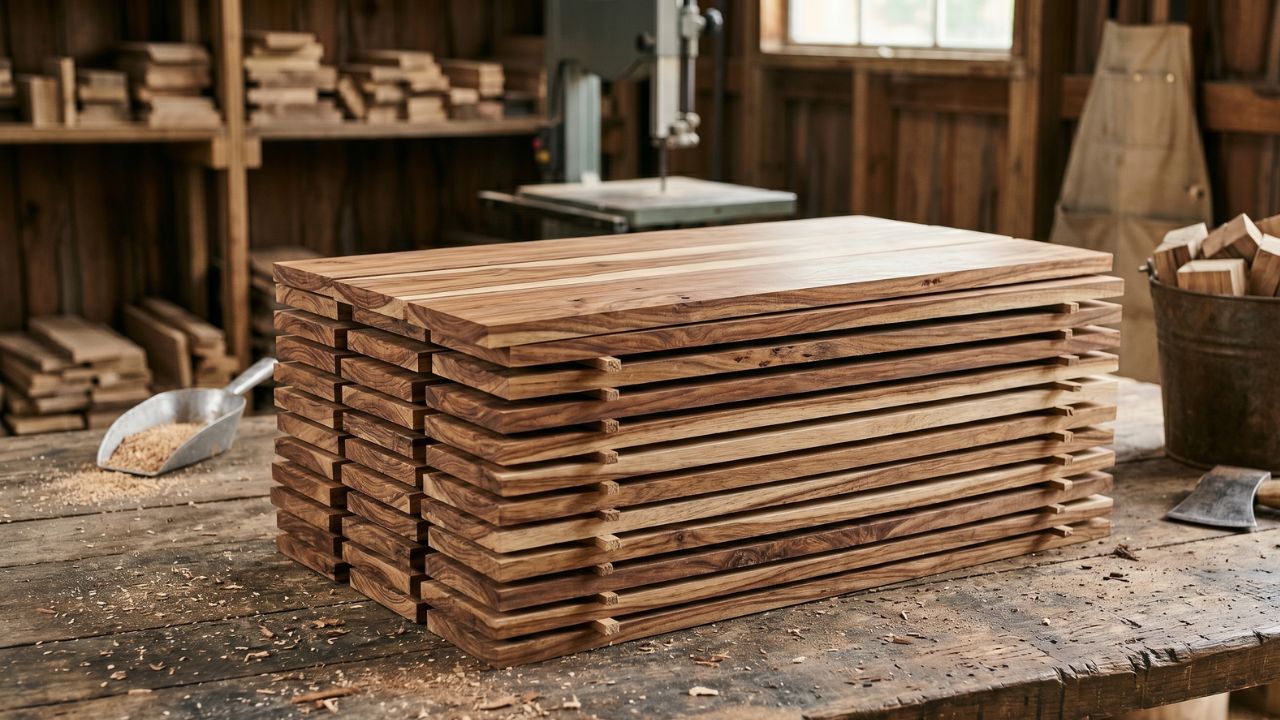
Whether you have a pecan tree to take down, a stack of logs to sell, or you’re shopping for lumber or smoking wood, pecan’s value is not a single number — it’s a range that depends entirely on what form the wood is in, its quality, and who’s buying it. This guide breaks down pecan’s worth across every market from raw timber to finished lumber to BBQ chunks.
Pecan wood ranges from $1.60–$7.00+ per board foot as milled lumber, $150–$400 per cord as firewood, and $15–$50 per bag as BBQ smoking chunks. Standing timber on the stump yields far less — around $30 per ton or $250 per thousand board feet before milling.
$1.60–$7.00+
Per board foot (milled lumber)
$150–$400
Per cord (firewood)
1,820 lbf
Janka hardness rating
Pecan’s two distinct markets
Pecan wood supports two entirely separate markets — high-end lumber for furniture and woodworking, and specialty cooking/firewood. The same tree can end up in a custom dining table or a backyard smoker, and the price it commands differs dramatically depending on which path it takes.
Lumber market
$1.60 – $7.00+ / board foot
Milled, dried, and graded pecan for furniture, cabinetry, flooring, and decorative veneer. Quality and grade determine where in the range the wood falls. FAS (First and Seconds) grade commands the highest prices.
Firewood & BBQ market
$150 – $400 / cord
Split or chunked pecan sold for heating, smoking, and grilling. BBQ-grade chunks and chips command a significant retail premium over bulk firewood due to the specialty cooking market.
Pecan lumber prices by grade
Retail prices for pecan lumber vary significantly based on the grade assigned after milling and drying. The most valuable lumber is designated as First and Seconds (FAS), which guarantees a minimum yield of clear-face cuttings. Lower grades like No. 1 and No. 2 Common are used where appearance is less important. Here’s how the grades map to price:
| Grade | Price range | Quality | Typical use |
|---|---|---|---|
| FAS (First & Seconds) | $5.00 – $7.00+ | Premium | Fine furniture, custom cabinetry, figured show pieces |
| Select | $4.00 – $5.50 | High | Furniture components, flooring, interior millwork |
| No. 1 Common | $2.50 – $4.00 | Mid | Cabinetry, cutting boards, smaller woodworking projects |
| No. 2 Common | $1.60 – $2.50 | Standard | Utility work, pallets, subflooring, craft projects |
| Shorts / Offcuts | $0.50 – $1.60 | Budget | Turning blanks, small crafts, or sold as smoking wood |
Pricing is highly dependent on the board’s thickness and width, with wider boards often incurring a significant premium. A wide, figured pecan slab with live edges can fetch well above $7.00 per board foot at specialty lumber yards and woodworking retailers.
Pecan wood value by use case
The same pecan tree can produce material worth very different amounts depending on how it’s processed and sold. Understanding this helps whether you’re selling a tree, buying wood, or deciding how to process material you already have.
Standing timber (on stump)
~$30/ton or $250/MBF
The lowest value form. Raw standing timber before felling typically yields around $30 per ton or $250 per thousand board feet — not much considering the effort involved in harvesting.
Milled & air-dried lumber
$3.00 – $7.00+ /BF
Processing raw logs into dried, milled lumber dramatically increases value. A log worth $250/MBF on the stump can yield $3,000+ per thousand board feet once milled and dried — but requires significant work.
Split firewood
$150 – $400 / cord
A cord of pecan firewood sells for $150–$400 depending on region and season. Customers can expect pricing to range anywhere from $50 for smaller quantities to $999 for a full cord.
BBQ chunks & chips
$15 – $50 / bag
Specialty smoking wood commands the highest price per pound of any pecan wood product. Kiln-dried, bagged BBQ chunks and chips retail for $15–$50 per bag — a significant premium over bulk firewood pricing.
Live edge slabs
$8.00 – $20.00+ /BF
Wide, figured live-edge pecan slabs for tables and statement pieces command the highest lumber prices of all — especially for slabs over 24 inches wide with attractive grain patterns.
Turning blanks & offcuts
$1.00 – $4.00 /BF
Shorter pieces and offcuts from furniture-grade processing are sold to woodturners, pen makers, and craft woodworkers — a good way to monetise material that otherwise might go to the wood pile.
What factors determine pecan wood’s value?
Wood quality & grade:
Straight, knot-free boards are worth significantly more than crooked or knotty material. Pecan wood that is straight and without knots is worth more than wood that is crooked or has many knots. Additionally, the size of the pieces can impact the price.
Board width & thickness
Wide boards are disproportionately valuable because they’re rarer and more useful for furniture-making. A 12-inch-wide clear pecan board commands a considerably higher per-board-foot price than a 4-inch-wide board of the same grade.
Regional availability
Pecan is native to the South-Central US — particularly Texas, Oklahoma, and nearby states. In these regions it’s readily available and priced accordingly. In the Northeast or Pacific Northwest, pecan lumber commands a premium as a less locally available species.
Processing & drying
The process of harvesting, drying, milling, and treating pecan wood requires a substantial amount of labor and resources, which adds up to the overall cost of production. Kiln-dried lumber commands a premium over air-dried, and S3S or S4S surfacing adds further value.
Season (for firewood)
Firewood prices spike 20–40% in winter months as demand surges. The same cord of pecan firewood that sells for $160 in August may fetch $220–$250 in January in cold-climate states.
Figure & grain character
Figured pecan — with curly, quilted, or bird’s-eye grain patterns — is relatively rare and commands significantly higher prices from furniture makers and custom woodworkers. These premium pieces can exceed $10–$15 per board foot at specialty dealers.
Pecan firewood vs. other hardwoods: price comparison
How does pecan stack up against competing firewood species in the market? Here’s a typical comparison at retail in the US:
| Wood species | Price / cord | BTU output | Availability |
|---|---|---|---|
| Hickory | $200 – $450 | ~28M BTU | Widespread |
| White Oak | $180 – $400 | ~26M BTU | Widespread |
| ⭐ Pecan | $150 – $400 | ~25M BTU | South-Central US |
| Maple | $150 – $350 | ~25M BTU | Northeast/Midwest |
| Ash | $130 – $300 | ~23M BTU | Eastern US |
| Cherry | $130 – $280 | ~20M BTU | Eastern US |
| Pine (mixed) | $80 – $160 | ~15M BTU | Nationwide |
Should you sell pecan as lumber or firewood?
If you have pecan logs or a tree to remove, the decision on how to sell it has a major impact on its value. The rule of thumb is simple: the more processing you’re willing to invest, the more the wood is worth.
Selling as firewood is the fastest and easiest route — split it, let it season, and sell by the cord or rick. But converting the same logs into milled, dried lumber can multiply the value by ten or more. A log worth $250 per thousand board feet on the stump can return $3,000+ per thousand board feet once sawn and dried — though it requires access to a sawmill and months of patience for the wood to dry.
Seller’s tips
Check for metal before milling. Yard trees almost always contain embedded nails, wire, or other metal from years of fence attachments or signage. Metal in logs destroys sawmill blades and most mills will refuse to process them without a metal detector scan first.
Factor in drying time. Green pecan lumber must air-dry for 1 inch of thickness per year — so 4/4 boards need roughly 12 months, and thicker slabs need proportionally longer. Kiln drying speeds this up but adds cost.
Sell offcuts as BBQ wood. Any short boards, slabs, or offcuts unsuitable for furniture can be sold to local BBQ enthusiasts or smoking wood suppliers at a meaningful premium over firewood prices — often $2–$4 per pound for kiln-dried pecan chunks.
Target local buyers first. Shipping lumber is expensive. Local furniture makers, custom woodworkers, and cabinet shops are often willing to pay fair prices for quality local pecan — and you avoid the complexity and cost of freight.
The bottom line
Pecan wood is genuinely valuable — but its worth depends entirely on what form it’s in and who’s buying it. As standing timber it’s worth relatively little. As milled FAS-grade lumber it can fetch $5–$7+ per board foot. And as specialty BBQ chunks it commands some of the highest per-pound prices in the smoking wood market. If you have pecan logs to sell, the investment of milling and drying pays back many times over. If you’re buying, you’re paying for one of North America’s finest hardwoods — and a smoking wood with serious competition credentials.