
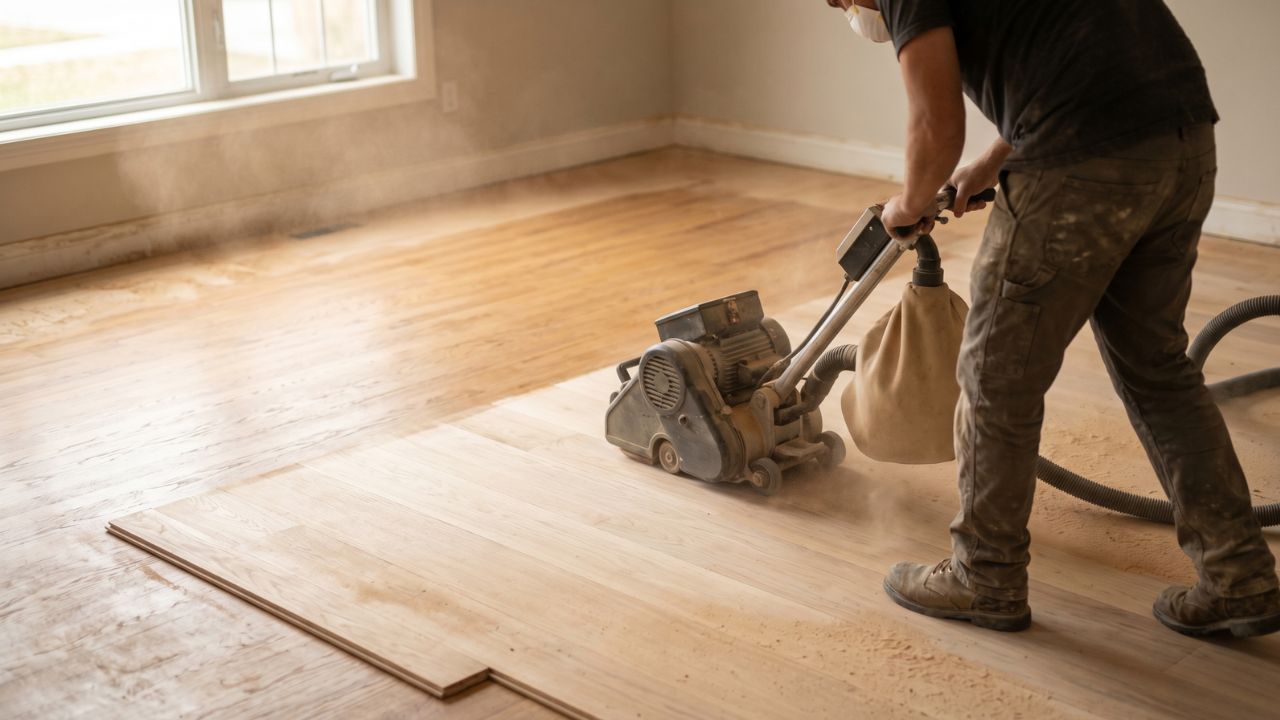
Engineered wood flooring is beloved for its durability, stability, and real-wood appearance — but when scratches, dents, or fading start to show, homeowners face a critical question. Can it be sanded and refinished like solid hardwood? The answer is yes, but with important caveats that depend entirely on your specific floor.
Short answer: Yes, most engineered wood floors can be sanded — but only if the top wear layer is thick enough. Floors with a wear layer under 2mm generally cannot be safely sanded. Always measure before you sand.
Understanding engineered wood structure
To understand why sanding engineered wood is more nuanced than sanding solid hardwood, it helps to know what you’re working with. Engineered wood is made up of multiple bonded layers — each serving a distinct purpose.
| Wear layer | Real hardwood veneer — the only part you see and sand | Key layer |
| Cross-ply layers | Alternating wood layers for dimensional stability | Structural |
| Base layer | Plywood or HDF core — provides rigidity and moisture resistance | Foundation |
The only layer that can be sanded is the top wear layer — the real wood veneer. Once you sand through it, you hit the structural core layers, which cannot be finished and will ruin the floor permanently. This is why wear layer thickness is everything.
Wear layer thickness: the deciding factor
Wear layer thickness varies considerably between products — from a paper-thin 0.6mm in budget floors to a generous 6mm in premium planks. Here’s how thickness maps to your sanding options:
| Wear layer thickness | Can be sanded? | Times sandable | Typical product tier |
|---|---|---|---|
| Under 2mm | No | 0 | Budget / entry-level |
| 2mm – 3mm | With caution | 1 (light sand only) | Mid-range |
| 4mm – 5mm | Yes | 1 – 2 times | Mid to premium |
| 6mm+ | Yes | 2 – 3 times | Premium / trade |
To measure your wear layer, find an inconspicuous corner, carefully lift a floor vent cover, or look at the manufacturer’s documentation. If you can’t determine the thickness, assume the minimum and proceed with extreme caution — or consult a flooring professional.
2mm
Minimum safe wear layer to sand
1–3×
Times most floors can be sanded
40 grit
Starting grit for heavy refinishing
How to sand engineered wood flooring: step by step
If you’ve confirmed your wear layer is thick enough, here’s how to sand and refinish it correctly. For floors with a wear layer of 4mm or more, you can use a drum or belt sander. For thinner wear layers, stick to a random orbital sander — it removes less material per pass.
- Clear and clean the floor: Remove all furniture, rugs, and floor fixtures. Vacuum thoroughly and wipe down with a dry cloth. Any grit left on the surface will scratch the floor during sanding.
- Repair damaged boards first: Fill deep gouges with wood filler matched to your floor’s species. Sand filler flush once dry. Replace any boards that are warped, delaminating, or structurally compromised — sanding won’t fix them.
- Start with the right grit: For heavy scratching or old finish removal, start with 40–60 grit. For light scuffing or refreshing the surface, begin at 80–100 grit. Always sand with the grain — never across it.
- Progress through grits: Work up through 60, 80, 100, and finally 120 grit. Each pass removes the scratch marks left by the previous grit. Don’t skip grits — it creates visible swirl marks in the finished floor.
- Edge-sand the perimeter: Use an edge sander or hand sanding block for the borders and corners that the drum sander can’t reach. Match grit to wherever you are in the main sanding sequence.
- Vacuum and tack cloth: Remove all dust with a vacuum, then wipe the entire floor with a tack cloth before applying any finish. Dust trapped under finish causes a gritty, uneven surface.
- Apply your chosen finish: Oil, polyurethane, and hardwax oil are the three most common options. Apply in thin coats, allow each coat to fully cure, and lightly buff with 220 grit between coats for adhesion.
Never use a drum sander on engineered wood with a wear layer under 4mm. Drum sanders are aggressive and can remove 1–2mm of material in a single pass — potentially sanding straight through the veneer before you realise.
Pros and cons of sanding engineered wood
Advantages
- ✓ Extends floor lifespan by years
- ✓ Restores original appearance
- ✓ Removes deep scratches and stains
- ✓ Cheaper than full replacement
- ✓ Allows colour change via restaining
Limitations
- ✗ Risk of damage if done incorrectly
- ✗ Only possible 1–3 times total
- ✗ Thin wear layers cannot be sanded
- ✗ Requires professional care
- ✗ Costly if hired out ($3–$8/sq ft)
Alternatives if your floor can’t be sanded
If your wear layer is too thin to sand safely, you still have options. Screen-and-recoat (also called “buff and coat”) involves lightly abrading the existing finish with a fine-grit screen — rather than removing it — and applying a fresh topcoat. This doesn’t fix deep scratches but renews the sheen and adds a protective layer. It can typically be done several times even on thin-veneered floors.
For isolated scratches, touch-up markers, fill sticks, and colour-matched repair kits can camouflage surface damage without any sanding at all. For severe widespread damage, plank-by-plank replacement (if the floor is a floating installation) is often more practical than a full tear-out and replacement.
The verdict
Yes, engineered wood flooring can be sanded — but the wear layer thickness is the non-negotiable limiting factor. Floors with 4mm or more of real wood veneer can be sanded one to three times over their lifetime, making them surprisingly refinishable. Floors with thin veneers under 2mm should never be machine-sanded. When in doubt, measure first, use the gentlest equipment possible, and consider hiring a flooring professional for your first refinish — a mistake here is permanent.