
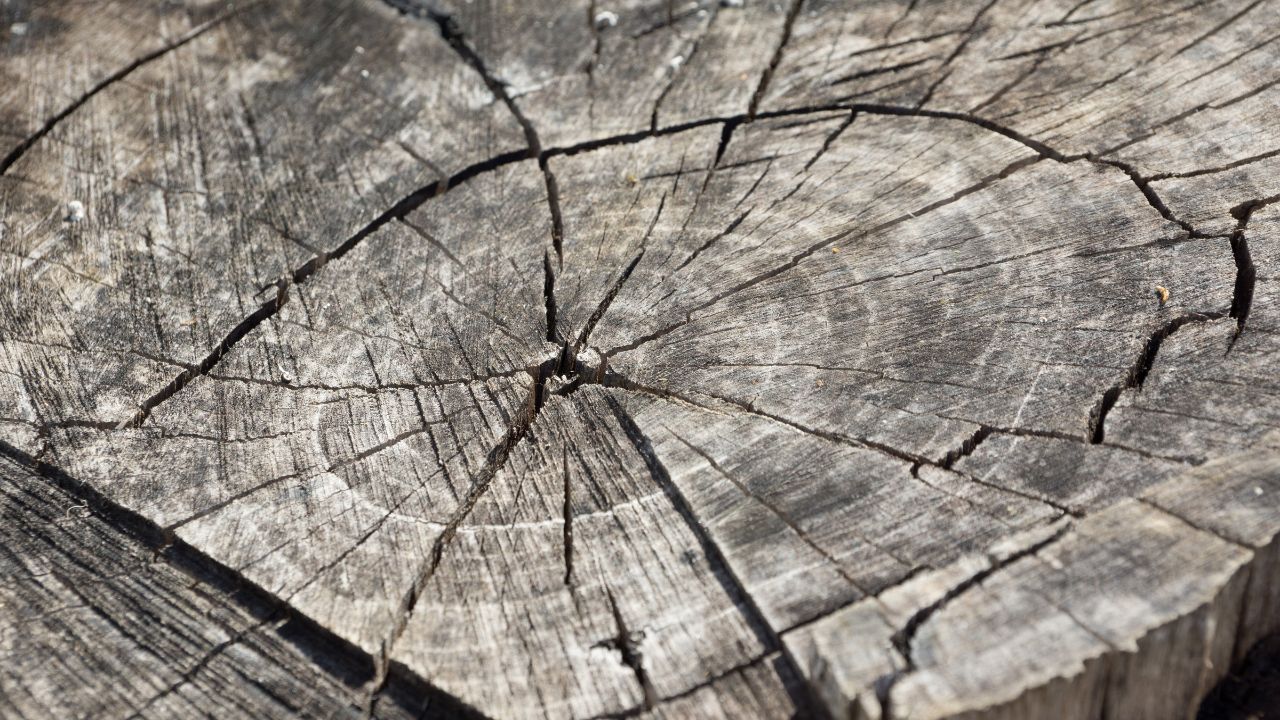
Wood usually cracks because it loses moisture and shrinks unevenly. When the outside of a board dries faster than the inside, or the wood cannot move freely, stress builds up. If that stress exceeds the strength of the wood fibers, they separate and form a crack.
Moisture changes are the most common cause, but they are not the only one. Screws placed too close to an edge, excessive loads, impact damage, and poorly designed joints can also split wood.
Understanding the cause helps you decide whether a crack needs monitoring, a repair, or professional assessment.
Why Does Wood Crack as It Dries?
Wood contains moisture within its cell walls and, when sufficiently wet, in its cell cavities. As drying progresses and moisture leaves the cell walls, the wood begins to shrink.
However, a board does not dry evenly throughout. Its exposed surfaces can lose moisture while the interior remains wetter. The outside tries to shrink around a core that has not yet contracted as much.
This difference creates tension. When the fibers cannot withstand it, cracks develop, often following the grain.
Oregon State University’s lumber-drying guide explains that uneven moisture levels and different shrinkage rates within wood create drying stresses.
Cracking is therefore often a drying problem—not simply a sign that the wood is old or poor quality.
Common Reasons Wood Cracks
1. Drying Too Quickly
Freshly cut lumber can develop cracks when exposed to conditions that remove surface moisture too rapidly.
Direct sunlight, strong airflow, and excessive heat can make drying difficult to control. Thick boards are particularly challenging because their centers take longer to dry.
Faster drying is not always better. The drying schedule needs to suit the species and thickness of the wood.
2. Seasonal Humidity Changes
Even properly dried wood continues to absorb and release moisture from the surrounding air.
During humid periods, it tends to swell. When the air becomes drier, it tends to shrink. Indoor heating can contribute to low relative humidity during winter, which is why cracks sometimes appear in furniture after the heating season begins.
Kiln-dried wood still responds to these changes. Drying it once does not permanently stop movement.
3. Wood Movement Is Restricted
Solid wood changes dimension much more across its grain than along its length.
If a wide tabletop is rigidly fastened across its width, it may be unable to shrink normally. The resulting stress can split the top or damage its joints.
Purdue Extension’s guidance on furniture construction emphasizes allowing wood to expand and contract across the grain.
Suitable tabletop fasteners, correctly oriented slotted holes, and floating-panel construction help accommodate that movement.
4. Fasteners Split the Fibers
Driving a screw or nail into wood forces fibers apart. Splitting becomes more likely when the fastener is too large, too close to an edge, or installed without a suitable pilot hole.
Overtightening can also damage the surrounding wood.
A crack beginning at a screw hole may therefore be an installation problem rather than a drying defect.
5. Repeated Wetting and Drying
Outdoor wood experiences changing conditions throughout the year. Rain wets the surface, followed by drying from sun and wind.
Repeated moisture changes can contribute to checking in fence boards, decking, posts, and outdoor furniture.
Poor drainage and persistent dampness create additional problems, including conditions that encourage decay. Cracking and decay are different issues, although they can occur together.
6. Knots and Grain Irregularities
Wood is a natural material, so its structure is not perfectly uniform.
Grain changes direction around knots, and some boards contain the tree’s central pith or other features that complicate drying. These areas can concentrate stress or move differently from the surrounding wood.
Two boards of the same species may therefore behave differently.
7. Impact or Excessive Loading
A dropped piece of furniture, an overloaded shelf, or a damaged connection can cause a sudden crack.
These failures should not be dismissed as normal seasonal movement. Consider what happened before the crack appeared and whether the item now bends, moves, or feels unstable.
Why Does Wood Crack at the Ends?
Moisture generally travels out through end grain faster than through the sides of a board. The ends can shrink before the middle, creating stresses that produce end cracks.
This explains why freshly sawn boards and logs often begin splitting at their ends.
Applying a suitable end-grain sealer promptly after cutting helps slow moisture loss there. It reduces the risk of end checking but cannot guarantee crack-free drying.
Checks, Splits, and Joint Gaps: What Is the Difference?
Not every visible opening has the same cause.
| Type of opening | What it usually means |
|---|---|
| Surface check | A separation in the wood associated with drying stress |
| End check | A drying crack beginning at the end of a board or timber |
| Split | A separation along the grain that may extend deeply or through the piece |
| Open glue joint | A separation where two pieces were bonded |
| Finish crack | A break in the coating that may not extend into the wood |
These descriptions help identify the problem, but they do not establish whether a component is safe. A narrow crack in a critical connection may matter more than a larger surface check elsewhere.
How to Prevent Wood from Cracking
Use Wood With Suitable Moisture Content
Choose lumber dried for its intended environment. Wood suitable for outdoor construction may still contain too much moisture for furniture in a heated home.
Use a moisture meter according to its instructions, including any species corrections. A dry-feeling surface does not prove that a thick board is dry throughout.
Allow Wood to Adjust Before Building
Store lumber in conditions similar to where the finished item will be used.
Acclimation is not a universal two-day or one-week process. Thickness, starting moisture content, storage conditions, and airflow all affect the time required.
Dry Fresh Lumber Under Controlled Conditions
Stack boards on level supports with evenly spaced spacer strips between layers. Protect the stack from rain and harsh sunlight while allowing appropriate airflow.
Avoid trying to accelerate drying with uncontrolled heat. Drying too slowly also creates problems, so the goal is a suitable drying rate rather than the slowest possible one.
Design for Seasonal Movement
Allow wide solid-wood components to expand and contract. Do not assume that adding more screws will prevent cracking; rigid restraint can make it worse.
Use joinery and hardware appropriate for the board’s grain direction and the project.
Drill Appropriate Pilot Holes
Predrill where the wood, fastener, and installation require it, especially near board ends. Follow the fastener manufacturer’s guidance for hole size, spacing, and installation.
Maintain Suitable Conditions and Finishes
Keep indoor furniture away from concentrated heat sources and address unusually dry or damp room conditions.
An appropriate finish can slow moisture exchange and protect the surface, but it cannot make solid wood stop moving. Outdoor finishes also need maintenance according to their condition and product instructions.
Can Cracked Wood Be Repaired?
Often, yes, but the repair depends on the cause and the wood’s function.
A clean furniture split that closes properly may be repairable with a suitable adhesive and clamping. A small cosmetic defect may need only a compatible filler. Wider openings may require a fitted wood repair or specialist treatment.
Filling a crack does not automatically restore strength. It also does not correct ongoing moisture problems or construction that prevents movement.
For a cracked beam, support post, stair component, or other load-bearing part, have the damage assessed before treating it as cosmetic. Deepening cracks, displaced sections, sagging, or damaged connections deserve particular attention.
Frequently Asked Questions
Does Cracking Mean the Wood Is Rotten?
No. Sound wood can crack as it dries. Decay is a separate process and may involve soft, weakened, or crumbly wood. The two problems can exist together.
Will a Wood Crack Close by Itself?
A crack may become narrower as humidity rises and the wood swells. However, separated fibers do not heal simply because the opening becomes less visible.
Does Oiling Wood Stop Cracking?
Oil is not a guaranteed solution. A suitable finishing product may slow moisture exchange, but it cannot correct internal drying stress, unsuitable moisture content, or restricted movement.
Does Hardwood Crack Less Than Softwood?
Not necessarily. Hardwood and softwood are botanical classifications. Cracking depends on the species, grain, board dimensions, drying conditions, and how the wood is used.
Why Does a Round Wood Slice Split?
A slice containing the center of the tree shrinks unevenly around and across its growth rings. That mismatch often produces a crack extending inward from the edge. Controlled drying can reduce the risk, but intact round slices are difficult to keep completely crack-free.