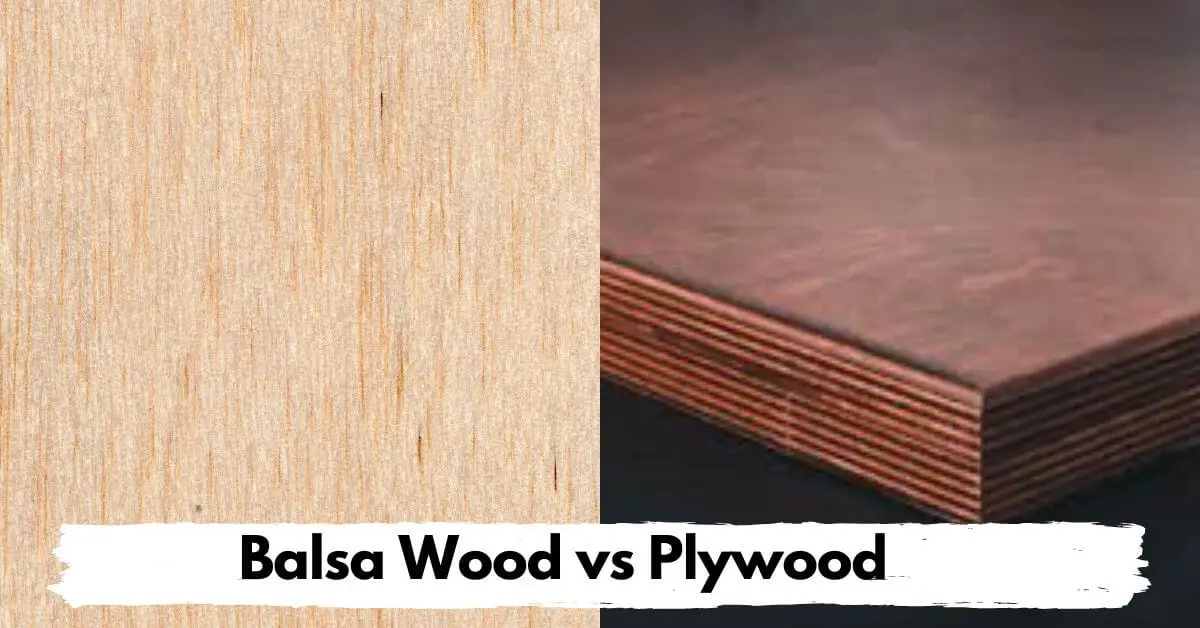
Balsa wood and plywood both show up constantly in hobby shops, hardware stores, and woodworking projects — but they couldn’t be more different in how they’re made or what they’re good for. One is a single, naturally ultra-light softwood; the other is an engineered panel built by gluing layers together for strength. Here’s exactly how they compare, and which one belongs in your next project.
The core difference: balsa is a solid, naturally lightweight softwood prized for its strength-to-weight ratio, while plywood is an engineered panel made of multiple thin wood veneers glued together at alternating grain angles for strength and stability. Balsa is for lightweight builds; plywood is for structural ones.
Balsa wood vs. plywood at a glance
Balsa wood
- Native to South & Central America
- A single natural softwood species
- Extremely lightweight
- Best strength-to-weight ratio of any commercial wood
- Soft, easy to cut by hand
Plywood
- • An engineered, layered panel
- • Heavier and denser
- • Strong, durable, and stable
- • Resists warping, splitting, cracking
- • Made from softwood or hardwood veneers
What is balsa wood?
Balsa wood is a softwood harvested from a fast-growing tree native to the rainforests of South and Central America. It’s the strongest wood for its weight in the world — pound for pound, it outperforms denser woods like pine, oak, and hickory in strength-to-weight terms, despite being remarkably soft and easy to cut.
This unusual combination — light as foam, but structurally sound for its weight — is why balsa is so widely used for model airplanes, boxes, crates, and surfboards. Its open cellular structure is what gives it such low density, but the cell walls themselves are surprisingly strong, which is the secret to its famous strength-to-weight performance.
What is plywood?
Plywood is made by gluing several thin veneer sheets together under high heat and pressure, with each layer’s grain oriented at right angles to the one before it. Construction typically uses three or more layers, and an odd number of layers (3, 5, 7, and so on) is standard practice to keep the panel balanced and free from warping.
This cross-grain layering is what makes plywood so much stronger and more dimensionally stable than a single solid board of the same thickness — the alternating grain directions help the panel resist splitting and respond to environmental stress far better than solid wood does.
How plywood’s layered structure works
- Veneer 1 — grain running horizontal
- Veneer 2 — grain running vertical (90° rotation)
- Veneer 3 — grain running horizontal again
Side-by-side comparison
| Property | Balsa wood | Plywood |
|---|---|---|
| Material structure | Single solid softwood | Three or more glued veneer layers |
| Weight | Extremely lightweight | Heavier and denser |
| Strength & durability | Fragile under load despite high strength-to-weight ratio | Stronger, more durable, more stable overall |
| Workability | Soft, easy to cut and shape with hand tools | Requires more robust tools due to its harder, denser nature |
| Stability over time | Can warp or dent more easily; not cross-grained | Cross-grain structure resists warping and splitting |
| Appearance | Natural, attractive grain that needs minimal finishing | Less natural appearance; often requires painting or finishing |
| Moisture & weather resistance | Poor — absorbs moisture readily | Good, especially exterior/marine grades |
| Cost | Generally less expensive per piece, though reinforcement needs can offset this | Generally less expensive overall for equivalent structural use |
| Sustainability | Biodegradable, sourced from fast-growing trees | Involves adhesives and chemicals; impact depends on sourcing |
Best uses for balsa wood
Balsa is often used to describe a type of wood that is lightweight and easy to work with, commonly used in crafts, models, and other projects that require a material that can be easily carved or shaped.
Model airplanes & RC builds
Ideal for projects that require a lightweight material, such as model airplanes or boats, where minimizing weight is critical to flight performance.
Architectural models
Perfect for lightweight architectural models, where precision cutting and easy shaping matter more than long-term durability.
Surfboards & floats
Widely used for making boxes, crates, and surfboards thanks to its buoyancy and remarkable strength relative to its weight.
Educational & hobby crafts
Excellent for hobbyists and educational projects since it can be shaped with a simple craft knife for detailed work.
Best uses for plywood
Plywood is a versatile material commonly used in construction and furniture-making, available in a variety of grades and thicknesses, and often used as a substitute for solid wood due to its lower cost, greater stability, and resistance to warping and cracking.
Construction & structural work
Common applications include flooring, roofing, sheathing, and cabinetry — anywhere load-bearing strength matters.
Furniture-making
Suitable for structural applications and where robustness is required, making it a workhorse material for cabinets, shelving, and furniture frames.
Workbenches & garage builds
A practical, durable choice for shelves, workbenches, and storage builds that need to withstand heavy daily use.
Musical instruments
Used in the manufacturing of musical instruments such as guitars and drums, where layered construction provides tonal stability.
Pros and cons
Balsa wood
✗ Limited to lightweight applications
✓ Best strength-to-weight ratio available
✓ Easy to cut, sand, and shape
✓ Natural, attractive grain
✗ Fragile compared to plywood or solid wood
Plywood
✗ Heavier — not suited to weight-critical builds
✓ Resistant to cracking and splitting
✓ Stable, strong, widely available
✓ Cost-effective for structural use
✗ Less natural appearance, often needs finishing
Which one should you choose?
The right material comes down entirely to what your project needs to do: fly, float, or fold easily versus stand up to structural load and daily wear.
Choose balsa: You’re building a model airplane, RC glider, architectural model, or anything where every gram of weight matters.
Choose balsa: You want a material that’s easy to cut and shape by hand with basic craft tools, with no power tools required.
Choose plywood: You’re building furniture, cabinetry, flooring, or anything that needs to bear weight or withstand daily wear.
Choose plywood: Your project will be exposed to handling stress, moisture, or structural load where warping and splitting are a real risk.
The bottom line
Balsa is a lightweight, soft wood known for its excellent strength-to-weight ratio, while plywood is a heavier, more durable material made of multiple glued wood veneer layers. Neither is objectively “better” — they’re built for entirely different jobs. Reach for balsa when weight is your enemy and precision hand-shaping matters, like model planes or architectural mock-ups. Reach for plywood when you need a panel that can take structural load, resist warping, and last for years, like furniture, flooring, or construction. Know your project’s real requirement, and the right material picks itself.