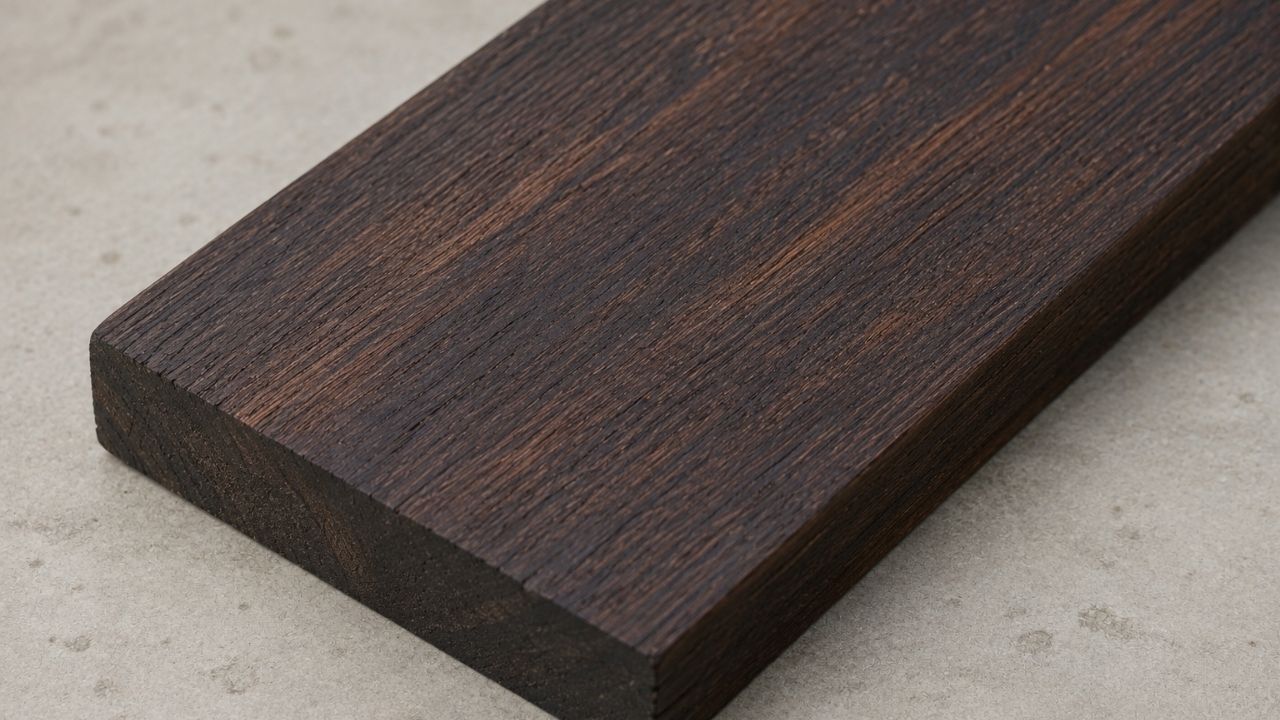
Yes, lignum vitae is one of the hardest woods in the world and is often considered the hardest commercially traded wood. It has an exceptionally high Janka hardness rating of around 4,390 to 4,500 lbf (19,510 to 20,000 N), depending on the source and test data.
However, saying that lignum vitae is simply “the hardest wood in the world” requires some clarification. Different wood species can rank differently depending on the sample, testing method, and whether the comparison includes rare or non-commercial species.
How Hard Is Lignum Vitae?
Lignum vitae is extremely hard and dense. The Wood Database lists lignum vitae with a Janka hardness of 4,390 lbf (19,510 N) and an average dried weight of about 78.5 lbs/ft³ (1,260 kg/m³).
The Janka hardness test measures the amount of force required to push a steel ball halfway into a piece of wood. A higher Janka value means the wood is more resistant to dents, wear, and indentation.
For comparison, white oak has a Janka hardness of about 1,350 lbf, while lignum vitae is rated at 4,390 lbf. This means lignum vitae is more than three times harder than white oak.
Is Lignum Vitae the Hardest Wood in the World?
The answer depends on what you mean by “hardest.”
Lignum vitae has historically been described as the hardest of the commercially traded woods. It has also been listed as the hardest wood in many traditional hardness charts.
However, some modern Janka hardness databases list other rare species with values higher than lignum vitae. For example, some datasets list waddywood and boonaree above lignum vitae.
Therefore, it is more accurate to say:
Lignum vitae is one of the hardest woods in the world and is commonly recognized as one of the hardest commercially available or commercially traded woods.
This wording is more accurate than claiming that no other wood can have a higher hardness value.
Lignum Vitae Janka Hardness
The Janka hardness of lignum vitae is commonly reported as approximately 4,390 lbf (19,510 N). Some sources round the value to about 4,500 lbf (20,000 N).
| Wood Species | Janka Hardness |
|---|---|
| Lignum Vitae | 4,390 lbf (19,510 N) |
| Australian Buloke | 3,760 lbf (16,740 N) |
| African Blackwood | 3,670 lbf (16,320 N) |
| Ipe | 3,680 lbf (16,300 N) |
| Cumaru | 3,540 lbf (15,740 N) |
| Ebony | Around 3,000+ lbf |
| White Oak | 1,350 lbf (5,990 N) |
| Red Oak | 1,290 lbf (5,740 N) |
These values show how far lignum vitae is above many commonly used hardwoods.
Why Is Lignum Vitae So Hard?
The exceptional hardness of lignum vitae is closely related to its very high density and natural resin content.
Lignum vitae has an average dried density of around 78.5 lbs/ft³ (1,260 kg/m³), which is extremely high for wood. In fact, it is dense enough to sink in water.
The wood also contains natural oils and resin that contribute to its distinctive properties. These characteristics give lignum vitae excellent resistance to wear and moisture.
Its hardness and natural lubrication were particularly valuable in applications where wood components had to withstand continuous friction and water exposure.
Is Lignum Vitae Harder Than Oak?
Yes. Lignum vitae is significantly harder than both red oak and white oak.
White oak has a Janka hardness of approximately 1,350 lbf, while lignum vitae is around 4,390 lbf.
This means lignum vitae has more than three times the Janka hardness of white oak.
Because of this exceptional hardness, lignum vitae is much more resistant to dents and wear. However, its hardness also makes it considerably more difficult to cut, sand, drill, and shape.
Is Lignum Vitae Harder Than Ipe?
Lignum vitae is generally harder than ipe according to commonly cited Janka values.
Lignum vitae is rated around 4,390 lbf, while ipe is commonly listed at around 3,680 lbf.
Both are extremely hard and durable woods, but lignum vitae has the higher Janka rating in these comparisons.
Is Lignum Vitae Harder Than Ebony?
Many ebony species are extremely hard, but lignum vitae generally has a higher Janka hardness than the commonly cited values for several commercially known ebony species.
For example, Gaboon ebony is commonly listed at around 3,080 lbf, while lignum vitae is around 4,390 lbf.
However, “ebony” refers to several different species, so the exact hardness depends on the species being compared.
Does Hardness Mean Lignum Vitae Is the Strongest Wood?
No. Hardness and strength are not the same thing.
The Janka test measures resistance to indentation and is useful for understanding how resistant a wood is to dents and wear. It does not measure every aspect of mechanical strength.
Wood can be tested for properties such as:
- Bending strength
- Crushing strength
- Stiffness
- Shear strength
- Impact resistance
- Hardness
A wood that is extremely hard is not automatically the strongest wood for every application. The Wood Database notes that hardness and density are closely related, but other strength properties do not necessarily follow the same relationship.
What Is Lignum Vitae Used For?
Lignum vitae has traditionally been used in applications where extreme durability, density, wear resistance, and natural lubrication are important.
Common and historical uses include:
- Bearings
- Bushings
- Shipbuilding components
- Tool handles
- Mallets
- Pulley wheels
- Carvings
- Turning projects
- Specialty mechanical components
Its natural oils and resistance to water made it especially valuable for marine applications. It was historically used for shaft bearings because the wood could withstand friction while providing natural lubrication.
Is Lignum Vitae Difficult to Work With?
Yes. Its exceptional hardness and density make lignum vitae difficult to work with compared with most common hardwoods.
Sharp tools are essential when cutting or shaping it. It can dull cutting edges quickly, and drilling, sanding, and turning may require more effort.
Its natural oils can also make gluing difficult. Proper surface preparation and an appropriate adhesive are important when joining lignum vitae.
Is Lignum Vitae Dense?
Yes, lignum vitae is extremely dense.
Its average dried weight is approximately 78.5 lbs/ft³ (1,260 kg/m³). Because this density is greater than that of water, a piece of lignum vitae can sink when placed in water.
Its high density contributes to several of its characteristics, including its hardness, durability, and resistance to wear.
Is Lignum Vitae Good for Outdoor Use?
Lignum vitae is highly resistant to decay and moisture, making it suitable for demanding outdoor and marine applications.
Its natural oils and dense structure help protect it against moisture and decay. Historically, these properties made lignum vitae particularly useful in shipbuilding and marine bearings.
However, because genuine lignum vitae is rare and subject to conservation and trade restrictions, it is not a practical choice for most modern outdoor projects.
Final Answer: Is Lignum Vitae the Hardest Wood?
Lignum vitae is one of the hardest woods in the world and is widely recognized as one of the hardest commercially traded woods. Its Janka hardness is approximately 4,390–4,500 lbf, making it dramatically harder than common woods such as oak.
However, it is not completely accurate to say that lignum vitae is definitively the hardest wood in existence. Some modern databases include rare, less commonly traded species with higher Janka values.
So, the best answer is:
Lignum vitae is among the hardest woods in the world and is one of the hardest commercially traded woods, but it is not necessarily the hardest wood under every ranking or test.