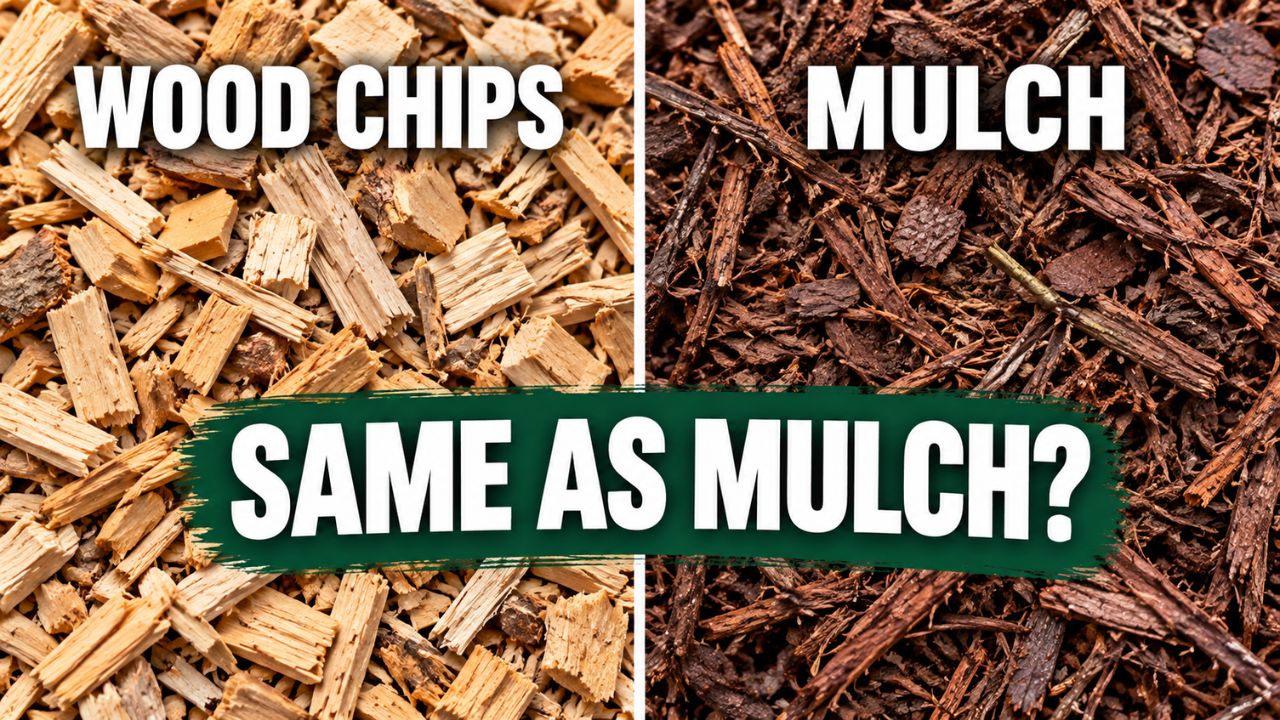
When shopping for garden supplies, you will often see “wood chips” and “mulch” used as if they mean the same thing. Bags of shredded bark, chipped wood, and dyed landscaping material may all sit together in the mulch section.
Wood chips are a type of mulch when spread over soil, but the two terms are not interchangeable. Wood chips describe a material, while mulch describes a covering placed on the soil surface. Mulch can include wood chips, bark, leaves, straw, compost, or gravel.
Understanding this difference makes it easier to choose the right ground covering for trees, flower beds, vegetable gardens, and pathways.
What Are Wood Chips?
Wood chips are small pieces produced by cutting branches, logs, or suitable wood residues with a chipper.
Their appearance depends on their source. Arborist chips from tree-trimming work often contain mixed sizes of wood, bark, twigs, and leaves. Other products may be screened to create a more consistent texture.
Wood chips have uses beyond landscaping, including fuel and industrial processing. Only material suitable for gardening should be considered for garden mulch.
What Is Mulch?
Mulch is a layer of material placed over the soil. Gardeners use it to protect the soil surface and manage growing conditions.
There are two broad categories:
- Organic mulch: Plant-based materials such as wood chips, bark, leaves, and straw that gradually decompose.
- Inorganic mulch: Materials such as gravel and stone that do not decompose into organic matter.
Here, “organic” describes the material’s origin. It does not mean the product is certified for organic gardening.
Wood Chips vs. Mulch: A Quick Comparison
Because wood chips belong within the mulch category, the comparison is really between one material and a wider group of materials.
| Feature | Wood chips | Mulch |
|---|---|---|
| Meaning | Pieces of chipped wood | Material covering the soil surface |
| Composition | Wood, sometimes mixed with bark and leaves | Wood, bark, leaves, straw, stone, and other materials |
| Appearance | Usually chunky or irregular | Varies with the material |
| Decomposition | Gradually breaks down | Organic types decompose; mineral types do not |
| Typical applications | Tree beds, shrub borders, informal paths | Different materials suit different planting areas |
| Other uses | Fuel, manufacturing, and more | The term describes its role as a soil covering |
For example, a pile of chips waiting for processing is simply wood chips. Spread suitable chips around a tree, and they are functioning as mulch.
Why Do Stores Label Wood Products as “Mulch”?
In garden centers, “mulch” often refers to packaged bark or shredded wood products. This retail shorthand can make it seem as though mulch is a separate material from wood chips.
A bag labeled “hardwood mulch” might contain shredded wood, bark, or a mixture. “Colored mulch” describes its appearance without fully identifying its source.
Read the product description rather than relying on the front label alone. Useful details include:
- The source material.
- Whether it is chipped, shredded, or screened.
- Whether coloring has been added.
- The volume in each bag.
- Its intended use.
Color and texture can help you choose a look, but they do not establish the product’s quality.
Are Wood Chips Good Mulch?
Yes, suitable wood chips can be an effective mulch, particularly around trees and shrubs.
They help retain soil moisture, moderate temperature changes, and suppress some weeds. Their gradual decomposition also contributes organic material to the landscape. Washington State University Extension identifies arborist chips as a useful choice for woody landscape plants.
However, wood chips do not eliminate maintenance. Weeds can still establish, chips can shift, and the layer gradually settles. Inspect the area periodically rather than assuming one application will last indefinitely.
Wood Chips vs. Bark Mulch
Bark mulch consists mainly of the outer bark of trees. Wood chips contain the woody material beneath the bark and may include other tree parts.
The main practical differences are appearance, consistency, availability, and price.
Choose wood chips when you want an informal finish, need to cover a broad area, or have access to suitable local material.
Choose bark mulch when you prefer the appearance of a particular bark product or need a consistent finish across a visible planting bed.
Neither material is automatically better in every situation. Fine shredded bark, large bark nuggets, and mixed arborist chips behave differently, so compare the actual products.
Which Mulch Should You Use?
Around Trees and Shrubs
Wood chips are a practical option for established tree beds and shrub borders.
Fresh arborist chips do not always need aging before use. University of Maryland Extension says they can be used around trees and shrubs when left on the surface rather than incorporated into the soil.
Keep the mulch away from trunks and stems. Piling it against bark creates an unnecessarily damp environment at the plant’s base.
In Flower Beds
Consider how often you disturb the soil.
Coarse chips may suit established shrub borders and some perennial plantings. In beds that you replant frequently, a finer material can be easier to move aside.
Avoid burying small plants or covering their crowns with mulch.
In Vegetable Gardens
Straw or shredded leaves may be easier to manage in beds that are regularly planted, cultivated, and harvested.
Wood chips can be useful on paths between growing beds. Using them there also reduces the chance of accidentally digging fresh chips into the planting soil.
On Garden Paths
Chips provide a natural-looking surface for informal paths. They are easy to spread, but loose pieces can move underfoot or with wheeled traffic.
A firm, stable path material may be more suitable where accessibility is the priority.
Do Wood Chips Remove Nitrogen from Soil?
This concern needs an important distinction.
Microorganisms use nitrogen while decomposing woody material. Mixing fresh chips into soil can temporarily reduce nitrogen availability near plant roots.
Surface mulching is different from incorporating wood into the soil. A layer around established trees and shrubs does not automatically cause widespread nitrogen deficiency.
Do not add fertilizer simply because you have applied wood chips. If plants show poor growth, investigate watering, soil conditions, and other possible causes before deciding they need nutrients.
Are Wood Chips Cheaper Than Other Mulches?
They can be, particularly when sourced locally from tree services. However, there is no universal price advantage.
A free load may still involve delivery charges, sorting, storage, and considerable spreading work. Packaged products may cost more per unit of volume but be easier to transport and handle for a small bed.
When comparing prices, calculate the total volume and delivery cost. A cheaper bag is not necessarily better value if it contains less material.
Also check the minimum delivery size. A truckload can be much more than a small garden needs.
How to Use Wood Chips Without Overmulching
Start by checking what is already on the soil. A fresh-looking top layer should not hide an excessive depth of older material.
For ordinary tree and shrub beds, University of Maryland guidance recommends approximately 1–3 inches of wood chips, with clearance around trunks. Appropriate depth varies with chip texture, drainage, and local conditions.
Follow these basic steps:
- Deal with established weeds. Mulch alone may not control persistent perennial weeds.
- Spread chips evenly over the soil. Avoid mixing fresh chips into the root zone.
- Keep trunks and plant crowns clear. Do not create deep mounds against plants.
- Check before replenishing. Add material where it has thinned rather than automatically covering the entire bed again.
Common Mistakes to Avoid
Assuming All Wood Waste Is Suitable
Unknown construction waste can contain coatings, preservatives, adhesives, or debris. Choose landscaping material from a source that can explain what it contains.
Choosing Only by Color
A dark or brightly colored product is not necessarily more nutritious, longer lasting, or better for plants.
Treating Mulch as Compost
Mulch covers the surface. Finished compost can also be used as a soil amendment. Fresh wood chips are not a direct substitute for finished compost mixed into a planting bed.
Replacing Everything on a Fixed Schedule
Inspect the existing layer first. Material that is still doing its job may only need leveling or a modest top-up.
Frequently Asked Questions
Can I Use Wood Chips Instead of Mulch?
Yes—wood chips are themselves a mulch when used to cover soil. The question is whether they suit the planting area and the appearance you want.
Is All Bagged Mulch Made from Wood Chips?
No. Bagged products can contain bark, shredded wood, mixed woody material, or other ingredients. Read the label to identify the contents.
Do Wood Chips Last Longer Than Shredded Mulch?
Not necessarily. Decomposition depends on the material, particle size, moisture, climate, and soil contact. “Shredded mulch” is too broad a category to give one reliable lifespan.
Can I Put New Wood Chips Over Old Mulch?
Usually, if the existing material is suitable and the combined layer will not become too deep. Check the depth and condition before adding more.
Should I Remove Wood Chips Before Planting?
Move them aside to reach the soil and make the planting hole. After planting, replace an appropriate surface layer while leaving the plant’s base clear.
Are Wood Chips Better Than Mulch?
They are one mulch option rather than a competing category. Choose wood chips for suitable tree beds, shrub borders, and informal paths; compare other materials when your planting style or maintenance needs differ.