
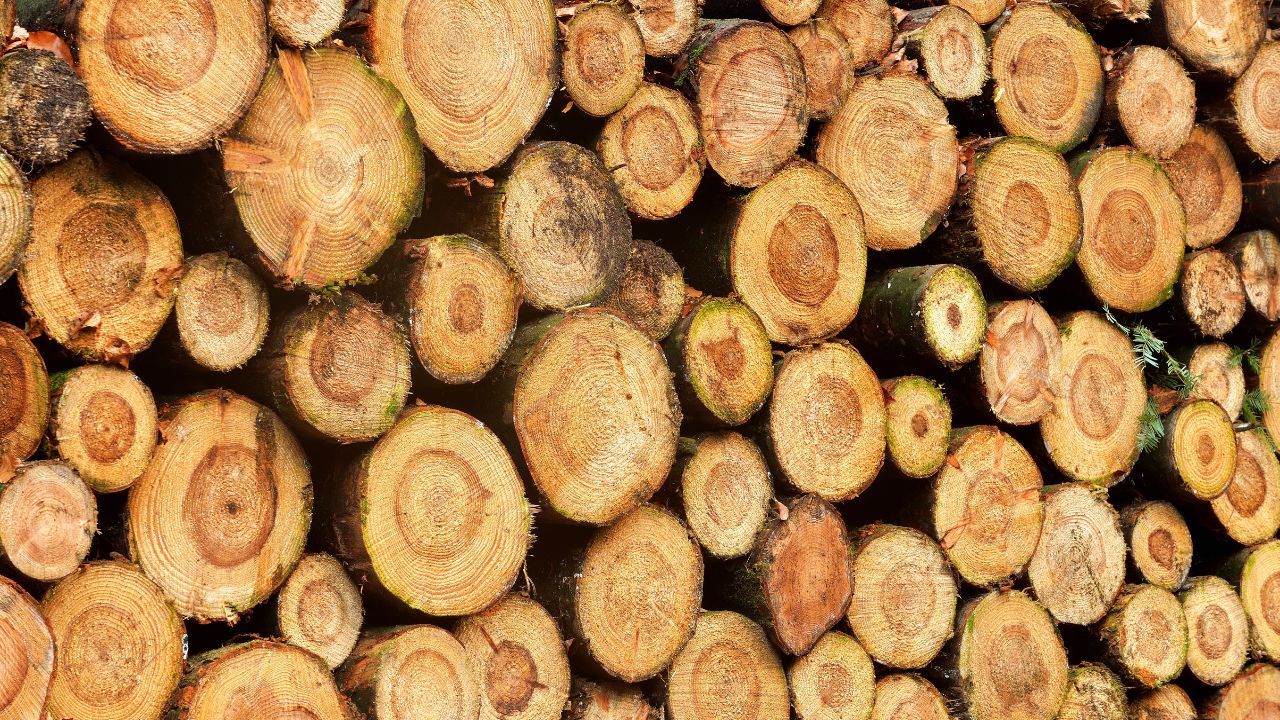
A full cord of firewood contains 128 cubic feet of neatly stacked wood, including bark and the air spaces between the pieces. A typical stack measures 8 feet long × 4 feet high × 4 feet deep.
However, a “face cord,” a pickup load, and a loose pile are not automatically equal to a full cord. Knowing how these measurements differ helps you check deliveries, compare prices, and plan your storage space.
What Is a Cord of Firewood?
A cord is a unit used to measure stacked firewood volume. It does not describe the number of logs, their weight, or the amount of heat they will produce.
Utah State University Extension defines a full cord as an evenly stacked pile containing 128 cubic feet of wood and air space.
The familiar dimensions are:
8 feet long × 4 feet high × 4 feet deep = 128 cubic feet
Other dimensions can produce the same volume. For example, a compact stack measuring 16 feet long, 4 feet high, and 2 feet deep also contains one cord.
The shape can change; the required stacked volume remains the same.
Does a Cord Include Air Gaps?
Yes. The spaces naturally left between stacked pieces are included in the measurement.
That means a cord does not contain 128 cubic feet of solid wood. The actual amount of solid material varies with log shape, splitting, bark, and stacking.
However, the inclusion of air gaps does not mean a loosely arranged pile qualifies. Pieces should be aligned and stacked compactly, without deliberately creating large empty spaces.
Firewood Cord Conversion Table
| Amount of firewood | Stacked volume |
|---|---|
| ⅛ cord | 16 cubic feet |
| ¼ cord | 32 cubic feet |
| ⅓ cord | Approximately 42.67 cubic feet |
| ½ cord | 64 cubic feet |
| ¾ cord | 96 cubic feet |
| 1 cord | 128 cubic feet |
| 1½ cords | 192 cubic feet |
| 2 cords | 256 cubic feet |
These figures describe stacked volume, not the space occupied by loosely dumped firewood.
How to Measure a Cord of Firewood
You need a tape measure and a reasonably even stack.
1. Stack the Wood Neatly
Arrange the pieces in parallel rows, with individual pieces resting close together. Avoid measuring a scattered or cone-shaped pile.
If you have several separate stacks, measure each one individually.
2. Measure Length, Height, and Depth
Take all measurements in feet.
For a single row, the depth is approximately the length of the firewood pieces. For several rows, measure their combined occupied depth without counting empty aisles between them.
If the top is uneven, take several height measurements and use an average for a practical estimate.
3. Calculate the Volume
Use this formula:
Stacked cubic feet = Length × Height × Depth
For example, a stack measuring 8 feet long, 4 feet high, and 2 feet deep contains:
8 × 4 × 2 = 64 cubic feet
4. Convert Cubic Feet to Cords
Divide the stacked volume by 128:
Number of cords = Stacked cubic feet ÷ 128
For the example above:
64 ÷ 128 = 0.5 cord
That stack contains half a cord.
What If Your Measurements Are in Inches?
Convert inches to feet before multiplying, or calculate everything in inches and divide by 1,728 to obtain cubic feet.
Cubic feet = Length in inches × Height in inches × Depth in inches ÷ 1,728
For example:
96 × 48 × 16 ÷ 1,728 = approximately 42.67 cubic feet
Then:
42.67 ÷ 128 = approximately one-third of a cord
Do not multiply measurements in feet and inches together without converting them to the same unit.
Full Cord vs. Face Cord: What Is the Difference?
A full cord has a defined volume of 128 stacked cubic feet.
A face cord is an informal description, often used for a stack measuring 8 feet long and 4 feet high, with a depth equal to one log length. Its volume therefore depends on the length of the pieces.
| Stack face | Log length/depth | Stacked volume | Fraction of a full cord |
|---|---|---|---|
| 8 feet × 4 feet | 12 inches | 32 cubic feet | ¼ cord |
| 8 feet × 4 feet | 16 inches | About 42.67 cubic feet | ⅓ cord |
| 8 feet × 4 feet | 18 inches | 48 cubic feet | ⅜ cord |
| 8 feet × 4 feet | 24 inches | 64 cubic feet | ½ cord |
A face cord is only one-third of a full cord when the stack is 8 feet long, 4 feet high, and 16 inches deep.
Ask for the actual dimensions or a quantity expressed in full cords or fractions of a cord. Measurement Canada’s buying guide similarly advises buyers to avoid relying on descriptions such as “face,” “stove,” or “apartment” cords.
How Much Wood Is in a Rick?
“Rick” is another informal term that may describe a stack or a face cord. Its meaning varies between sellers and locations.
Do not assume that one rick equals a particular fraction of a cord. Ask:
- How long is the stack?
- How high is it?
- How long are the individual pieces?
- What stacked volume is being supplied?
Once you know those dimensions, you can calculate the amount yourself.
Is a Loose Load of 128 Cubic Feet a Full Cord?
Not necessarily. Loose firewood generally occupies more space than the same pieces stacked neatly because the gaps are larger.
A truck or trailer holding 128 cubic feet of loosely thrown logs should not automatically be counted as a full cord.
There is no single dependable conversion for every loose load. Piece length, shape, splitting, and loading method all affect how much it settles when stacked.
For a practical delivery check, stack the wood and measure it.
Can a Pickup Truck Carry a Full Cord?
A “pickup load” is not a reliable unit of firewood volume.
Truck beds vary in length, width, and height. Wheel wells reduce usable space, and stacked wood fits differently from loose wood. A heaped load adds another source of uncertainty.
Weight also matters. Even if wood physically fits, it may exceed the vehicle’s payload capacity.
Ask the seller for the quantity in cords or stacked cubic feet rather than assuming a truckload equals a full cord.
How Many Cubic Meters and Cubic Yards Are in a Cord?
One full cord is approximately:
- 3.62 stacked cubic meters
- 4.74 stacked cubic yards
The calculations are:
128 cubic feet × 0.0283168 = approximately 3.62 cubic meters
128 cubic feet ÷ 27 = approximately 4.74 cubic yards
These remain stacked-volume conversions. They should not be used as equivalent measurements for loose loads or solid wood.
How to Compare Firewood Prices
Compare prices using the same quantity.
For example, suppose one seller offers half a cord for $180, while another offers a full cord for $320.
The half-cord offer works out to:
$180 ÷ 0.5 = $360 per full cord
The full-cord offer has the lower price per unit of volume.
These are illustrative prices, not current market estimates. Also compare species, moisture condition, log length, delivery charges, and whether stacking is included.
A cheaper cord is not necessarily better value if the wood is unsuitable for your appliance or needs substantial drying.
Frequently Asked Questions
How Many Cubic Feet Are in Half a Cord?
Half a cord contains 64 stacked cubic feet. One possible arrangement is 8 feet long, 4 feet high, and 2 feet deep.
How Many Cubic Feet Are in a Quarter Cord?
A quarter cord contains 32 stacked cubic feet.
Do Three Rows of 16-Inch Logs Make a Cord?
Yes, if each row is 8 feet long and 4 feet high and the pieces provide a full 16-inch depth. Three such rows have a combined depth of 48 inches, or 4 feet.
Does Wood Species Change the Size of a Cord?
No. A cord of oak and a cord of pine both occupy 128 cubic feet when properly stacked. Their weight and heat output can differ.
How Many Logs Are in a Cord?
There is no fixed number. Larger pieces mean fewer logs, while smaller splits mean more. Measure volume rather than counting pieces.
Is a Cord the Same as 128 Board Feet?
No. A board foot is a lumber measurement equal to 1/12 of a cubic foot of solid material. A cord measures a stack of firewood, including bark and normal air gaps. The two should not be treated as interchangeable buying units.