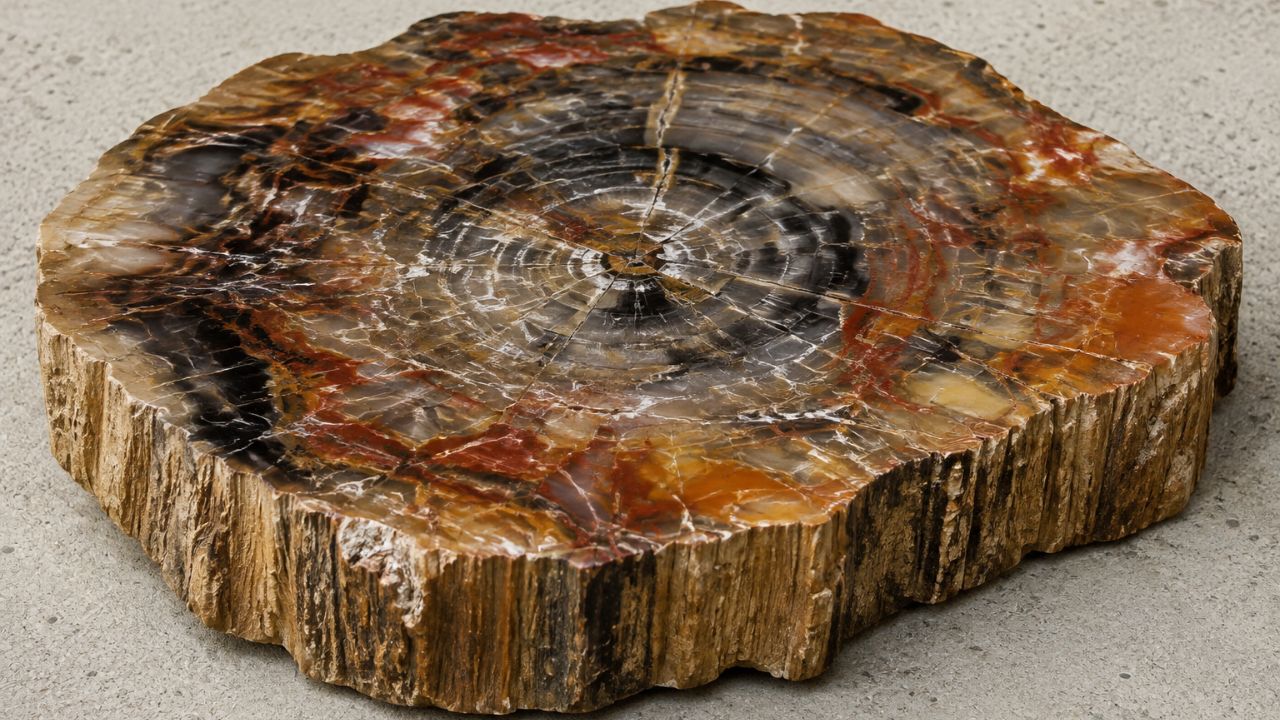
Petrified wood can be worth anywhere from a few dollars to thousands of dollars, depending on its size, color, quality, pattern, origin, condition, and whether it has been cut and polished. Small, common pieces may have little commercial value, while large, colorful, well-preserved specimens can command hundreds or even thousands of dollars.
There is no fixed price per pound for petrified wood. A rough piece may be inexpensive, while a beautifully polished slab can be worth much more because of its rarity, appearance, preparation, and collector demand.
How Much Is Petrified Wood Worth?
As a general guide, common rough petrified wood may sell for only a few dollars per pound, while attractive polished pieces can sell for tens or hundreds of dollars. Exceptional slabs, large logs, furniture pieces, and rare specimens can sell for thousands of dollars.
For example, a recent auction of a large 184-pound petrified wood log sold for $325, while a polished slab measuring about 23 × 21 inches sold for $850 at another 2026 auction. These examples show why weight alone cannot determine value.
| Type of Petrified Wood | Approximate Value |
|---|---|
| Small common rough pieces | $1–$10+ |
| Rough decorative pieces | $10–$100+ |
| Small polished specimens | $20–$150+ |
| Quality polished slabs | $100–$1,000+ |
| Large decorative logs | $200–$2,000+ |
| Large premium slabs/tabletops | $1,000–$10,000+ |
| Rare museum-quality specimens | Can be considerably higher |
These are broad market ranges rather than fixed prices. The actual value of an individual specimen can be much lower or higher depending on its characteristics and the buyer.
What Is Petrified Wood?
Petrified wood is fossilized wood in which the original organic material has been replaced or preserved by minerals, commonly silica. The process can preserve the original structure of the tree, including growth rings, grain, and sometimes cellular details.
Although it looks like wood, petrified wood is essentially stone. Its appearance can range from ordinary brown or gray material to extremely colorful specimens containing reds, yellows, greens, blues, and other shades.
The mineral composition and trace elements present during fossilization are responsible for many of these colors.
Why Is Some Petrified Wood More Valuable Than Others?
Not every piece of petrified wood has the same commercial or collector value. Several characteristics can dramatically affect its price.
1. Color
Color is one of the most important factors affecting the value of petrified wood.
Common brown, gray, and tan material is generally less valuable than specimens displaying vivid and unusual colors.
Minerals and trace elements can create different colors during the fossilization process. For example, iron compounds can contribute to red, orange, yellow, and brown colors, while other mineral inclusions can produce green, blue, or purple shades.
Pieces with several contrasting colors and attractive patterns are particularly popular with collectors.
2. Pattern and Grain
One of the most attractive features of petrified wood is that it can preserve the original appearance of wood.
A valuable specimen may clearly display:
- Tree rings
- Wood grain
- Bark patterns
- Growth structures
- Knots
- Contrasting mineral patterns
- Fine cellular detail
A piece with a well-defined and visually appealing pattern can be worth considerably more than a similar-sized piece with a dull or poorly preserved appearance.
3. Size
Size also plays an important role.
Small pieces are relatively common and can be inexpensive. Large, intact logs are much more difficult to find, transport, cut, and polish.
However, larger does not automatically mean more valuable. A huge piece with poor color, extensive fractures, or an unattractive pattern may be worth less than a smaller specimen with exceptional color and preservation.
4. Quality of Preservation
The quality of fossilization is another important consideration.
High-quality petrified wood can preserve detailed features of the original tree. Pieces with severe cracks, fractures, voids, weathering, or poor mineral replacement may have less commercial value.
Collectors generally prefer stable specimens with clear details and attractive patterns.
5. Polish and Finish
A rough piece of petrified wood and a professionally polished specimen can have very different values.
Cutting and polishing can reveal colors and patterns hidden inside the stone. However, this process requires specialized equipment, time, skill, and abrasive materials.
FossilEra notes that much of the commercial value of quality petrified wood can come from the labor involved in extracting, cutting, and polishing it.
A polished slab with excellent color and pattern can therefore sell for substantially more than the same material in rough form.
Is Petrified Wood Worth More When It Is Polished?
Usually, yes.
Polishing can reveal the internal structure, color, and grain of petrified wood. This makes it more attractive for collectors, interior decoration, jewelry, and furniture.
However, polishing does not automatically increase the value of every specimen.
If the original piece has poor color, extensive fractures, or little visible grain, polishing may not add much value. On the other hand, an attractive piece with strong color and good preservation can become significantly more valuable after professional cutting and polishing.
Large slabs also require substantial labor. Some specialist polishers charge by the square inch, so the preparation cost can become significant for large pieces.
How Much Is Rough Petrified Wood Worth?
Common rough petrified wood can have relatively low value.
Some commercial sellers report rough decorative material at around a few dollars per pound, while smaller common specimens can sell for considerably less depending on quality and quantity. FossilEra, for example, notes that some private-land petrified logs in Arizona are sold for around $2 per pound, including extraction and transportation costs.
However, you should not use $2 per pound as a universal price.
A rough specimen with exceptional color, agatization, unusual preservation, or collectible characteristics may be worth much more.
How Much Is a Petrified Wood Slab Worth?
Petrified wood slabs can range from relatively inexpensive decorative pieces to several thousand dollars.
The price depends on:
- Slab dimensions
- Thickness
- Color
- Pattern
- Number of cracks
- Quality of polishing
- Origin
- Rarity
- Demand
- Preparation costs
A recent 2026 auction provides a useful real-world example: a polished petrified wood slab approximately 23 × 21 inches sold for $850.
Another large petrified wood log weighing about 184 pounds sold for $325 at auction.
These examples demonstrate that a heavier piece isn’t necessarily worth more than a smaller polished specimen.
How Much Is a Petrified Wood Log Worth?
A petrified wood log can be worth anywhere from a relatively small amount to several thousand dollars or more.
The most important factors include:
Size + condition + color + preservation + pattern + origin + preparation = value
Large, intact logs are particularly attractive for landscaping, museums, private collections, and interior decoration.
However, transportation can significantly affect the economics of a large log. Petrified wood is extremely heavy because it is stone rather than ordinary wood. A buyer may therefore consider not only the specimen’s value but also the cost of extraction, loading, transportation, cutting, and polishing.
Does the Origin of Petrified Wood Affect Its Value?
Yes.
The geological location where petrified wood formed can influence collector interest and price.
Some locations are particularly famous for colorful or unusual petrified wood. Arizona, for example, is well known for its petrified wood deposits.
The origin can also provide information about the geological age, type of fossilized tree, and mineralization process.
However, an attractive specimen from a less famous locality can still be more valuable than an ordinary specimen from a famous location.
Is Rainbow Petrified Wood More Valuable?
Rainbow petrified wood can be more valuable because of its colorful appearance.
The term “rainbow petrified wood” is generally used for specimens displaying multiple contrasting colors and patterns. Strong reds, oranges, yellows, greens, browns, and other colors can create a highly attractive appearance after polishing.
The value still depends on the overall quality. A specimen with many colors but extensive fractures may not be as valuable as a stable specimen with fewer but exceptionally vivid colors.
Is Opalized Petrified Wood Valuable?
Opalized wood can be particularly valuable when it has exceptional color, translucency, or play-of-color.
During fossilization, silica can occur in different forms. In some specimens, opal is present instead of the more common quartz or chalcedony.
High-quality opalized wood can have a gemstone-like appearance and attract collectors and lapidary enthusiasts.
However, not every piece described as “opalized wood” is extremely valuable. The quality, rarity, color, stability, and visual appearance still determine the price.
Is Petrified Wood Rare?
Petrified wood itself is not necessarily rare.
Many petrified wood deposits are extensive, and common specimens can be relatively abundant. FossilEra notes that some deposits extend across very large areas and that most petrified wood has little commercial value.
What can be rare is high-quality petrified wood.
A large, intact specimen with exceptional color, excellent preservation, minimal fractures, and a beautiful pattern is much harder to find.
This is why two pieces of petrified wood that look similar in size can have dramatically different values.
Does the Age of Petrified Wood Affect Its Value?
Age can contribute to collector interest, but it is not the only factor that determines value.
Petrified wood can be millions of years old, but simply being older does not automatically make a specimen more valuable.
Collectors generally consider:
- Geological age
- Rarity
- Preservation
- Color
- Mineral composition
- Size
- Origin
- Scientific significance
- Visual appeal
A younger specimen with exceptional preservation and color may be more desirable than an older but ordinary specimen.
Can You Sell Petrified Wood?
Yes, legally sourced petrified wood can be sold in many circumstances.
However, the legality of selling petrified wood depends on where it was collected and the laws governing that land.
This is especially important in the United States.
For example, federal regulations allow limited personal collection of petrified wood from certain BLM-managed public lands, generally up to 25 pounds plus one piece per person per day, with a 250-pound annual limit. Material collected under this free-use provision is for personal use and may not be sold or bartered to commercial dealers.
Therefore, you should never assume that a piece you legally collected for personal use can automatically be sold.
Can You Collect Petrified Wood From Public Land?
The answer depends on the specific land and agency.
On certain BLM-managed lands, limited recreational collection is allowed under specific rules. The federal regulation permits up to 25 pounds plus one piece per day and 250 pounds per calendar year without charge, subject to the applicable rules.
However, material collected under those rules is intended for personal use and cannot simply be sold commercially.
Other public lands can have completely different rules.
Always check the regulations for the specific property before collecting petrified wood.
How to Determine How Much Your Petrified Wood Is Worth
If you already own a piece and want to estimate its value, follow these steps.
Step 1: Weigh the Specimen
Record the weight and dimensions.
Weight is useful for comparing similar pieces, but do not calculate value solely by multiplying weight by a price per pound.
Step 2: Examine the Color
Look carefully for vivid colors, contrasting patterns, and unusual mineralization.
Bright and distinctive colors can increase collector interest.
Step 3: Check the Pattern
Look for visible tree rings, grain, bark, knots, and other preserved structures.
Step 4: Inspect for Cracks
Turn the specimen over and inspect all sides.
Large cracks, unstable sections, repairs, and missing pieces can reduce its value.
Step 5: Determine Whether It Is Rough or Polished
A polished specimen is generally easier to evaluate visually because its internal patterns are visible.
If the piece is rough, avoid assuming that polishing will automatically make it valuable.
Step 6: Identify Its Origin
If you know where the specimen came from, record the location and any documentation you have.
Provenance can be especially important for unusual or high-value specimens.
Step 7: Compare Actual Sales
Try to find completed sales, rather than relying only on asking prices.
An item listed for $1,000 does not necessarily mean it is worth $1,000. Actual auction results provide stronger evidence of what buyers have recently paid.
What Makes Petrified Wood Valuable?
The most valuable pieces generally combine several desirable characteristics:
- Exceptional color
- Clear and attractive grain
- Excellent preservation
- Large size
- Minimal fractures
- Interesting mineral patterns
- Rare origin or material
- High-quality polishing
- Scientific or historical significance
- Legal and documented provenance
The combination is more important than any single characteristic.
Is Petrified Wood a Good Investment?
Petrified wood can be collectible, but it should not automatically be considered a financial investment.
Prices can vary considerably depending on collector demand, quality, location, preparation, and market conditions.
Unlike standardized commodities, each specimen is unique. This makes direct price comparisons difficult.
If you buy petrified wood, it is generally better to choose a piece you genuinely appreciate rather than purchasing it solely because you expect its value to increase.
Where Can You Sell Petrified Wood?
Depending on the size and quality of the specimen, potential selling channels include:
- Rock and mineral dealers
- Fossil dealers
- Gem and mineral shows
- Auction houses
- Online marketplaces
- Local collectors
- Lapidary shops
- Antique and natural-history dealers
- Specialty fossil auctions
For an ordinary small piece, shipping costs can make professional appraisal uneconomical. For a large or potentially rare specimen, an experienced fossil or mineral dealer may provide a more useful valuation.
Why Is Polished Petrified Wood So Expensive?
Polished petrified wood can be expensive because the buyer is paying for more than the fossil itself.
The final price can include:
- Excavation
- Heavy equipment
- Transportation
- Cutting
- Grinding
- Polishing
- Equipment wear
- Labor
- Storage
- Breakage risk
Large slabs can require specialized cutting and polishing equipment and considerable labor.
Therefore, the price of a finished slab may be much higher than the value of the original rough material.
Frequently Asked Questions
How Much Is Petrified Wood Worth Per Pound?
There is no universal price per pound. Common rough material may sell for only a few dollars per pound, while high-quality specimens can be worth considerably more. Color, preservation, size, pattern, and polish are often more important than weight alone.
Is Petrified Wood Worth Any Money?
Yes, but not all petrified wood is valuable. Common small pieces may have little commercial value, while large, colorful, well-preserved, and polished specimens can be worth hundreds or thousands of dollars.
What Color Petrified Wood Is Worth the Most?
There is no single color that is always the most valuable. Bright, unusual, and strongly contrasting colors generally attract more collector interest, especially when they occur with excellent preservation and attractive patterns.
Is Black Petrified Wood Valuable?
Black petrified wood can be valuable if it has excellent preservation, attractive patterns, unusual mineralization, or other collectible characteristics. Color alone does not determine its value.
Is Green Petrified Wood Valuable?
Green petrified wood can attract collector interest because green coloration is less common than ordinary brown or gray material. However, its value depends on the intensity and quality of the color, pattern, preservation, size, and origin.
Is Petrified Wood Rare?
Common petrified wood can be relatively abundant, but exceptional specimens are much rarer. Large, intact pieces with vivid colors, excellent preservation, and minimal fractures can be highly collectible.
Can Petrified Wood Be Worth Thousands of Dollars?
Yes. Large, high-quality slabs, furniture pieces, rare specimens, and exceptional museum-quality material can reach thousands of dollars. The market is highly variable, so an appraisal or comparison with recent sales is recommended for valuable specimens.
Is Petrified Wood Legal to Sell?
It depends on where it came from and the applicable laws. In the United States, certain BLM rules allow limited personal collection, but material collected under the free-use provision cannot be sold or bartered commercially.
Final Thoughts
So, how much is petrified wood worth? The answer can range from just a few dollars for a common rough piece to hundreds or thousands of dollars for a large, colorful, well-preserved, and professionally polished specimen.
The most important factors are size, color, pattern, preservation, condition, origin, rarity, and preparation. Weight alone is not enough to determine its value.
If you have a piece of petrified wood that you believe may be valuable, document its size, weight, appearance, and origin, then compare it with recent completed sales of similar specimens. For unusually large or rare pieces, getting an opinion from a reputable fossil or mineral dealer can provide a much more reliable valuation.