
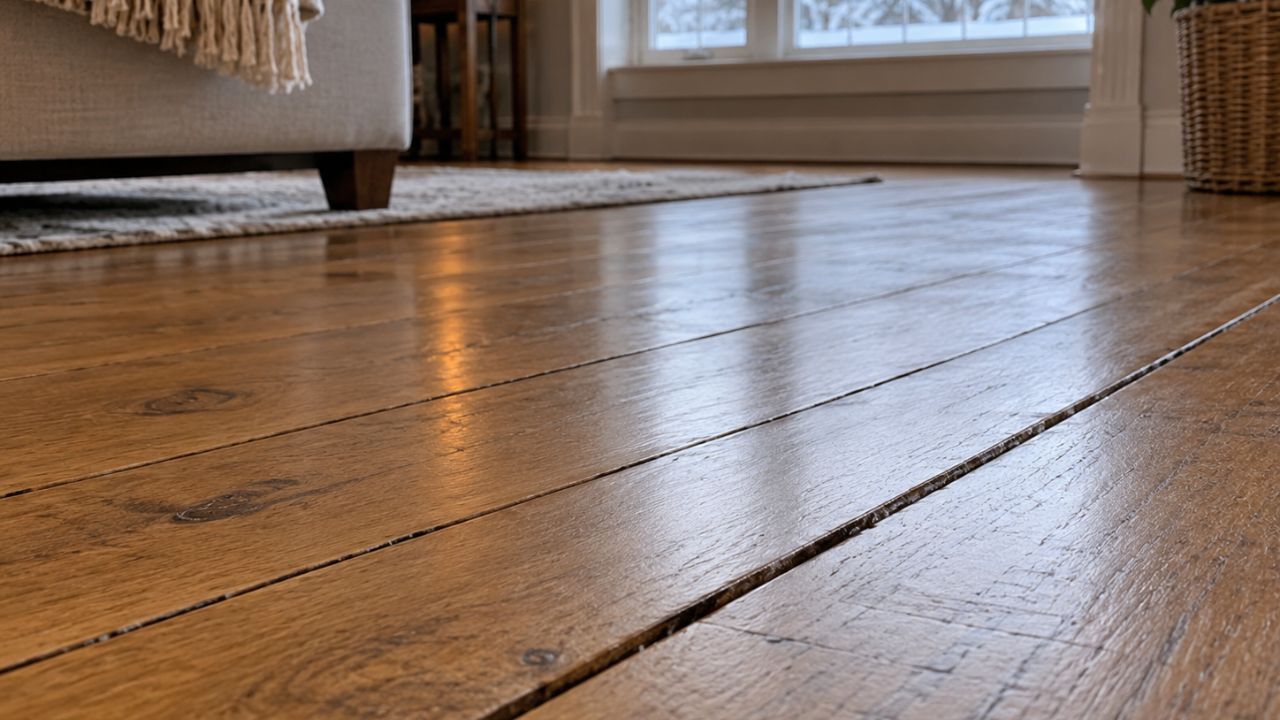
Yes, wood floors can shrink in winter when indoor humidity drops. As the boards lose moisture, they become slightly narrower, which can create gaps between them. Small seasonal gaps are common, particularly in solid hardwood flooring, and may narrow again when humidity rises.
However, not every gap is harmless or seasonal. Persistent openings, cracked boards, and loose flooring may point to installation problems or more severe moisture changes.
Before reaching for wood filler, check the room conditions and how the floor behaves over time.
Why Do Wood Floors Shrink in Winter?
Wood absorbs and releases moisture in response to its surroundings. When it loses moisture, it shrinks; when it gains moisture, it swells.
In cold climates, outdoor air often contains relatively little moisture. When that air enters a home and is heated, its relative humidity drops unless moisture is added. Over time, the flooring responds to the drier conditions.
The change occurs mainly across the grain, so boards typically change more in width than in length. Even a small amount of shrinkage across individual boards can make the seams noticeable.
The main cause is moisture loss, rather than cold temperatures directly shrinking the floor. A home with stable indoor humidity may experience much less seasonal movement.
Are Gaps Between Floorboards Normal in Winter?
Small gaps that appear during dry weather and narrow during more humid periods can be normal.
The National Wood Flooring Association’s winter-care guidance explains that moisture loss can cause gapping and that seasonal changes affect both solid and engineered wood floors.
A recurring pattern is useful evidence. For example, narrow seams that appear each heating season and close when normal humidity returns are different from one large opening that keeps getting wider.
There is no single gap measurement that proves every floor is acceptable. Board width, species, construction, installation method, and moisture history all influence the assessment.
Seasonal Gaps vs. Problems That Need Attention
| What you notice | What it may indicate | Sensible next step |
|---|---|---|
| Small gaps appear across the floor during dry weather | Seasonal shrinkage | Measure humidity and monitor |
| Gaps narrow when normal humidity returns | Reversible seasonal movement | Maintain more consistent conditions |
| One or two joints separate while surrounding boards remain tight | A localized installation or connection issue | Ask the installer to inspect |
| Gaps remain throughout the year | Persistent shrinkage or another underlying problem | Arrange a flooring assessment |
| Boards crack, splinter, or become loose | Damage beyond ordinary cosmetic gapping | Have the floor checked |
| Boards lift, buckle, or show moisture staining | A possible moisture or installation problem | Investigate promptly |
These signs help guide the next step; they do not replace an inspection when the cause is unclear.
Do Engineered Wood Floors Shrink Too?
Yes. Engineered wood flooring generally moves less than comparable solid wood flooring because its layered construction improves dimensional stability.
However, it still contains real wood and remains sensitive to environmental conditions. Excessively dry air can cause gaps, surface checking, or distortion in some products.
Installation method also matters. A floating floor, glued floor, and nailed floor do not respond in exactly the same way. Open end joints in a floating floor, for example, should not automatically be dismissed as ordinary seasonal shrinkage.
Follow the care requirements for the specific product.
Why Are Some Floors More Affected Than Others?
Wider Boards
For the same percentage of shrinkage, a wider solid board changes more in width than a narrower one. This can make individual gaps more noticeable.
That does not mean all wide-plank floors will develop problems. Product construction and indoor conditions remain important.
Wood Species and Grain Orientation
Different species move by different amounts as their moisture content changes. The way lumber is sawn also affects movement.
Hardness alone does not tell you how stable a floor will be.
Moisture Conditions at Installation
Flooring installed with too much moisture for its eventual environment may shrink significantly afterward.
Acclimation should follow the manufacturer’s instructions and account for the flooring, subfloor, and expected living conditions. Simply leaving boxes in a room for a fixed number of days does not establish readiness.
Large Indoor Humidity Swings
A floor exposed to humid summers and very dry winters experiences a larger moisture change than one in a consistently controlled environment.
Local conditions can also differ within a home. A room near a strong heat source may behave differently from a room on another floor.
What Humidity Level Is Best for Wood Floors?
Use the humidity range specified by your flooring manufacturer.
A range of 30–50% relative humidity appears in many flooring instructions, but it is not universal. Other products may specify a different range.
For example, Bruce’s engineered flooring installation instructions call for maintaining recommended humidity levels and note that humidification may be necessary during dry conditions.
Use a digital hygrometer to monitor the room. Place it away from direct sunlight, heating vents, and the immediate output of a humidifier.
Do not raise humidity aggressively just to force gaps closed. Excess moisture can cause condensation on cold surfaces and create other building problems. If the floor’s requirements conflict with what your home can maintain without condensation, discuss the situation with the flooring manufacturer and an HVAC professional.
How to Reduce Winter Shrinkage
1. Measure Before Making Changes
Check indoor relative humidity over several days. Record readings in the affected room rather than relying only on a thermostat elsewhere in the house.
Photograph the same gaps periodically so you can compare their appearance.
2. Add Humidity When Needed
If humidity is below the flooring manufacturer’s range, a properly sized humidifier may help.
A portable unit may serve one room, while a whole-house system may be more appropriate for a widespread issue. Follow cleaning and maintenance instructions, and keep mist, leaks, and condensation off the floor.
3. Keep Conditions Consistent
Aim for reasonably steady temperature and humidity throughout the heating season. Large changes in an intermittently heated room can make movement harder to control.
Maintain suitable conditions during extended absences as well.
4. Clean Without Soaking
Use the cleaner and method recommended for your floor. Wipe up spills promptly and avoid wet mopping.
Adding water directly to the boards is not a safe way to correct dry indoor air.
5. Allow Time for the Wood to Respond
A hygrometer may show an improvement before the floor changes noticeably. Wood takes time to gain moisture.
There is no guaranteed number of days for gaps to narrow, and permanent damage will not necessarily reverse when humidity improves.
Should You Fill Winter Gaps in Wood Floors?
Avoid filling moving seasonal gaps before understanding their cause.
Filler applied while boards are at their narrowest may crack, loosen, or be pushed out when the wood expands. Packing openings with rigid material can also interfere with normal movement.
A flooring professional may recommend repairs for permanent gaps, but the method depends on the floor and the reason for the opening. Options could include an appropriate filler, a fitted wood repair, or replacement of damaged boards.
Do not fill the expansion space around the room’s perimeter. That gap has a different purpose from an unwanted opening between boards.
Will the Gaps Close in Summer?
They may narrow or close if the wood regains moisture as indoor humidity rises.
But the calendar alone does not determine the outcome. Air conditioning, dehumidification, local climate, and household ventilation all influence summer conditions.
Gaps caused by broken locking joints, installation defects, or permanent damage may remain. If openings persist after conditions have stabilized within the recommended range, arrange an inspection.
Frequently Asked Questions
Does Turning Up the Heat Make Floor Gaps Worse?
It can lower relative humidity if no moisture is added, which may encourage further drying. Check humidity rather than assuming temperature alone explains the gaps.
Can a Humidifier Fix Gaps in Hardwood Floors?
It may help reduce gaps caused by excessively dry air. It cannot reliably repair cracked boards, loose fasteners, failed joints, or other installation problems.
Does Refinishing Prevent Winter Shrinkage?
No. A finish can slow moisture exchange, but it does not stop wood movement. Refinishing is not a substitute for controlling indoor conditions.
Are Cracks Inside Boards the Same as Gaps Between Boards?
No. A gap is an opening between separate boards. A crack or check is a separation within a board itself and may require a different assessment.
Should You Wait Until Summer Before Calling an Installer?
You can monitor small, familiar seasonal gaps while correcting low humidity. Contact the installer sooner if the floor is new, gaps are unusually large or localized, or boards are cracking, lifting, or becoming loose.