
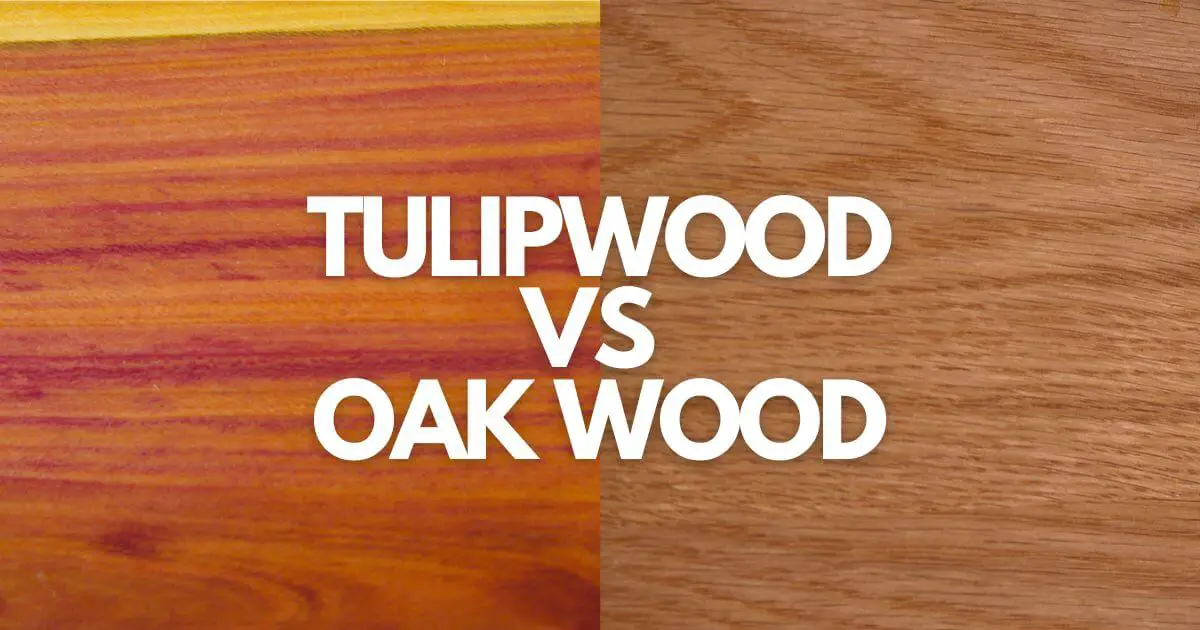
Oak wood is more durable, stable, and rot-resistant than tulipwood. That’s why oak wood is considered more suitable for outdoor purposes.
What Is Tulipwood?
Tulipwood has a high density and is resistant to insects, making it suitable for various applications, from furniture making to musical instrument manufacturing.
Tulipwood, also known as Brazilian tulipwood, comes from small- to medium-sized rainforest trees and is native to northeastern Brazil.
What Is Oak Wood?
Oak wood is very durable and naturally resistant to rot. It is frequently used in boatbuilding and marine applications. Oaks are native to the Northern Hemisphere.
Oak wood is known for its natural properties. It is a popular choice for outdoor applications such as decks, fences, and siding, as well as indoor applications where durability is essential.
There are many species of oak trees, and their wood is highly valued for its strength and beautiful color. Here are a few popular oak wood species:
- White Oak – (Quercus alba)
- Red Oak – (Quercus rubra)
- Live Oak – (Quercus virginiana)
- Post Oak – (Quercus stellata)
| # | Tulipwood | Oak Wood |
|---|---|---|
| Scientific name | Disambiguation | Quercus |
| Tree Size | 15-30 ft (5-9 m) tall, less than 1 ft (0.3 m) trunk diameter | 60-85 ft (19-25 m) tall, 3-4 ft (1-1.2 m) trunk diameter |
| Hardness | Very hard and dense | Moderately hard |
| Rot-resistant | Low rot resistance | Very resistant to rot |
| Waterproof | No | No |
Uses
Oak wood is commonly used for quality flooring, furniture, cabinetry, boatbuilding, barrels, and veneer, while tulipwood is often used for decorative purposes, such as inlays, veneers, musical instruments, and small turned objects.
Oak is generally better suited to applications that require durability, while tulipwood is often chosen for decorative and specialty projects.
Appearance
The heartwood of tulipwood is typically creamy white to pale yellow, while the sapwood is pale yellow to light greenish-yellow. The heartwood has streaks of yellow and light pink.
The heartwood of oak wood ranges from light to medium brown, and the sapwood is typically lighter in color than the heartwood.
The color of oak wood can vary depending on the species and growing conditions. Red oak has a pinkish-brown color with strong grain patterns, while white oak has a more yellowish-brown color.
Both kinds of wood have a straight grain with a coarse, uneven texture. When exposed to UV light and air, oak wood can darken slightly over time.
Workability
Tulipwood can be challenging to work with, while oak wood is relatively easy to work with. Because tulipwood has a high density, it can also cause a blunting effect on cutters, while oak wood is moderately hard. Beginners should use sharp and proper tools when working with tulipwood.
Both kinds of wood turn very well. Oak wood responds well to steam bending and glues, stains, and finishes nicely.
Hardness
Tulipwood is harder and denser than oak wood. Tulipwood has a Janka hardness of 2,500 lbf (11,120 N), while white oak has a Janka hardness of 1,350 lbf (5,990 N). The Janka hardness of wood can vary depending on the species.
Oak wood is less hard than tulipwood but harder than many other common hardwoods, such as cherry, walnut, and maple.
Here are the Janka hardness ratings of popular wood species:
| Wood Species | Janka Hardness |
|---|---|
| Black Ash | 850 lbf (3,780 N) |
| English Oak | 1,120 lbf (4,980 N) |
| Black Oak | 1,210 lbf (5,380 N) |
| Red Oak | 1,220 lbf (5,430 N) |
| White Oak | 1,350 lbf (5,990 N) |
| Bur Oak | 1,360 lbf (6,030 N) |
| Black Locust | 1,700 lbf (7,560 N) |
| Shagbark Hickory | 1,880 lbf (8,360 N) |
| Tulipwood | 2,500 lbf (11,120 N) |
| Cocobolo | 2,960 lbf (14,140 N) |
| Ipe | 3,510 lbf (15,620 N) |
Rot Resistance
Tulipwood is moderately durable and resistant to insects, while oak wood is naturally resistant to decay and rot, which makes it a popular choice for outdoor and moisture-prone applications.
Oak wood does contain natural compounds that contribute to its resistance to moisture and decay. That’s why oak wood does not require much care.
To protect tulipwood from rot, it should be properly sealed and treated with an exterior finish.
Durability
Oak wood is generally more durable than tulipwood, particularly when used in outdoor applications. Its natural resistance to decay and moisture allows it to perform well in demanding environments.
Tulipwood is also a durable hardwood, but it is generally better suited to indoor and decorative applications where it can be protected from prolonged moisture exposure.
Cost
The cost of tulipwood and oak depends on factors such as species, quality, availability, board size, and location.
Oak is widely available in many regions, while tulipwood is a more specialized and less commonly available wood. Therefore, prices can vary considerably depending on the supplier and market.
Outdoor Use
Oak wood is generally a better choice for outdoor applications because of its natural resistance to decay and moisture. It is commonly used for decks, fences, siding, boatbuilding, and other exterior projects.
Tulipwood can be used for outdoor applications when properly protected with an appropriate exterior finish, but it is generally less suitable for prolonged exposure to moisture.
Which Wood Is Stronger: Tulipwood or Oak Wood?
Tulipwood is harder and denser than oak wood, but hardness and density do not necessarily determine overall strength.
For outdoor applications, oak wood is generally a more suitable and durable choice because of its resistance to decay and moisture.
When choosing between the two, consider the specific type of strength required for your project rather than hardness alone.
Which Wood Is Waterproof: Tulipwood or Oak Wood?
Neither tulipwood nor oak wood is completely waterproof. However, oak wood can withstand moisture much longer than tulipwood because of its natural resistance to decay and moisture.
Some wood species contain natural compounds that help protect the surface from moisture. You can also apply a good exterior finish for use in damp areas. This forms a protective layer on the surface of the wood and increases its durability.
Which Is Better: Tulipwood or Oak Wood?
The better choice depends on the type of project.
Oak wood is generally the better option for outdoor projects, flooring, boatbuilding, furniture, and applications that require durability and resistance to decay.
Tulipwood is a better option for decorative work, musical instruments, veneers, inlays, and other specialty applications where its unique appearance and hardness are desirable.
If your project will be exposed to moisture or outdoor conditions, oak is generally the safer choice. For indoor decorative projects, tulipwood can provide an attractive and distinctive appearance.