
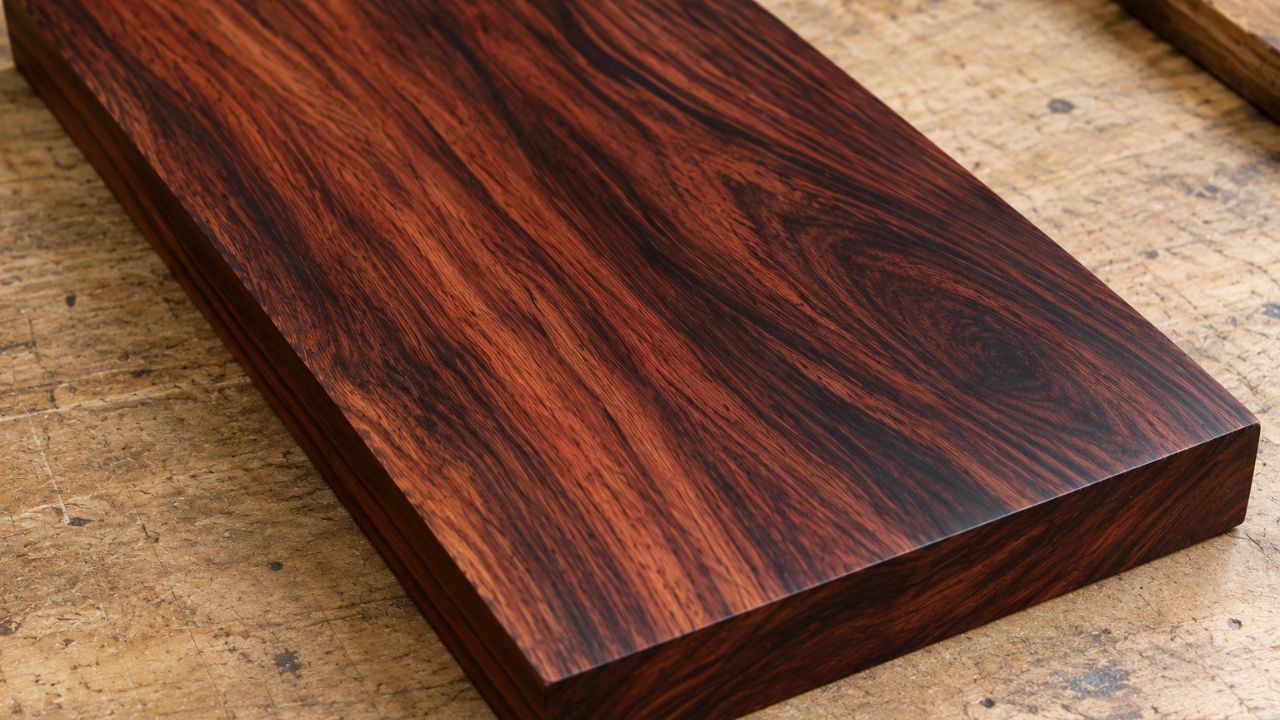
Rosewood comes from trees growing in tropical regions of Asia, Africa, and the Americas. Well-known sources include India, Brazil, Madagascar, and parts of Central America. The exact origin depends on the species, because rosewood is a name used for several different woods.
Many woods commonly called true rosewoods belong to the genus Dalbergia. However, some unrelated trees are also sold under rosewood trade names. That is why checking the scientific name is the most reliable way to understand what you are buying.
Where Do the Main Rosewood Species Grow?
Brazilian Rosewood
Brazilian rosewood (Dalbergia nigra) comes from Brazil and is closely associated with the country’s Atlantic Forest. It became famous for its use in fine furniture and acoustic guitars.
Despite its international popularity, it is not a tree native to every South American country. Kew’s botanical database identifies Brazil as its native range.
East Indian Rosewood
East Indian rosewood (Dalbergia latifolia) is native to parts of the Indian subcontinent, Myanmar, the Andaman Islands, and Java. It has also been introduced to other countries.
This species is widely associated with guitar backs and sides, furniture, and decorative veneers. It should not be confused with sheesham (Dalbergia sissoo), another wood sometimes called Indian rosewood. Kew lists their botanical identities separately.
Honduran Rosewood
Honduran rosewood (Dalbergia stevensonii) grows naturally in Belize, Guatemala, and southeastern Mexico, according to Kew.
Its name can be confusing: “Honduran” does not mean that every piece comes from modern-day Honduras. Common timber names are not always precise descriptions of a tree’s native distribution.
Madagascar Rosewood
Madagascar rosewood refers to several rosewood species from Madagascar, the island off Africa’s southeastern coast.
One example is Dalbergia baronii, which Kew identifies as native to eastern Madagascar. Because the trade name covers more than one species, buyers should request the botanical name rather than relying only on “Madagascar rosewood.”
Siamese Rosewood
Siamese rosewood (Dalbergia cochinchinensis) comes from mainland Southeast Asia. Its native range includes Thailand, Cambodia, Laos, and Vietnam.
The name “Siamese” reflects Thailand’s former name, Siam, but the species also grows naturally in neighboring countries. Kew’s species record confirms this wider distribution.
Does Rosewood Only Grow in Rainforests?
No. Different rosewood species grow in different environments. Some occur in wet tropical forests, while others grow in forests with distinct wet and dry seasons.
For example, East Indian rosewood grows primarily in seasonally dry tropical environments. Brazilian rosewood is associated with wetter tropical conditions. Describing all rosewood as rainforest timber therefore oversimplifies where these trees grow.
Does the Country of Sale Tell You Its Origin?
No. A supplier in the United States or Europe may sell rosewood originally harvested in Asia, Africa, or Latin America. The country where a board is sold is not necessarily where the tree grew.
Likewise, a species can be cultivated outside its native range. A trade name alone does not establish the harvest location of an individual piece.
When buying rosewood, ask for its scientific name, country of harvest, and sourcing records. These details help distinguish similar-looking woods and provide a clearer picture of where the material actually came from.