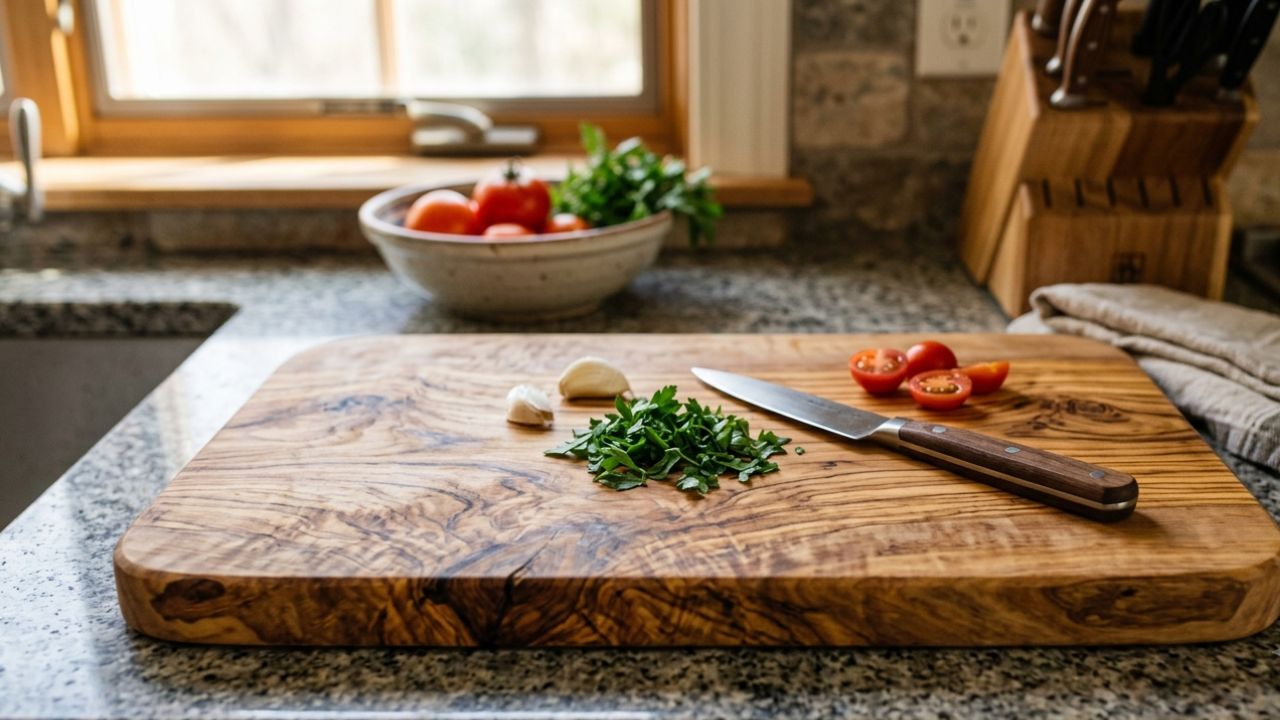
Olive wood can make a beautiful cutting board, but it is not the best choice for every kitchen.
It is exceptionally dense, naturally striking, and often sold in small live-edge boards with dramatic grain patterns. That makes olive wood excellent for serving cheese, bread, fruit, charcuterie, and light food preparation.
For heavy daily chopping with quality kitchen knives, however, a maple or walnut board is often the more practical choice. Olive wood is very hard, can be tough on knife edges, and may crack if it is not dried and cared for properly.
Quick Answer
Olive wood is a good cutting-board material if you want:
- A unique, decorative board
- A board for serving and light prep
- Good resistance to dents and visible knife marks
- A smaller board for fruit, bread, cheese, or charcuterie
- A natural wood piece with varied color and grain
Olive wood may not be ideal if you want:
- A large daily chopping board
- The gentlest surface for sharp knives
- A board with minimal care needs
- A dishwasher-safe board
- A low-cost, easy-to-replace work surface
What Is Olive Wood?
Olive wood comes from olive trees, commonly Olea europaea. It is a hardwood known for warm golden tones, dark brown streaks, and swirling grain patterns.
Because olive trees are often small and irregularly shaped, olive wood boards are usually smaller than standard maple butcher blocks. Many have natural edges, knots, curves, or distinctive figure that make every board look different.
Olive wood is commonly used for:
- Serving boards
- Charcuterie boards
- Small cutting boards
- Utensils and spoons
- Bowls
- Decorative kitchenware
- Turned wood items
Is Olive Wood Hard Enough for Cutting Boards?
Yes—olive wood is more than hard enough.
European olive wood is often reported with a Janka hardness of roughly 2,700 lbf. For comparison, hard maple is commonly around 1,450 lbf and black walnut around 1,010 lbf.
That high hardness helps olive wood resist dents, scratches, and visible knife marks. However, hardness also has a trade-off: a very hard cutting surface can be less forgiving on knife edges than maple or walnut.
If you use expensive knives every day, olive wood may be better as a serving board or secondary prep board than as your main chopping board.
Pros of Olive Wood Cutting Boards
Beautiful Natural Appearance
Olive wood is one of the most visually distinctive kitchen woods. Its combination of pale golden wood, darker streaks, and irregular grain gives it a warm, handmade appearance.
Dense and Durable
Its high density helps it resist everyday dents and superficial knife marks. A well-made olive wood board can stay attractive for years with proper care.
Great for Serving
Olive wood is especially well suited to cheese, bread, fruit, appetizers, tapas, and charcuterie. It can move directly from food preparation to the table.
Naturally Compact Size
Many olive wood boards are small enough to store easily and use for quick kitchen tasks, such as slicing lemons, chopping herbs, or serving snacks.
Each Board Looks Different
Olive wood’s variable grain means no two boards look exactly alike. This makes it popular for gifts and decorative kitchens.
Cons of Olive Wood Cutting Boards
Very Hard on Knife Edges
Olive wood’s density can make it less knife-friendly than softer cutting-board woods. It may dull sharp knife edges faster than maple, walnut, or other traditional board woods.
Can Crack if Neglected
Olive wood can crack when it is soaked, washed in a dishwasher, left near heat, or allowed to dry unevenly. This is especially important for boards with natural edges, knots, or irregular grain.
Usually Smaller Than Standard Butcher Blocks
Olive trees do not usually produce large, straight boards. Most olive wood cutting boards are smaller serving boards rather than large work surfaces for daily meal preparation.
Can Be Expensive
Olive wood is often sold as a specialty or decorative product. A high-quality olive board may cost more than a standard maple or bamboo board of a similar size.
Quality Varies
Some boards are solid olive wood, while others may use small joined pieces, resin-filled voids, or decorative construction. Check for cracks, open seams, rough edges, and unclear finish information before buying.
Olive Wood vs. Maple for Cutting Boards
| Feature | Olive Wood | Hard Maple |
|---|---|---|
| Appearance | Dramatic, varied grain | Light, even, classic appearance |
| Hardness | Very hard | Moderately hard |
| Knife-friendliness | Moderate | Very good |
| Best use | Serving and light prep | Daily chopping and food prep |
| Typical board size | Often small or irregular | Widely available in large sizes |
| Care needs | High; prone to cracking if neglected | Moderate; needs regular conditioning |
Hard maple is a standard choice for cutting boards because it is hard, close-grained, and widely used for food-contact items. The FDA Food Code specifically permits hard maple or an equivalently hard, close-grained wood for cutting boards and similar utensils.
Is Olive Wood Food Safe?
A well-made olive wood board intended for food preparation can be used safely when it is properly cleaned and maintained.
The wood species alone does not guarantee that a board is suitable for food contact. Check that:
- The product is sold for food preparation or serving.
- Any glue, filler, or finish is suitable for food contact.
- The board has no deep cracks, gaps, or loose joints.
- You can hand wash and dry it promptly.
- The manufacturer provides care instructions.
Do not rely on claims that a wooden board “cleans itself” or never needs washing. All cutting boards need proper cleaning after food preparation.
How to Care for an Olive Wood Cutting Board
Olive wood needs consistent care to prevent cracking and maintain its appearance.
Hand Wash Only
Wash the board with warm water, mild dish soap, and a soft sponge. Do not soak it in water.
Never Use a Dishwasher
Dishwasher heat, long water exposure, and detergent can cause olive wood to split, warp, or develop cracks.
Dry It Promptly
Towel dry the board after washing, then store it on its edge or where air can circulate around both sides.
Use Food-Grade Mineral Oil
Condition the board with food-grade mineral oil or a cutting-board cream when it appears dry or water no longer beads on the surface.
Avoid using cooking oils, including olive oil, because they can become sticky or rancid over time.
Keep It Away From Heat
Do not leave olive wood beside a stove, radiator, sunny window, or hot dishwasher vent. Rapid drying can increase the risk of cracking.
What to Look for When Buying an Olive Wood Board
Choose a board with:
- A smooth, well-sanded surface
- No visible cracks or open splits
- No loose bark or weak natural edges
- A stable base that does not rock
- Clear food-contact and care information
- Enough thickness for its intended use
- A size suitable for your normal kitchen tasks
For daily chopping, choose a larger, flatter board with a stable surface. For serving, a smaller live-edge olive board can be an excellent choice.
Frequently Asked Questions
Is olive wood good for daily chopping?
It can be used for daily chopping, but it is not the most knife-friendly option because it is very hard. Maple or walnut is usually a better choice for a main work board.
Does olive wood dull knives?
Olive wood can dull knife edges faster than softer board woods because of its high density and hardness.
Is olive wood waterproof?
No. Olive wood is not waterproof. It can resist normal kitchen use when properly conditioned, but it can still absorb water, crack, or warp if soaked or neglected.
Can I use olive oil on an olive wood cutting board?
No. Use food-grade mineral oil or a board conditioner instead. Cooking oils can become sticky and rancid over time.
Is olive wood good for charcuterie boards?
Yes. Olive wood is an excellent choice for cheese boards, charcuterie boards, bread boards, and serving platters because of its appearance and durability.
Can olive wood boards go in the dishwasher?
No. Hand wash only, dry promptly, and condition the wood when needed.
Final Verdict
Olive wood is a good cutting-board material for serving, light prep, and anyone who values natural beauty.
Its main strengths are its exceptional grain, dense feel, and resistance to visible surface damage. Its main drawbacks are its high hardness, potential effect on knife edges, smaller board sizes, and need for careful hand washing and conditioning.
For a beautiful cheese board or occasional prep board, olive wood is an excellent choice. For a large everyday chopping board, hard maple or walnut is usually the more practical option.