
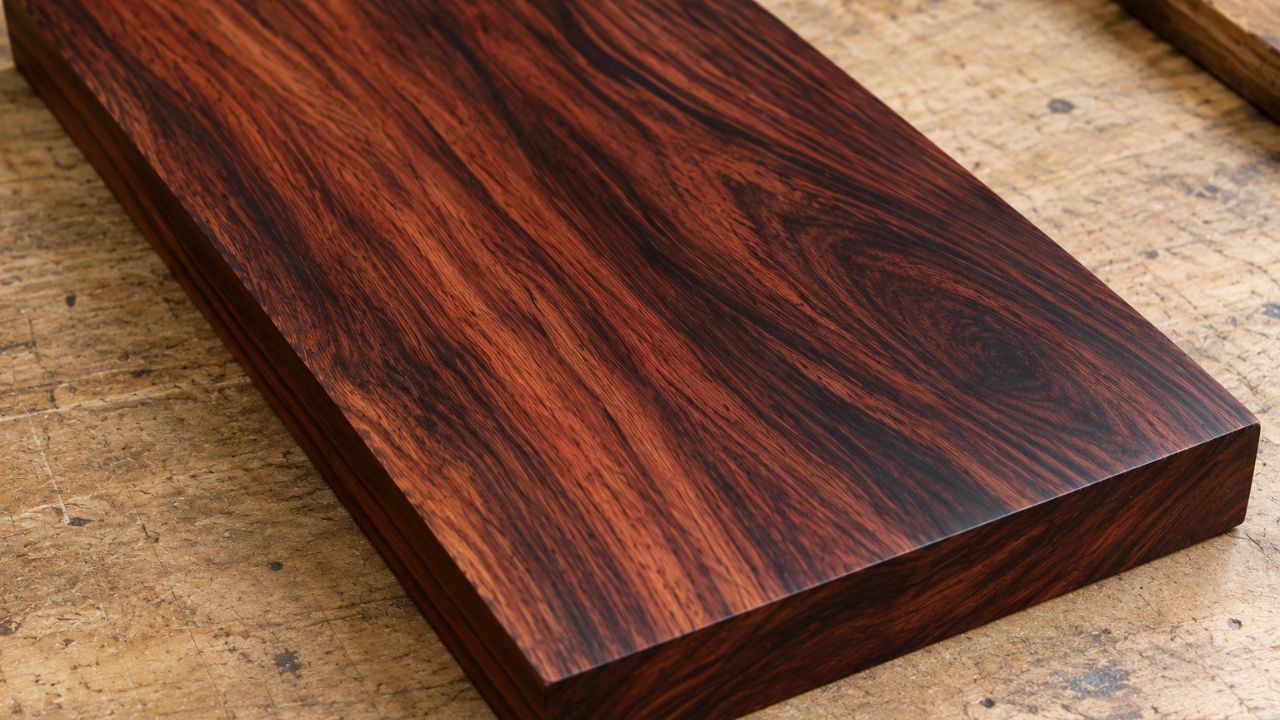
Brazilian rosewood is a dense, durable hardwood known for its dark streaks, rich color, and use in fine musical instruments. Its scientific name is Dalbergia nigra, and it comes from Brazil.
For generations, woodworkers have valued it for decorative furniture, veneers, and acoustic guitars. Today, limited availability and strict trade controls make it a specialist material rather than an everyday woodworking choice.
Its main advantages are its appearance, natural durability, and suitability for detailed work. Its disadvantages include high prices, sourcing difficulties, and the extra care needed when gluing and handling valuable stock.
What Is Brazilian Rosewood?
Brazilian rosewood belongs to the Dalbergia genus in the legume family, Fabaceae. It is also known as Rio rosewood, Bahia rosewood, and jacarandá-da-Bahia.
The species is native to Brazil and is closely associated with the Atlantic Forest. Kew’s Plants of the World Online confirms its botanical identity and native distribution.
It should not be confused with East Indian rosewood, Brazilian cherry, or other woods sold under similar trade names. When buying lumber or an instrument, the scientific name is more reliable than the common name alone.
Brazilian Rosewood Properties
| Property | Description |
|---|---|
| Scientific name | Dalbergia nigra |
| Wood type | Hardwood |
| Native origin | Brazil |
| Heartwood color | Shades of brown, red, and violet with dark streaks |
| Sapwood | Pale and clearly distinct from the heartwood |
| Grain | Generally straight, sometimes irregular |
| Texture | Coarse, with visible pores |
| Air-dried weight | Approximately 47–56 lb/ft³, or 752–897 kg/m³ |
| Natural durability | High resistance to fungal decay and insect attack |
| Workability | Machines and veneers well; gluing requires care |
| Typical applications | Musical instruments, veneers, fine furniture, and small decorative objects |
The USDA Wood Handbook describes its physical characteristics, working properties, and traditional uses. Natural variation means individual boards will differ.
Color and Appearance
Brazilian rosewood’s strongest visual feature is the contrast between its brown or reddish background and dark, irregular streaks. Some boards have relatively restrained grain, while others display dramatic patterns.
The pale sapwood creates a clear contrast with the darker heartwood. Whether that contrast is desirable depends on the design: some makers include it deliberately, while others select heartwood only.
Finishing can deepen the color and emphasize the grain. Before committing to a finish, test it on an offcut to see how it changes the appearance.
Hardness and Weight
Brazilian rosewood is hard and heavy. Its density makes it suitable for small components that need strength and resistance to everyday wear.
However, hardness does not make a finished object scratch-proof. Sharp edges, grit, and careless handling can still damage the wood or its finish.
Its weight also matters in furniture design. Large solid sections can produce a noticeably heavy piece, making veneer a practical way to use its appearance without the same material volume.
Durability and Moisture Resistance
The heartwood has a strong reputation for resistance to decay and insect attack. This natural durability is one reason older objects can remain serviceable when properly cared for.
However, Brazilian rosewood is not waterproof. It still responds to moisture changes, and prolonged wetting can affect joints, finishes, and the surrounding construction.
Its durability also does not make it a sensible choice for ordinary outdoor projects. Cost, scarcity, and sourcing restrictions favor more selective uses.
What Is Brazilian Rosewood Used For?
Acoustic Guitars
Brazilian rosewood is especially associated with acoustic guitar backs and sides. It also appears in fingerboards, bridges, and decorative components.
Martin Guitar describes it as a tonewood valued for resonance, sustain, and rich overtones. These qualities contribute to its reputation among instrument makers and players.
However, the wood species alone does not determine sound. The soundboard, bracing, body shape, construction, and setup all influence the finished guitar.
Fine Furniture and Decorative Veneers
Brazilian rosewood has a long history in high-quality furniture and cabinetry. Its contrasting grain makes it suitable for visible surfaces such as doors, drawer fronts, and tabletops.
Veneer allows a thin layer of decorative wood to cover a larger surface. It can also produce matched patterns that would be difficult or wasteful to create using thick solid boards.
Turned Objects and Small Components
Traditional uses include handles, billiard cue components, and decorative turnings. Smaller pieces may also suit custom craftwork when their dimensions and condition are appropriate.
For scarce material, careful layout is especially valuable. A small usable offcut may be worth retaining for a repair or decorative detail.
Restoration Work
Documented older stock can be useful when repairing an instrument or piece of furniture originally made with Brazilian rosewood.
Matching the existing grain, color, and dimensions is often more important than selecting the most visually dramatic replacement piece.
Advantages of Brazilian Rosewood
Distinctive Appearance
Its dark streaks and varied color can make a small panel or instrument back visually striking. Many projects need little additional decoration when the wood itself provides the pattern.
Strong, Durable Material
Its hardness and naturally durable heartwood support long-lasting objects when the construction and care are appropriate. These properties are useful in furniture details and instrument components.
Good Machining and Finishing Qualities
Despite its density, Brazilian rosewood can machine and veneer well. With sharp tools and suitable preparation, it can produce a clean, attractive surface.
Established Instrument-Making Heritage
Brazilian rosewood has an important place in acoustic guitar history. Martin states that it stopped using the species for standard-production back-and-side sets in 1969, although it has continued using limited supplies for special instruments. Martin’s FAQs explain that transition.
For collectors and restoration specialists, this historical connection can be part of the appeal.
Disadvantages of Brazilian Rosewood
High Price
Brazilian rosewood can be expensive even in small sizes. For example, American Tonewood lists a fingerboard blank described as pre-1970 stock at $295.
That is an individual asking price, not a standard market rate. Dimensions, defects, appearance, and provenance all affect value.
Limited Availability
Finding the right piece can be difficult. A seller may have suitable wood for a fingerboard but nothing wide enough for a matched guitar back or furniture panel.
Replacement stock may also differ noticeably from the original purchase.
Gluing Requires Care
The wood’s oily character can complicate adhesive bonding. Successful joints require suitable surface preparation, an appropriate adhesive, and attention to the adhesive manufacturer’s instructions.
Test the proposed method on scrap before assembling an expensive component.
Defects Can Be Costly
Cracks, holes, distortion, or unsuitable grain can reduce the usable portion of a board. A high asking price does not guarantee defect-free material.
Inspect both faces and the ends, and request clear measurements and photographs when buying remotely.
Dust Requires Proper Control
Cutting and sanding produces wood dust that should not be inhaled. Use effective extraction and suitable respiratory protection where needed.
The UK Health and Safety Executive explains that wood dust can cause serious health problems and recommends capturing it at the machine.
Is Brazilian Rosewood Legal to Buy?
Brazilian rosewood is listed in CITES Appendix I. International commercial trade is generally prohibited, with limited exceptions and documentation requirements.
That does not mean every existing board or guitar is illegal to own or sell. Eligibility depends on the material’s history, the transaction, and applicable national rules. Qualifying pre-Convention stock may be traded with the appropriate documents.
The U.S. Fish and Wildlife Service explains these restrictions and exceptions. Before an international transaction, confirm requirements with the relevant CITES authority.
Is Brazilian Rosewood Worth Using?
Brazilian rosewood can be appropriate for a carefully planned custom instrument, a restoration, or a decorative project where its particular appearance matters.
For general woodworking, its price and sourcing requirements may outweigh the benefits. East Indian rosewood is often a more accessible option, although it has its own trade requirements.
Choose Brazilian rosewood because the specific piece suits your project and has credible sourcing records. Its rarity alone does not guarantee better workmanship, better sound, or a better finished product.