
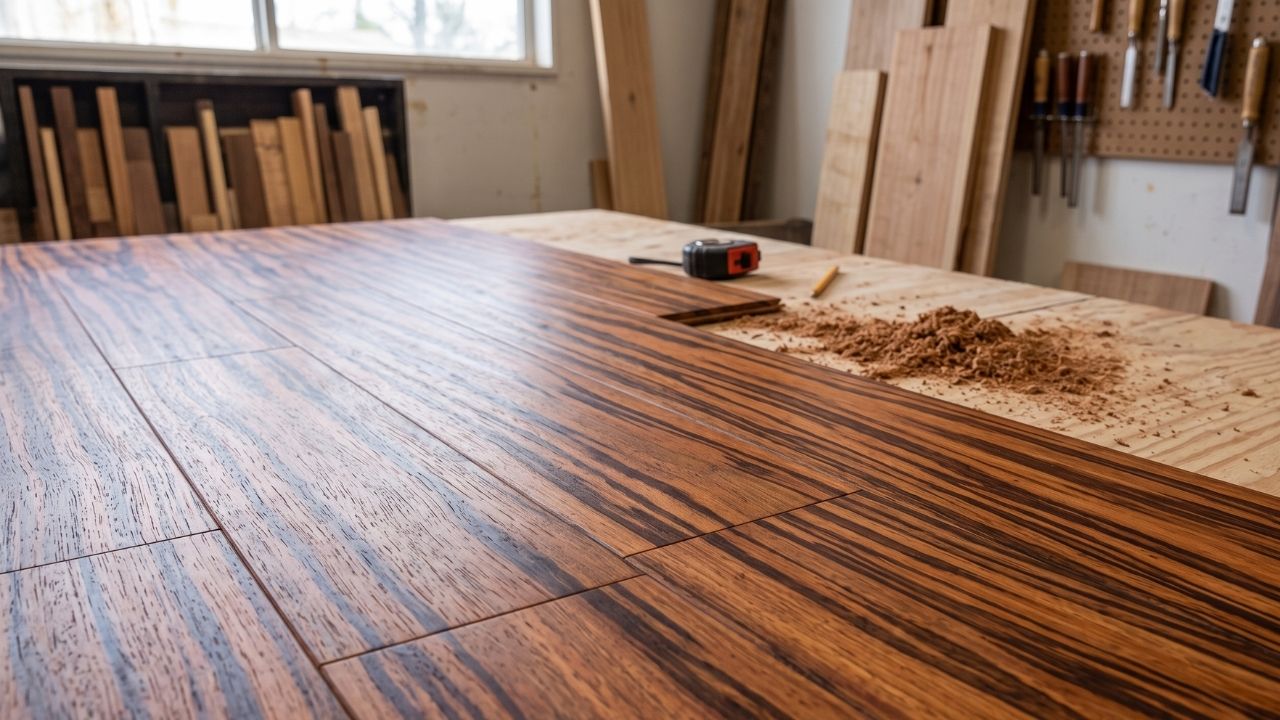
Tigerwood engineered wood flooring combines the distinctive appearance of Tigerwood hardwood with the dimensional stability of an engineered flooring construction.
Tigerwood is known for its dramatic reddish-orange to brown color and naturally occurring dark stripes. In engineered flooring, a real Tigerwood wear layer is bonded to a multi-layer core, usually made from plywood or another engineered wood material.
This construction gives homeowners the appearance of an exotic hardwood floor while providing better dimensional stability than a solid Tigerwood plank. Engineered hardwood is designed to reduce the amount of seasonal movement caused by changes in temperature and humidity, although it is still a real wood product and is not waterproof.
Tigerwood engineered flooring can be used in residential interiors, including living rooms, bedrooms, hallways, dining rooms, and other areas where a durable and distinctive hardwood floor is desired.
What Is Tigerwood Engineered Flooring?
Tigerwood engineered flooring is made from a real Tigerwood top layer attached to a stable engineered core.
The top layer provides the natural appearance of Tigerwood, while the layers underneath provide structural stability.
A typical engineered Tigerwood plank consists of:
- Tigerwood wear layer – the visible surface.
- Core layers – usually cross-layered plywood or another engineered wood material.
- Backing layer – helps balance the board and improve stability.
The grain direction of the core layers is arranged differently from one layer to another. This construction limits the amount of expansion and contraction that occurs when indoor humidity changes.
The thickness of the Tigerwood wear layer varies between products. Some current Tigerwood engineered flooring products, for example, are offered with a 3 mm wear layer.
Tigerwood Engineered Flooring Properties
| Property | Tigerwood Engineered Flooring |
|---|---|
| Surface | Real Tigerwood |
| Core | Usually plywood or engineered wood |
| Appearance | Reddish-brown with dark stripes |
| Hardness of Tigerwood | About 2,170 lbf Janka |
| Durability | High |
| Dimensional stability | Better than solid Tigerwood |
| Moisture resistance | Better stability than solid wood, but not waterproof |
| Maintenance | Moderate to low |
| Installation | Floating, glue-down, or staple-down depending on product |
| Common use | Residential and commercial interiors |
Specifications vary between manufacturers, so always check the technical specifications of the particular flooring product.
What Does Tigerwood Engineered Flooring Look Like?
The main reason people choose Tigerwood flooring is its appearance.
Tigerwood typically has a reddish-orange, reddish-brown, or golden-brown background with contrasting dark streaks. The stripes can vary considerably between individual boards.
This means that no two floors will look exactly the same.
Some boards may have strong dark striping, while others may have a more subtle pattern. The natural variation is part of the appeal of Tigerwood.
The wood can also become darker with exposure to light over time.
Why Choose Engineered Tigerwood Flooring?
There are several reasons to choose engineered Tigerwood instead of solid Tigerwood.
1. Real Tigerwood Appearance
The top surface is genuine Tigerwood, so you get the natural color and grain pattern of the species rather than a printed imitation.
This is particularly important for people who want an exotic hardwood appearance.
2. Better Dimensional Stability
Engineered flooring generally handles changes in humidity better than solid hardwood because of its cross-layered construction.
This does not mean the floor will never expand or contract. Engineered hardwood still responds to moisture and temperature changes.
However, its construction can reduce seasonal movement compared with a solid wood plank.
3. Suitable for More Installation Conditions
Depending on the product and manufacturer’s specifications, engineered Tigerwood flooring can be installed using:
- Floating installation
- Glue-down installation
- Staple-down installation
Some current Tigerwood engineered products specifically list all three methods.
The correct method depends on the construction of the flooring and the subfloor.
4. Good Wear Resistance
Tigerwood is a hard tropical hardwood, with a commonly reported Janka hardness of around 2,170 lbf.
This makes the Tigerwood surface resistant to many everyday dents and impacts.
However, hardness does not make the floor scratch-proof. Sand, dirt, furniture movement, and sharp objects can still damage the finish.
5. Unique Appearance
Compared with common oak, maple, or pine flooring, Tigerwood provides a much more distinctive appearance.
Its dark natural stripes can create a strong visual pattern across an entire room.
Tigerwood Engineered Flooring vs Solid Tigerwood Flooring
The biggest difference is how the floor is constructed.
| Feature | Engineered Tigerwood | Solid Tigerwood |
|---|---|---|
| Top surface | Real Tigerwood | Solid Tigerwood throughout |
| Core | Engineered wood | Solid Tigerwood |
| Dimensional stability | Better | More affected by humidity |
| Installation options | Floating, glue, staple depending on product | Usually nail/staple or glue depending on product |
| Moisture tolerance | Better, but not waterproof | More sensitive to moisture movement |
| Refinishing | Depends on wear-layer thickness | Usually more refinishing potential |
| Installation over concrete | Often possible with appropriate product | More limited |
| Cost | Often more economical | Usually higher |
| Appearance | Real Tigerwood | Real Tigerwood |
Engineered flooring can be more dimensionally stable because its cross-layered construction restricts movement. However, the exact performance depends on the product’s construction and installation.
Advantages of Tigerwood Engineered Wood Flooring
1. Beautiful Exotic Appearance
The most obvious advantage is its appearance.
The contrasting Tigerwood grain can make the floor a major design feature in a room.
2. More Stable Than Solid Tigerwood
The engineered core helps reduce expansion and contraction caused by seasonal humidity changes.
This can make engineered Tigerwood more practical in environments where solid hardwood would experience greater dimensional movement.
3. Durable Surface
Tigerwood is naturally hard and durable.
A properly finished Tigerwood engineered floor can handle normal residential foot traffic well.
4. Multiple Installation Options
Depending on the product, engineered Tigerwood can be floated, glued, or stapled.
This provides more flexibility than some solid hardwood flooring products.
5. Real Hardwood Surface
Engineered flooring is not the same as laminate flooring.
The visible surface can be a genuine Tigerwood veneer or wear layer, giving the floor the natural appearance of real wood.
6. Good Choice for High-Traffic Areas
Tigerwood’s hardness makes it suitable for areas such as:
- Living rooms
- Hallways
- Dining rooms
- Offices
- Entryways
- Bedrooms
However, high-traffic areas still require proper cleaning and maintenance.
Disadvantages of Tigerwood Engineered Flooring
1. More Expensive Than Some Common Engineered Flooring
Tigerwood is an exotic hardwood, so Tigerwood engineered flooring can cost more than engineered flooring made from widely available species such as oak.
2. Wear Layer Thickness Matters
Not all engineered flooring has the same wear layer.
A thin decorative veneer may have limited sanding and refinishing potential, while a thicker wear layer can provide more opportunities for future refinishing.
Therefore, do not compare engineered Tigerwood flooring only by total plank thickness.
Ask the manufacturer for the actual Tigerwood wear-layer thickness.
3. Still Sensitive to Moisture
Engineered construction improves dimensional stability, but it does not make the flooring waterproof.
Standing water, leaks, excessive subfloor moisture, or prolonged humidity can still damage engineered wood flooring.
4. Color Can Change
Tigerwood naturally changes color with exposure to light.
The original reddish-orange appearance can become darker or less vibrant over time.
5. Difficult to Replace Perfectly
Because Tigerwood has naturally varied stripes and grain patterns, a replacement board may not match older boards exactly.
Is Tigerwood Engineered Flooring Waterproof?
No.
Engineered Tigerwood flooring is more dimensionally stable than solid wood flooring, but it is still a wood-based flooring product.
Moisture can still damage:
- The Tigerwood wear layer
- Core layers
- Adhesive
- Joints
- Subfloor
Engineered hardwood should therefore not be treated like waterproof vinyl flooring.
Clean spills quickly and address plumbing leaks or moisture problems as soon as possible.
Can Tigerwood Engineered Flooring Be Installed Over Concrete?
Yes, many engineered Tigerwood products can be installed over concrete, but the specific flooring must be approved for that installation method.
Engineered hardwood is often preferred over solid hardwood for concrete because its construction provides greater dimensional stability. Depending on the product, installation may involve floating or glue-down installation.
The concrete subfloor must be:
- Clean
- Flat
- Structurally sound
- Dry enough for the flooring system
- Properly tested for moisture
A moisture barrier or moisture-mitigation system may also be required depending on the installation method and manufacturer.
Tigerwood Engineered Flooring Maintenance
Tigerwood flooring does not require complicated maintenance.
Regular Cleaning
Sweep or vacuum regularly to remove dirt and sand.
Abrasive particles can gradually wear down the finish.
Clean Spills Quickly
Do not allow water or other liquids to remain on the floor.
Use a cleaning product recommended for the flooring’s finish.
Protect the Floor From Furniture
Use felt pads under furniture legs.
Avoid dragging heavy furniture across the surface.
Use Mats
Place mats near exterior entrances to reduce the amount of dirt and moisture brought onto the floor.
Avoid Excessive Water
Do not use excessive amounts of water when cleaning engineered wood flooring.
How Long Does Tigerwood Engineered Flooring Last?
There is no single lifespan that applies to every Tigerwood engineered floor.
Service life depends on:
- Wear-layer thickness
- Manufacturing quality
- Finish
- Installation
- Foot traffic
- Cleaning
- Indoor humidity
- Maintenance
A thicker real-wood wear layer generally provides more potential for future refinishing than a very thin veneer.
Always check the manufacturer’s warranty and refinishing recommendations before purchasing.
Can Tigerwood Engineered Flooring Be Refinished?
Sometimes.
Whether an engineered Tigerwood floor can be sanded and refinished depends primarily on the thickness of its real-wood wear layer.
A thicker wear layer provides more material that can potentially be sanded, while a thin veneer may not be suitable for conventional refinishing.
Some engineered Tigerwood products are manufactured with wear layers around 3 mm, but specifications vary.
Before refinishing, check:
- Wear-layer thickness
- Manufacturer’s instructions
- Existing finish
- Amount of previous sanding
- Condition of the floor
Do not assume that every engineered floor can be refinished.
Tigerwood Engineered Flooring Cost
The cost of Tigerwood engineered flooring varies considerably.
Factors affecting the price include:
- Wear-layer thickness
- Total plank thickness
- Board width
- Grade
- Finish
- Core construction
- Brand
- Installation method
- Location
- Shipping
Exotic hardwood flooring generally costs more than common engineered species.
When comparing products, look at the total installed cost, not just the price per square foot.
Installation, underlayment, adhesive, subfloor preparation, trim, and delivery can all add to the final project cost.
What to Look for When Buying Tigerwood Engineered Flooring
Before buying, don’t focus only on the color and price.
Check the following specifications.
1. Wear-Layer Thickness
Ask how thick the actual Tigerwood wear layer is.
This is one of the most important specifications because it affects long-term durability and potential refinishing.
2. Core Construction
Look for information about the core.
Plywood-based engineered flooring is common, but products can differ significantly in construction and quality.
3. Total Thickness
Total plank thickness is useful, but it should not be confused with wear-layer thickness.
A thicker board does not automatically mean a thicker Tigerwood surface.
4. Finish
Check whether the floor is:
- Prefinished
- Unfinished
- Matte
- Satin
- Gloss
Prefinished flooring can reduce the amount of finishing work required after installation.
5. Installation Method
Confirm whether the product supports:
- Floating
- Glue-down
- Staple-down
Do not assume that every engineered Tigerwood floor supports all three.
6. Warranty
Read the manufacturer’s residential and commercial warranty carefully.
Check what is covered and what conditions can void the warranty.
7. Moisture Requirements
Ask for the manufacturer’s moisture requirements for both the flooring and subfloor.
This is especially important when installing over concrete.
Tigerwood Engineered Flooring vs Oak Engineered Flooring
Oak is one of the most common engineered flooring species, while Tigerwood is selected mainly for its exotic appearance.
| Feature | Tigerwood | Oak |
|---|---|---|
| Appearance | Bold striped pattern | More traditional grain |
| Hardness | High | Moderate to high |
| Color | Reddish/orange-brown | Light to medium brown |
| Availability | More limited | Widely available |
| Price | Usually higher | More options across price ranges |
| Design style | Dramatic/exotic | Traditional/modern |
| Maintenance | Similar | Similar |
If you want a floor that stands out visually, Tigerwood has a major advantage.
If you want easier sourcing and more choices in grades, widths, and finishes, oak is usually easier to find.
Is Tigerwood Engineered Flooring Worth It?
Tigerwood engineered flooring can be worth the investment if you want the distinctive appearance of Tigerwood combined with the greater dimensional stability of engineered construction.
It is particularly attractive for homeowners who want:
- Real exotic hardwood
- A distinctive striped appearance
- Good wear resistance
- Better stability than solid Tigerwood
- Multiple installation options
It may not be the best choice if your priority is the lowest possible flooring cost or a completely waterproof floor.
Frequently Asked Questions
Is Tigerwood good for engineered flooring?
Yes. Tigerwood is a hard and durable hardwood, making it suitable as the wear layer for engineered flooring. Its distinctive color and dark striping also make it visually appealing.
Is Tigerwood engineered flooring real wood?
Yes. The visible Tigerwood layer is real wood. The rest of the plank consists of engineered core and backing layers.
Is Tigerwood engineered flooring better than solid Tigerwood?
Neither is universally better. Engineered Tigerwood is generally more dimensionally stable, while solid Tigerwood contains the same wood throughout the entire plank and may offer greater refinishing potential depending on its thickness.
Can Tigerwood engineered flooring go in a basement?
It can be possible with a suitable product and installation system, but basement installations require careful moisture control. Engineered flooring is more suitable for some below-grade applications than solid hardwood, but it is still not waterproof.
Does Tigerwood engineered flooring scratch easily?
Tigerwood is a hard wood, so it has good resistance to dents and wear. However, the finish can still scratch from sand, dirt, furniture, pets, or sharp objects.
Does Tigerwood engineered flooring fade?
It can change color with exposure to sunlight. The original reddish-orange and brown tones can become darker or less vibrant over time.
Can you put Tigerwood engineered flooring over radiant heat?
Some engineered wood flooring products are compatible with radiant heating, but this is product-specific. Check the manufacturer’s installation instructions before installation.
Does Tigerwood engineered flooring need an underlayment?
It depends on the installation system. Floating floors generally require an appropriate underlayment, while glue-down installations use an approved adhesive system. Always follow the manufacturer’s specifications.
How do you clean Tigerwood engineered flooring?
Regularly sweep or vacuum the floor and clean it using a product recommended for the flooring’s finish. Avoid excessive water and standing moisture.
Final Thoughts
Tigerwood engineered wood flooring is a good option for homeowners who want the distinctive appearance of Tigerwood with the dimensional stability of engineered hardwood construction.
The real Tigerwood surface provides its characteristic reddish-brown color and dark natural stripes, while the engineered core helps reduce seasonal movement compared with solid hardwood.
Its biggest advantages are appearance, hardness, durability, and dimensional stability. Its main limitations are cost, sensitivity to moisture, possible color changes, and the need to carefully consider the wear-layer thickness before buying.
If you’re comparing Tigerwood flooring products, don’t choose based on appearance alone. Check the wear-layer thickness, core construction, total thickness, finish, installation method, moisture requirements, warranty, and manufacturer specifications.
For many homeowners, a well-made Tigerwood engineered floor offers a practical way to bring the distinctive appearance of an exotic hardwood into the home while gaining some of the stability advantages of engineered flooring.