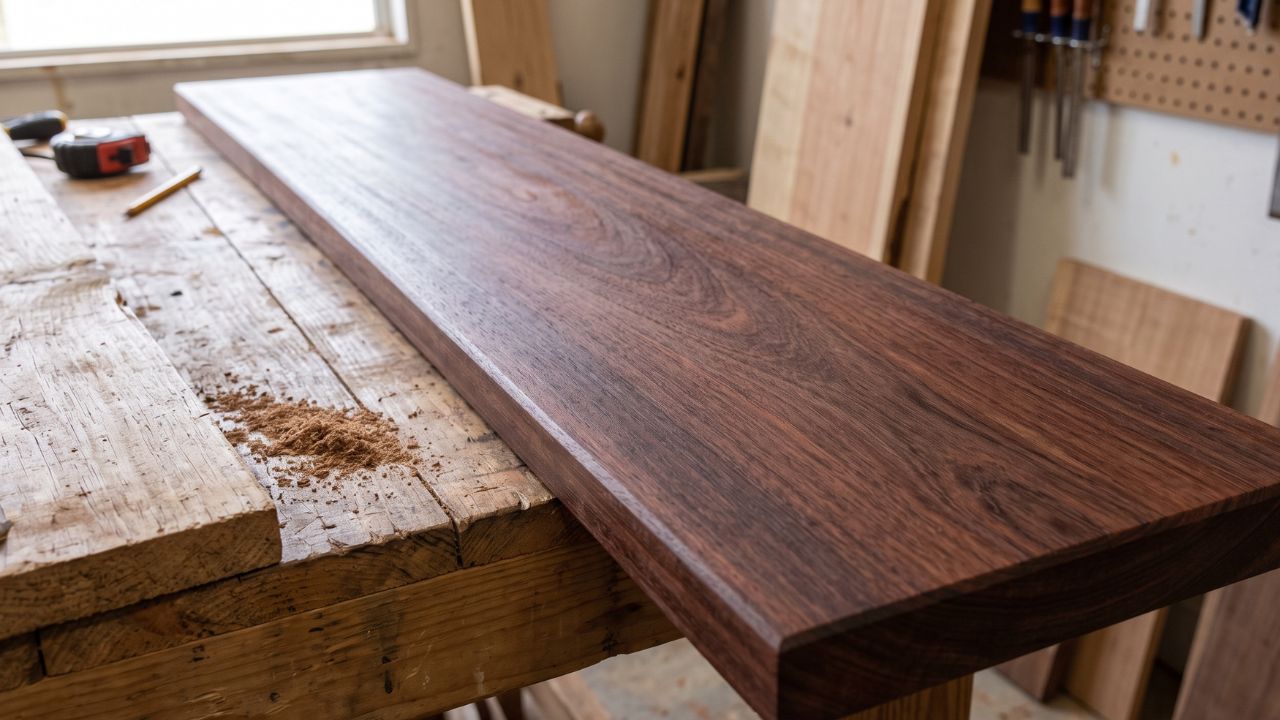
Massaranduba wood is a dense and durable tropical hardwood from South America. It is known for its high hardness, strength, attractive reddish-brown color, and excellent resistance to decay and insects.
The name Massaranduba generally refers to timber from the Manilkara genus, particularly Manilkara bidentata. It is also known by names such as Brazilian redwood, Bulletwood, Balata, and Paraju.
Because of its combination of strength and durability, Massaranduba is used for construction, furniture, flooring, decking, marine work, bridges, and other demanding applications.
However, its extreme density also creates some challenges. It can be difficult to dry and machine, and pre-drilling is generally recommended when using screws or nails.
Massaranduba Wood Properties
| Property | Massaranduba Wood |
|---|---|
| Scientific name | Manilkara bidentata and related Manilkara species |
| Wood type | Hardwood |
| Origin | Central and South America |
| Color | Reddish-brown to dark red-brown |
| Grain | Usually straight, sometimes interlocked |
| Texture | Fine and uniform |
| Density | Approximately 900–1,100 kg/m³ at around 12% moisture content |
| Janka hardness | About 3,100–3,300 lbf |
| Durability | Very durable |
| Insect resistance | Good resistance to many insects |
| Workability | Difficult to moderate |
| Drying | Slow and prone to checking and warping |
| Common uses | Construction, furniture, flooring, decking, marine work, heavy timber |
Published values vary depending on species, origin, moisture content, and testing method. For example, technical sources report densities around 1,000–1,060 kg/m³ and Janka hardness around 3,190 lbf.
Appearance of Massaranduba Wood
Massaranduba is popular partly because of its attractive natural appearance.
Freshly cut heartwood is generally light red to rose-red and gradually becomes dark reddish-brown or deeper brown when exposed to air and light. The sapwood is usually much lighter than the heartwood.
The grain is generally straight but can sometimes be slightly wavy or interlocked. Its texture is fine and relatively uniform.
The natural color can be maintained with an appropriate exterior finish, while unfinished outdoor wood will gradually develop a more grayish appearance as it weathers.
Massaranduba Wood Uses
Massaranduba is suitable for applications that require high hardness, strength, and durability.
1. Construction
Its strength and durability make Massaranduba useful for heavy construction and structural applications.
It has been used for:
- Heavy timber
- Beams
- Posts
- Bridges
- Structural components
- Stairs
- Heavy-duty carpentry
Its high density makes it particularly suitable for applications where resistance to wear and impact is important.
2. Furniture
Massaranduba can be used to make durable indoor and outdoor furniture.
Its rich reddish-brown color and fine texture can produce an attractive finished surface, although its high hardness means that machining can require sharp tools and appropriate techniques.
3. Flooring
Massaranduba is suitable for flooring because of its high hardness and resistance to wear.
Its hardness can help it withstand heavy foot traffic and everyday impacts. However, because flooring is a specialized application, the appropriate moisture content, milling quality, installation method, and finish should be considered.
A separate guide can cover Massaranduba wood flooring in more detail.
4. Decking
Massaranduba is widely used for exterior decking because of its high density and natural durability.
It can perform well in demanding outdoor conditions when properly installed and maintained. Because of its hardness, however, installation generally requires suitable fasteners and pre-drilling.
A separate article can cover Massaranduba wood decking in detail, including installation, spacing, maintenance, and comparison with other decking species.
5. Marine and Water-Related Construction
Massaranduba has also been used for marine and freshwater construction, bridges, jetties, and other applications where durable timber is required.
Its natural durability makes it suitable for demanding environments, although the exact suitability depends on the exposure and the specific product.
6. Decorative and Specialty Woodworking
The attractive color and fine texture make Massaranduba suitable for:
- Millwork
- Turned objects
- Tool handles
- Decorative components
- Musical instruments
- Interior woodwork
Advantages of Massaranduba Wood
1. Very Durable
One of the biggest advantages of Massaranduba is its natural durability.
Its heartwood is rated Class 1 for durability in several technical references, indicating very high resistance to decay under the relevant testing/classification systems.
2. Extremely Hard
Massaranduba has a Janka hardness of roughly 3,100–3,300 lbf, depending on the reference and material tested.
This makes it significantly harder than many common domestic hardwoods and softwoods.
Its hardness makes it resistant to dents, abrasion, and general surface wear.
3. Good Resistance to Insects
Massaranduba heartwood has good resistance to many insect attacks and is classified as durable against termites in some European durability classifications.
However, resistance can vary between heartwood and sapwood, so the two should not be treated as identical.
4. Strong and Heavy
Massaranduba combines high density with strong mechanical properties.
This makes it useful for heavy construction and applications where the wood must withstand significant loads and wear.
5. Attractive Color
Its reddish-brown heartwood gives Massaranduba a distinctive appearance without requiring a dark stain.
The color generally becomes darker and more weathered over time.
6. Good Wear Resistance
Because Massaranduba is extremely hard and dense, it performs well in applications exposed to frequent foot traffic, impact, and abrasion.
This is one reason it is used for both interior and exterior high-wear applications.
Disadvantages of Massaranduba Wood
1. Difficult to Dry
Drying is one of the biggest challenges with Massaranduba.
The wood dries slowly and can develop checking, warping, and other defects if drying is too rapid or poorly controlled. Proper kiln or air-drying practices are important.
2. Difficult to Machine
Massaranduba’s high density and hardness can make it harder to cut and machine than ordinary wood species.
It can also dull cutting tools more quickly, so sharp, high-quality tools are recommended.
3. Pre-Drilling Is Recommended
Because the wood is so hard, screws and nails can be difficult to drive directly into the material.
Pre-drilling is generally recommended when fastening Massaranduba.
4. Heavy Weight
Its high density is an advantage for strength and durability but a disadvantage during transportation and installation.
Large Massaranduba boards can be significantly heavier than common softwoods.
5. Gluing Can Be Difficult
The density and characteristics of Massaranduba can make gluing more challenging than with less dense woods.
Special attention to surface preparation and adhesive selection may be necessary.
6. Limited Stability During Drying
Although properly seasoned Massaranduba can perform well, the wood can experience movement and checking during drying.
Good-quality, properly dried lumber is therefore important for demanding projects.
Is Massaranduba Good for Outdoor Use?
Yes. Massaranduba is well suited to many outdoor applications because of its high density and natural durability.
It is commonly used for outdoor structures, decking, heavy construction, bridges, and other demanding applications. Technical references classify its heartwood as very durable.
However, outdoor performance still depends on proper installation and exposure conditions. Good drainage, appropriate fasteners, and correct installation are important.
Is Massaranduba Waterproof?
No wood should automatically be considered completely waterproof.
Massaranduba has excellent natural durability and performs well in moisture-prone environments, but it can still absorb moisture and experience dimensional movement.
Proper installation and maintenance are important when the wood is exposed to repeated wetting and drying.
Is Massaranduba Harder Than Ipe?
Massaranduba is extremely hard, but Ipe is generally harder based on commonly reported Janka hardness values.
Massaranduba is often reported around 3,190 lbf, while Ipe is commonly reported around 3,500–3,700 lbf, depending on the source and material tested.
Both are very dense and durable tropical hardwoods, so the better choice depends on availability, cost, appearance, application, and sourcing requirements.
Massaranduba vs Cumaru
Massaranduba and Cumaru are both dense tropical hardwoods commonly considered for demanding applications.
| Feature | Massaranduba | Cumaru |
|---|---|---|
| Hardness | Very high | Very high |
| Durability | Very high | Very high |
| Color | Reddish-brown | Brown to reddish-brown |
| Weight | Very heavy | Very heavy |
| Workability | Difficult | Difficult |
| Outdoor use | Excellent | Excellent |
| Common uses | Construction, decking, flooring, marine work | Decking, flooring, furniture, construction |
Both can be excellent choices for demanding applications. The final choice often comes down to price, availability, appearance, and project requirements.
How to Maintain Massaranduba Wood
Maintenance depends on where the wood is installed.
For outdoor applications:
- Keep the surface clean.
- Remove leaves, dirt, and standing water.
- Inspect boards periodically for cracks or damage.
- Use a suitable finish if you want to preserve the original reddish-brown color.
- Allow the wood to weather naturally if a silver-gray appearance is acceptable.
- Use appropriate fasteners to reduce installation and corrosion problems.
For indoor applications, regular cleaning and an appropriate wood finish are usually sufficient.
Is Massaranduba Wood Expensive?
Massaranduba is generally more expensive than common softwoods because it is a dense tropical hardwood that can be more difficult to process and transport.
However, its price varies significantly depending on:
- Lumber grade
- Board dimensions
- Origin
- Availability
- Certification
- Supplier
- Local market
- Current demand
Therefore, there is no single price that applies to all Massaranduba lumber.
Is Massaranduba Sustainable?
Sustainability depends on the source of the wood and how it was harvested.
When purchasing Massaranduba, look for responsible sourcing and, where appropriate, certification such as FSC. Certification can provide additional information about the forest management and chain of custody of the particular product.
Do not assume that every piece of Massaranduba has the same environmental credentials simply because it belongs to the same species.
Frequently Asked Questions
What is Massaranduba wood?
Massaranduba is a dense tropical hardwood commonly associated with Manilkara bidentata and related Manilkara species. It is known for its reddish-brown color, high hardness, strength, and natural durability.
What is Massaranduba wood also called?
Massaranduba is also known by names including Brazilian redwood, Bulletwood, Balata, and Paraju. Common names can vary by region and may refer to different species, so checking the scientific name is useful when purchasing lumber.
Is Massaranduba a hardwood?
Yes. Massaranduba is a very dense tropical hardwood.
Is Massaranduba rot resistant?
Yes. The heartwood is considered very durable and has strong resistance to decay. Several technical references classify it as Class 1 for natural durability.
Is Massaranduba termite resistant?
Massaranduba has good resistance to many insects, and some European classifications rate it as durable against termites. However, performance can vary between heartwood and sapwood and according to environmental conditions.
Is Massaranduba good for furniture?
Yes. Its strength, durability, and attractive reddish-brown appearance make it suitable for many furniture applications. Its high density can make machining more difficult than with softer woods.
Is Massaranduba easy to work with?
Not particularly. Its high density and hardness can make cutting and machining more demanding. Sharp tools and pre-drilling are recommended for many applications.
Does Massaranduba change color?
Yes. Fresh Massaranduba is generally reddish or rose-red and becomes darker brown or reddish-brown with exposure. Outdoor weathering can eventually produce a grayish appearance.
Is Massaranduba better than Ipe?
Not necessarily. Both are extremely durable tropical hardwoods. Ipe is generally harder, while Massaranduba can provide an attractive combination of durability, strength, and value. The better option depends on the project and available products.
Final Thoughts
Massaranduba is a very hard, dense, strong, and durable tropical hardwood that can handle demanding applications. Its reddish-brown appearance also makes it attractive for both decorative and functional projects.
Its biggest advantages are durability, hardness, strength, insect resistance, and wear resistance. Its main disadvantages are its heavy weight, difficult drying, demanding machining, and need for pre-drilling during installation.
Massaranduba can be an excellent choice when you need a durable hardwood for construction, furniture, outdoor projects, or other high-wear applications. However, always select properly dried, appropriately graded lumber and consider the specific requirements of your project before purchasing.