
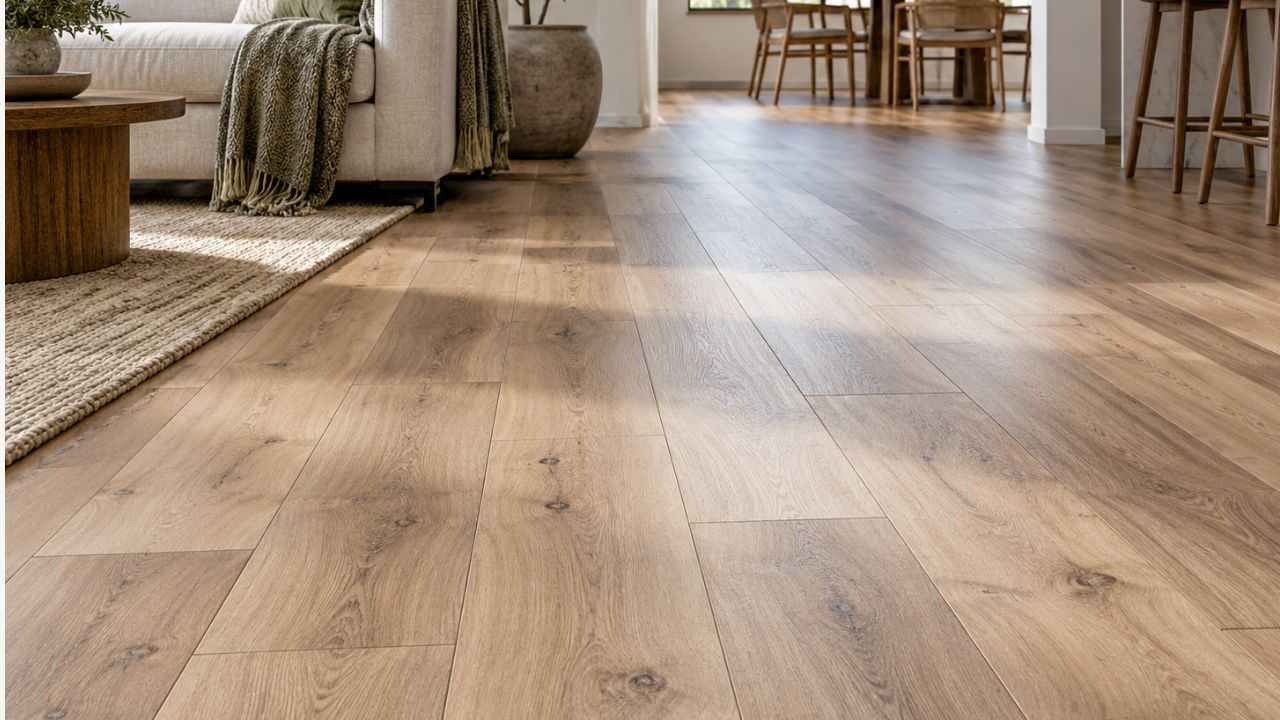
Standard laminate flooring is not waterproof. Some newer products offer waterproof protection against everyday spills, splashes, and wet cleaning, but that protection depends on the exact product and its installation. A waterproof label does not automatically mean the floor can survive flooding or moisture coming from underneath.
The difference matters when choosing flooring for a kitchen, bathroom, laundry room, or basement. Before buying, check what the manufacturer covers, where the product can be installed, and how its edges and joints must be finished.
Why Can Water Damage Laminate Flooring?
Most conventional laminate flooring has four main layers:
- Wear layer: Protects against everyday surface wear.
- Decorative layer: Provides the printed wood or stone appearance.
- Core: Usually a wood-fiber board that gives the plank its thickness and structure.
- Backing layer: Helps balance and support the construction.
The surface can resist spills while the core remains vulnerable to moisture. Water that enters through joints, cut edges, or damaged areas can cause the core to swell.
Some newer products use improved core materials, water-repellent edge treatments, and tightly fitting joints to reduce that risk. However, their performance must be assessed as a complete installed floor.
The North American Laminate Flooring Association explains how enhanced cores and joint protection contribute to water performance in its laminate flooring water-performance guide.
Waterproof vs Water-Resistant Laminate Flooring
These labels are useful starting points, but the product documentation provides the details that matter.
| Feature | Standard Laminate | Water-Resistant Laminate | Laminate Marketed as Waterproof |
|---|---|---|---|
| Everyday spills | Requires prompt cleanup | Designed for improved spill resistance | Designed for specified household water exposure |
| Joint protection | Varies | May include treated edges or improved joints | Usually relies on a combination of surface, joint, and core technology |
| Standing water | Avoid | Protection may have time limits | Coverage depends on the warranty |
| Moisture from below | Requires separate control | Requires separate control | Do not assume it is covered |
| Bathroom suitability | Do not assume suitability | Check the specific product | Check room approval and installation requirements |
| Flood protection | Do not assume coverage | Do not assume coverage | Do not assume coverage |
Water resistance is product-specific. Two floors sold under similar descriptions may have different installation requirements and exclusions.
What Does “Waterproof Laminate” Actually Mean?
For many products, waterproof protection refers primarily to water reaching the floor from above during normal household use.
Examples may include spilled drinks, muddy footprints, pet accidents, or permitted wet cleaning. The manufacturer may require special treatment around the room perimeter, pipes, thresholds, or other vulnerable areas.
Some systems also include specific subfloor protection. Others cover only damage to the flooring itself.
Before purchasing, read the documents for the exact collection and product code. A waterproof claim for one range does not apply automatically to every laminate sold by the same brand.
Does a 24-, 48-, or 72-Hour Claim Mean You Can Leave Water on the Floor?
No. A stated exposure period describes a particular test or coverage condition. It is not a recommended cleanup schedule.
Remove spills promptly even when the floor offers extended water protection. Liquid may reach unprotected areas, surrounding cabinetry, or adjoining surfaces.
Is Laminate Flooring Waterproof Enough for a Kitchen?
A suitably rated laminate can work well in a kitchen. Occasional splashes and small spills are different from an unnoticed dishwasher leak or water collecting beneath a refrigerator.
For a kitchen installation:
- Choose a product approved for that room.
- Follow the required edge and perimeter sealing instructions.
- Wipe up spills promptly.
- Inspect appliance connections and nearby joints.
- Avoid leaving damp mats against the floor.
Select the product for the exposure you expect, and check how its warranty treats appliance or plumbing leaks.
Can You Use Laminate Flooring in a Bathroom?
Yes, some laminate products are approved for bathrooms, but ordinary laminate should not be assumed suitable.
A bathroom installation may require a specified flexible sealant and compressible foam strip around expansion spaces. These details help keep surface water from reaching vulnerable edges while allowing the floating floor to move.
For example, Quick-Step’s UK bathroom guidance specifies its Hydrokit and foam strip for water-resistant finishing. Those instructions apply to the relevant products and market, rather than every laminate floor.
Bathroom approval does not automatically include shower floors, steam rooms, or continuously wet areas. The flooring also does not replace any separate waterproofing required for the room.
Is Waterproof Laminate Suitable for Basements?
It may be suitable if the manufacturer permits below-grade installation and the basement meets its moisture requirements.
The main concern is often moisture from the concrete or surrounding ground. A surface designed to resist spilled water does not solve a damp-subfloor problem.
Before installation, check:
- Whether the product is approved for basements.
- The required subfloor moisture tests and limits.
- Whether a separate vapor barrier is needed.
- The approved underlayment.
- Whether leaks or persistent dampness need correcting first.
An attached cushion is not automatically a vapor barrier. Follow the instructions for the complete installation.
What Happens When Laminate Flooring Gets Wet?
A small spill removed promptly may leave no damage. If water reaches a moisture-sensitive core, possible signs include:
- Raised or swollen plank edges.
- Bubbling or separation of surface layers.
- Distorted joints.
- Discoloration.
- Persistent dampness beneath the flooring.
Raised joints do not always prove water damage; installation problems can also cause movement. Identify the cause before deciding on a repair.
Will Swollen Laminate Return to Normal?
A swollen wood-fiber core often does not return fully to its original shape after drying. Drying removes moisture, but it may not reverse permanent deformation.
Unlike solid hardwood, conventional laminate cannot be sanded down and refinished to remove this damage. Affected planks may need replacement.
What Should You Do After a Spill or Leak?
1. Stop the Water Source
For an appliance or plumbing leak, address the source before focusing on the flooring.
2. Remove Surface Water Promptly
Use absorbent towels or suitable water-removal equipment. Pay attention to joints, edges, and areas beneath movable items.
3. Check Whether Water Reached Underneath
A dry-looking surface does not confirm that the underlayment or subfloor is dry. For a substantial leak, have the affected layers assessed.
4. Dry the Area Appropriately
Ventilation and dehumidification may help with clean-water incidents. Avoid using concentrated heat to force swollen edges flat.
If water is contaminated or the affected area is extensive, arrange professional assessment.
5. Document Damage Before Repairs
Take photographs and retain the product details and purchase records. Contact the retailer or manufacturer if a warranty claim may apply.
Can You Make Existing Laminate Flooring Waterproof?
Generally, you cannot turn ordinary laminate into a manufacturer-rated waterproof floor by applying a coating over it.
Adding polyurethane, wax, or a generic sealer may change the appearance, interfere with joints, or conflict with the warranty. The factory surface may also prevent proper adhesion.
Use joint or perimeter sealants only where the manufacturer specifies them. Do not fill every expansion gap with a rigid material or glue a floating floor in place.
If your existing floor is unsuitable for the room’s water exposure, replacement with an appropriate product is more dependable than an unapproved coating.
How to Clean Laminate Without Water Damage
- Remove grit with a dry mop or a suitable vacuum attachment.
- Use the recommended cleaner and a lightly damp mop.
- Avoid flooding the surface during cleaning.
- Dry visible moisture promptly.
- Keep wet mats and towels from sitting on the floor.
- Use steam cleaning only when expressly permitted for that exact product.
“Waterproof” does not mean every cleaning method is acceptable. Follow the care instructions even when the floor has strong spill protection.
What to Check Before Buying Waterproof Laminate
Ask the retailer for the installation instructions and water warranty before purchasing. Confirm:
| Question | Why It Matters |
|---|---|
| Is this exact product approved for my room? | Bathroom, basement, and laundry-room permissions can differ. |
| What water exposure is covered? | Everyday spills may be treated differently from leaks or flooding. |
| Are there cleanup time limits? | Coverage may depend on how long liquid remains. |
| What sealing accessories are required? | Protection may rely on specific installation details. |
| Does the warranty cover the subfloor? | Flooring coverage and subfloor coverage are different. |
| What moisture control is required below it? | Surface protection does not eliminate subfloor requirements. |
| Are labor and replacement costs included? | A product warranty may cover less than the full repair bill. |
Frequently Asked Questions
Is All Laminate Flooring Water-Resistant?
Many laminate surfaces resist brief spills, but the level of protection varies. Do not assume an unidentified or older floor has enhanced water resistance.
Can Waterproof Laminate Survive a Flood?
Do not assume so. Flooding can expose the underside, perimeter, and surrounding building materials to water beyond the product’s intended conditions. Check the exact warranty and assess all affected layers.
Can You Mop Waterproof Laminate?
Usually, an approved damp-cleaning method is permitted. Some products allow additional methods, but these must be confirmed in the care instructions.
Does Waterproof Underlayment Protect Ordinary Laminate From Spills?
Underlayment does not stop spilled water from entering the plank joints or reaching the core. Its moisture-control role depends on its design and installation.
Is Waterproof Laminate Worth Buying?
It can be worthwhile when you want laminate’s appearance with better protection against household spills. Choose based on documented performance and room suitability, then install and maintain it as specified.