
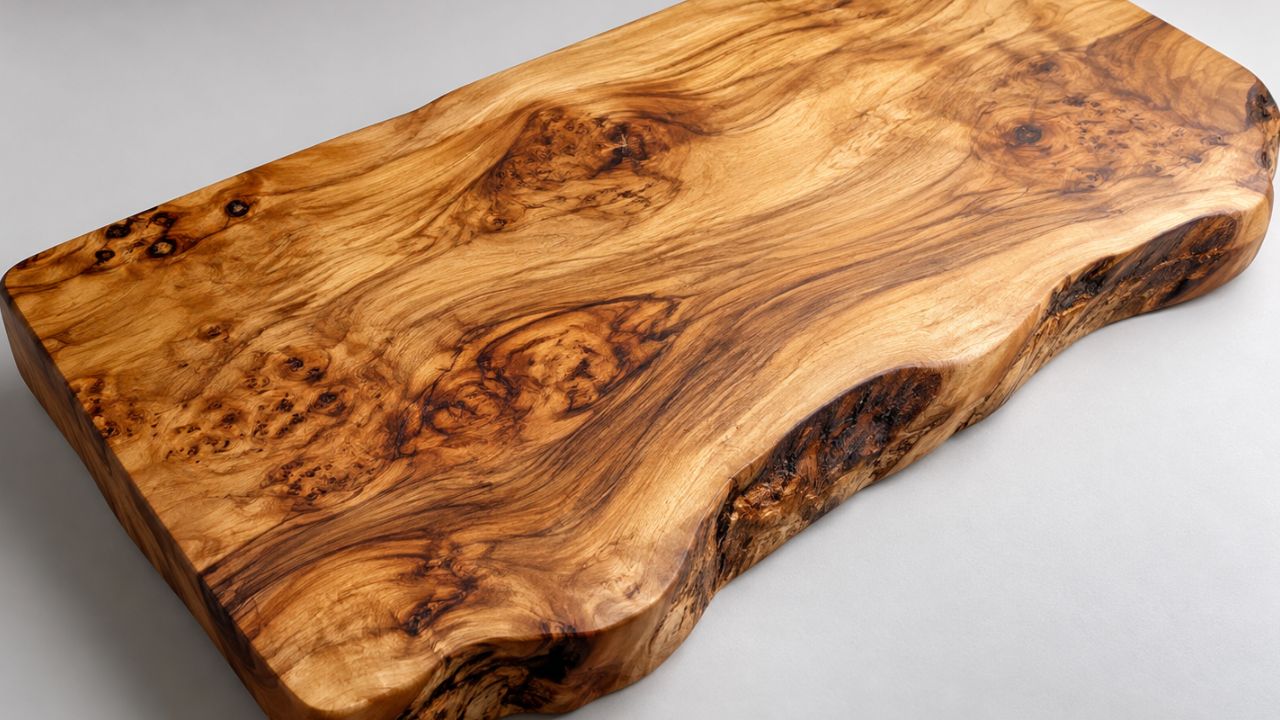
Myrtlewood can be expensive, especially when it has striking grain, unusual color, or burl figure. However, ordinary lumber can be considerably more affordable. It is a regional specialty wood, and finding a particular size or grain pattern can be difficult, but describing all myrtlewood as extremely rare is misleading.
A plain board and a highly figured guitar set may come from the same species, yet their prices can be very different. To judge whether myrtlewood is worth buying, look at the actual piece, its condition, and how much usable material it provides.
What Is Myrtlewood?
Myrtlewood is the wood of Umbellularia californica, a broadleaf evergreen tree also called Oregon myrtle or California bay laurel.
Its colors can include cream, golden brown, gray, and olive, sometimes with darker streaks. Some boards have relatively straight grain, while others display curls, mottling, or intricate burl patterns.
These variations make it appealing for furniture, bowls, decorative boxes, knife handles, and musical instruments.
Is Myrtlewood Expensive?
Yes, premium myrtlewood can be expensive. Strongly figured boards, sound burls, and carefully matched instrument sets often command higher prices than ordinary stock.
However, there is no single price that accurately represents all myrtlewood. A small decorative blank, a bulk order of plain lumber, and a wide tabletop slab are different products.
The price usually reflects a combination of:
- Grain and color.
- Board width, thickness, and length.
- Drying and preparation.
- Defects and usable yield.
- Order quantity.
- Shipping and local availability.
For a small project, an attractive offcut may provide all the myrtlewood you need without the expense of a full slab.
How Much Does Myrtlewood Cost?
As one current example, Wood Vendors listed the following bulk lumber prices on its page dated October 8, 2026:
| Myrtlewood Product | Order Quantity | Listed Price per Board Foot |
|---|---|---|
| 4/4 Select & Better | 500–999 board feet | $8.00 |
| 4/4 Select & Better | 1,000+ board feet | $7.50 |
| 5/4 Mill Run | 500–999 board feet | $8.50 |
| 5/4 Mill Run | 1,000+ board feet | $7.75 |
These are large-order prices from one supplier, not typical small-order retail quotes or a national average. The supplier describes its Select & Better stock as having comparatively little figure and color variation. Request a delivered quote and confirm availability before budgeting. Wood Vendors’ myrtlewood prices
This example shows why a blanket claim that myrtlewood always costs $40–$50 per board foot is unreliable. Ordinary lumber and specially selected decorative pieces occupy different price categories.
Understand How the Wood Is Sold
| Product | Common Pricing Method | What to Compare |
|---|---|---|
| Ordinary lumber | Per board foot | Grade, thickness, dimensions, and drying |
| Figured boards | Per board foot or individual board | Figure, soundness, and usable area |
| Live-edge slabs | Per slab or board foot | Finished dimensions after flattening |
| Turning blanks | Per blank | Size, moisture condition, and defects |
| Instrument sets | Per matched set | Matching, grain orientation, dimensions, and preparation |
A board foot is a volume equal to 144 cubic inches. It helps compare lumber quantities, but it does not account for the extra value of unusual figure or specialized preparation.
Is Myrtlewood Rare?
Myrtlewood has a geographically limited native range, but that does not mean every tree or board is exceptionally rare.
Oregon State University describes California-laurel as growing from southwestern Oregon into California, including coastal ranges and parts of the western Sierra Nevada. Its range extends much farther south than northern California.
For a buyer, three different questions matter:
- Does the tree grow locally? Outside its native region, it may be unfamiliar.
- Does a supplier stock the lumber? A species can grow in a region without being routinely stocked by every lumberyard.
- Can you find the exact piece required? A wide, dry board with strong figure is more selective than an ordinary small blank.
The third question often explains why a particular piece carries a premium.
Why Is Some Myrtlewood So Expensive?
1. Distinctive Grain and Color
Much of myrtlewood’s appeal is visual. Curly figure, contrasting streaks, and interesting color combinations can make a piece desirable for a project where the wood will remain visible.
Buyers may pay more for a board that becomes the main feature of a tabletop, cabinet front, or instrument.
2. Large, Sound Pieces Are More Selective
Finding several small blanks is different from finding one wide slab without major defects.
Cracks, decay, and irregular edges can reduce the amount of usable material. A larger piece that accommodates a project with little waste may be worth more than its raw dimensions suggest.
3. Drying and Preparation Add Costs
Lumber must be processed and dried before it is suitable for many woodworking projects. Thick stock requires particular care.
A low-priced green slab may still need drying, flattening, and trimming. Compare it with ready-to-use stock only after accounting for that extra work and the possibility of material loss.
4. Matching Takes Selection
Furniture panels and instrument sets may require pieces that match in color or grain. Selecting those pieces adds work and limits the available choices.
Bookmatched material—adjacent cuts opened to create a mirrored pattern—can be especially attractive, but the visual result still depends on the individual wood.
5. Shipping Changes the Final Price
Large slabs can be expensive to transport. Handling, packaging, and delivery may significantly increase the purchase cost.
For smaller projects, a nearby supplier with a suitable piece may offer better value than a cheaper board shipped a long distance.
Is Myrtlewood Burl More Valuable?
Myrtlewood burl can be valuable because of its intricate grain. However, a burl is not automatically worth a high price.
Its usefulness depends on the amount of sound wood available after cutting around cracks, bark pockets, voids, and decay.
Before buying a burl, ask for:
- Clear photographs of all accessible sides.
- Dimensions of the usable section.
- Its drying or moisture condition.
- Details of repairs, fillers, or stabilization.
- Disclosure of known defects.
An impressive exterior does not always reveal how much usable wood is inside.
Is Myrtlewood Worth the Money?
Myrtlewood can be worth the extra cost when its appearance contributes directly to the finished project.
Good examples include a decorative bowl, a jewelry-box lid, a cabinet panel, or a carefully selected instrument set. In these applications, a relatively small amount of wood can have a large visual impact.
It is harder to justify a premium for concealed parts or surfaces that will be painted. Choose the material according to what the project needs, rather than paying for figure that will disappear beneath an opaque finish.
A high price also does not guarantee outdoor durability. Myrtlewood’s decorative value should not be confused with natural resistance to decay.
How to Buy Myrtlewood Without Overspending
Buy for Your Finished Dimensions
Write down the minimum dimensions needed before shopping. Allow for cutting and preparation, but avoid paying for a large slab when smaller boards will do.
Compare Usable Yield
A cheaper piece may cost more in practice if much of it must be discarded.
For example, a hypothetical $100 purchase that provides five usable board feet costs $20 per usable board foot. Another purchase costing $120 but providing eight usable board feet works out to $15 per usable board foot.
The second purchase costs more upfront but gives better material value.
Ask What the Grade Means
Terms such as “fancy,” “character,” and “premium” can vary between sellers. Ask for photographs and a description of allowed defects instead of relying on the label alone.
Use Figured Wood Selectively
Reserve the most decorative stock for visible areas. Less figured material may suit other parts of the same project.
Compare Delivered Prices
Include shipping, taxes, surfacing, and any other required preparation when comparing quotes.
Frequently Asked Questions
Is Myrtlewood One of the Most Expensive Woods?
Exceptional figured pieces can be expensive, but ordinary myrtlewood does not belong in a universal “most expensive woods” ranking. Price depends heavily on the specific product.
Does Myrtlewood Grow Only in Oregon?
No. Oregon myrtle and California bay laurel are names for the same species, which grows in both Oregon and California.
Is Myrtlewood More Expensive Than Walnut?
Sometimes, particularly when comparing highly figured myrtlewood with ordinary walnut. Either species can become expensive in selected grades, wide slabs, or unusual figure. Compare equivalent products from actual suppliers.
Is Every Myrtlewood Tree Valuable?
No. A tree’s value as lumber depends on soundness, size, grain, access, processing costs, and demand. Retail prices for finished boards cannot be applied directly to a standing tree or unprocessed log.
Is Myrtlewood the Same as Crape Myrtle?
No. Oregon myrtlewood comes from Umbellularia californica. Crape myrtles belong to Lagerstroemia, so prices and woodworking characteristics should not be treated as interchangeable.