
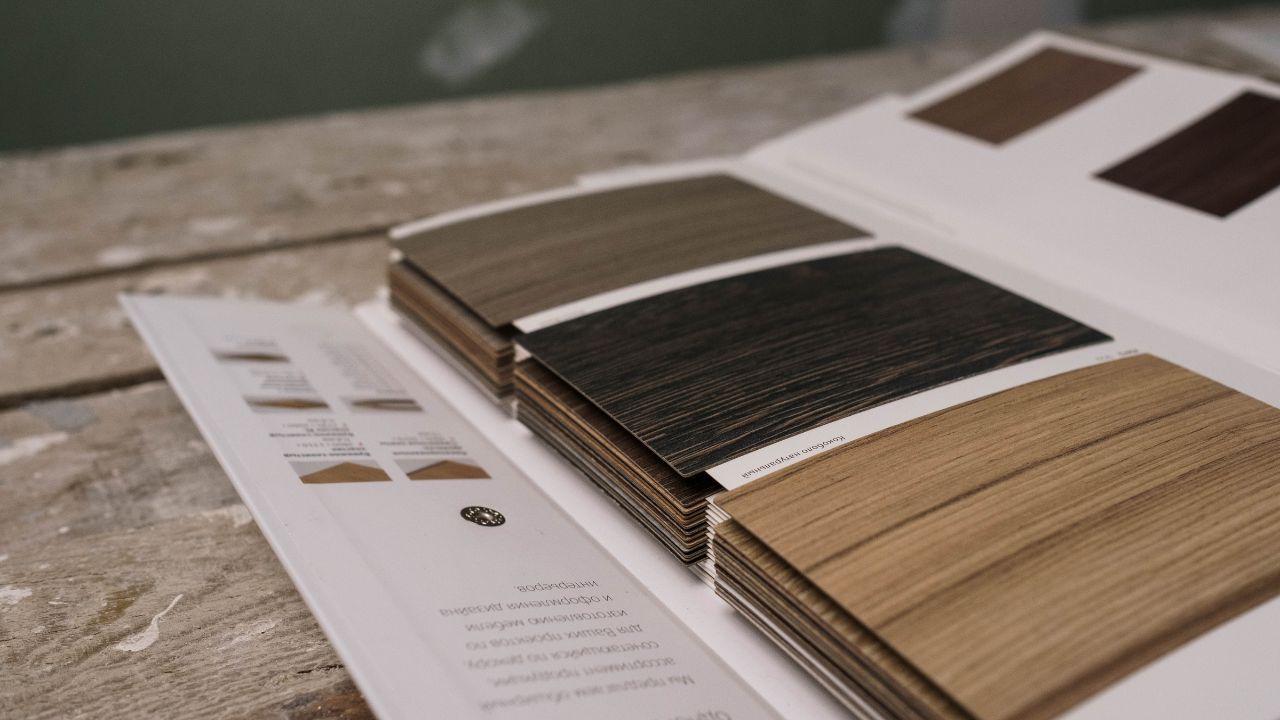
Yes, wood veneer is real wood. It is a thin layer of timber sliced, peeled, or sawn from a log and usually bonded to a supporting material such as plywood, MDF, or particleboard.
The distinction is between real wood and solid wood. A walnut-veneered tabletop has genuine walnut on its surface, but it is not necessarily made from walnut throughout its thickness.
That does not automatically make it inferior. Veneer appears in both inexpensive furniture and high-quality custom pieces. What matters is how the entire piece is constructed.
What Is Wood Veneer Made Of?
Natural wood veneer comes from the same trees used to produce solid lumber. Oak, walnut, maple, cherry, and sapele are common examples.
Manufacturers cut the timber into thin sheets, which retain the species’ natural grain, pores, and color variation. Columbia Forest Products’ veneer guide describes veneer as wood produced through rotary cutting, slicing, or sawing.
A typical veneered furniture panel contains three main elements:
- Wood face: The visible decorative layer.
- Adhesive: Bonds the veneer to its support.
- Core: Provides most of the panel’s thickness and structural support.
A protective finish may then be applied over the wood.
For example, a cabinet described as “oak veneer over MDF” has an oak surface and a manufactured fiberboard core. Both parts of that description matter when deciding whether it suits your needs.
Is Veneer the Same as Fake Wood?
Natural wood veneer is not fake wood. Its grain comes from the timber itself rather than a printed image.
However, product descriptions sometimes use “veneer” loosely. Terms such as “wood-effect veneer,” “foil finish,” or “paper veneer” may describe a decorative imitation rather than a real wood face.
Paper-backed wood veneer is different: it has genuine wood bonded to a paper backing for support. The paper is behind the wood, not a replacement for it. FormWood explains this construction in its paper-backed veneer overview.
If a listing is unclear, ask the seller: “Is the visible surface actual wood, and what is the core made from?”
Wood Veneer vs. Solid Wood vs. Laminate
These materials can look similar in photographs, but they have different constructions.
| Feature | Wood Veneer | Solid Wood | Decorative Laminate |
|---|---|---|---|
| Visible surface | Thin layer of real wood | Real wood | Usually a printed or manufactured decorative layer |
| Construction | Wood face over a supporting core | Timber through the component’s thickness | Decorative surface bonded to a core |
| Grain | Natural grain and variation | Natural grain and variation | Manufactured pattern |
| Sanding | Limited by veneer thickness | Usually allows more material removal | Cannot be sanded to reveal natural wood grain |
| Staining | Possible with suitable preparation | Possible with suitable preparation | Ordinary penetrating stain generally will not work |
| Cost | Budget to premium | Varies widely | Budget to premium |
Here, “laminate” means a manufactured decorative surface, not simply any material made by bonding layers together.
Also, solid wood does not have to mean one uninterrupted plank. A solid-wood tabletop may consist of several boards glued together along their edges.
Why Do Manufacturers Use Veneer?
To Create Attractive Large Surfaces
Veneer allows manufacturers to cover broad tabletops, cabinet doors, and wall panels with carefully selected grain.
Consecutive sheets can be arranged in matching patterns. Book matching, for example, places adjacent sheets like the facing pages of an open book, creating a mirrored effect.
This is often a deliberate design choice in premium furniture.
To Use Decorative Timber Efficiently
Thin sheets cover more surface area from a given amount of decorative timber than thick boards do.
A furniture maker can therefore use figured walnut or another desirable species on the visible surfaces while choosing a different material for the core.
To Improve Panel Stability
A properly designed veneered panel can move less with humidity changes than a wide solid-wood board.
This depends on the complete construction, including the core, adhesive, and balancing layers. Veneer itself still responds to moisture, and poorly made panels can warp.
To Manage Cost
Using a thin decorative face can reduce material costs. However, elaborate grain matching, rare veneer, and skilled workmanship can make a veneered piece expensive.
The word “veneer” alone does not tell you whether furniture is cheap or well made.
Is Veneer Furniture Good Quality?
It can be. A well-built veneered cabinet may provide better service than a poorly constructed solid-wood alternative.
Consider the parts that are easy to overlook:
Core material: Is it appropriate for the furniture’s purpose and expected exposure?
Bonding: Does the surface lie flat, without bubbles or lifting edges?
Edge protection: Are corners and panel edges neatly finished?
Joinery and hardware: Do drawers move smoothly, doors align, and joints feel secure?
Finish: Is the coating even and suitable for everyday use?
A beautiful wood face cannot compensate for weak joints or an unsuitable core.
How Can You Tell Whether Furniture Has Real Wood Veneer?
Read the Material Description
Clear wording is the most useful starting point.
“Walnut veneer over plywood” describes both the surface and the support. “Walnut finish” may only refer to color and does not confirm the presence of walnut wood.
Ask for written clarification if the listing uses vague terms.
Inspect an Exposed Edge
An unfinished edge, existing chip, or accessible opening may reveal a thin wood face over a different material.
Do not scratch or damage furniture to test it. Edge banding and solid-wood edging can also conceal the construction, so one edge is not always conclusive.
Look at the Grain
Natural veneer has real wood features, but appearance alone is unreliable. Good printed surfaces can imitate pores, and carefully matched veneer can look unusually consistent.
Repeating patterns may suggest laminate, but consecutive veneer sheets can also share similar grain.
Do Not Rely on Weight
Veneered furniture is not necessarily light. MDF and particleboard cores can make a piece quite heavy.
Likewise, some solid woods are naturally lightweight. Weight is a poor substitute for a proper material specification.
Can You Sand and Refinish Wood Veneer?
Sometimes, but the thin wood face limits what is possible.
Light preparation may be suitable when the veneer is sound and thick enough. Removing deep scratches or repeatedly sanding away old finishes can break through to the backing or core.
Before refinishing, check:
- Whether the surface is genuine wood.
- Whether the veneer is securely attached.
- How much wood remains.
- Whether the existing coating actually needs removal.
Some projects only need cleaning and a compatible maintenance coat. Others require professional repair.
Can You Stain Veneer?
Yes, bare real wood veneer can generally accept stain. The result depends on the species, preparation, and stain.
An existing clear finish can prevent penetrating stain from reaching the wood. Removing it requires care because sanding aggressively may destroy the veneer.
Always test the color and finishing process in a discreet area or on matching scrap.
Does Wood Veneer Peel Easily?
Well-bonded veneer should not peel during normal use. Lifting or bubbling may result from poor adhesion, excessive moisture, heat, impact damage, or problems in the underlying panel.
Protect edges from standing water and avoid placing hot cookware directly on the surface.
If an edge starts lifting, repair it before it catches and breaks away. Applying polish will not restore a failed glue bond.
Is Veneer Waterproof?
No. Neither a real wood face nor an ordinary furniture finish makes a panel waterproof.
Water can enter through damaged coatings, joints, and exposed edges. Some cores may swell substantially when wet, even if the decorative face initially looks intact.
For bathrooms, kitchens, and other demanding locations, choose a complete product designed for that exposure.
Should You Buy Veneer or Solid Wood?
Choose wood veneer when you want genuine wood grain, attractive matching across large panels, and construction suited to cabinets, desks, or other broad surfaces.
Choose solid wood when greater sanding allowance, substantial edge shaping, or a particular furniture design makes it the better fit.
A piece can also use both successfully—for example, solid-wood legs supporting a veneered tabletop.
The useful question is not simply whether veneer is real wood. It is whether the wood face, core, finish, and workmanship are right for the way you will use the furniture.