
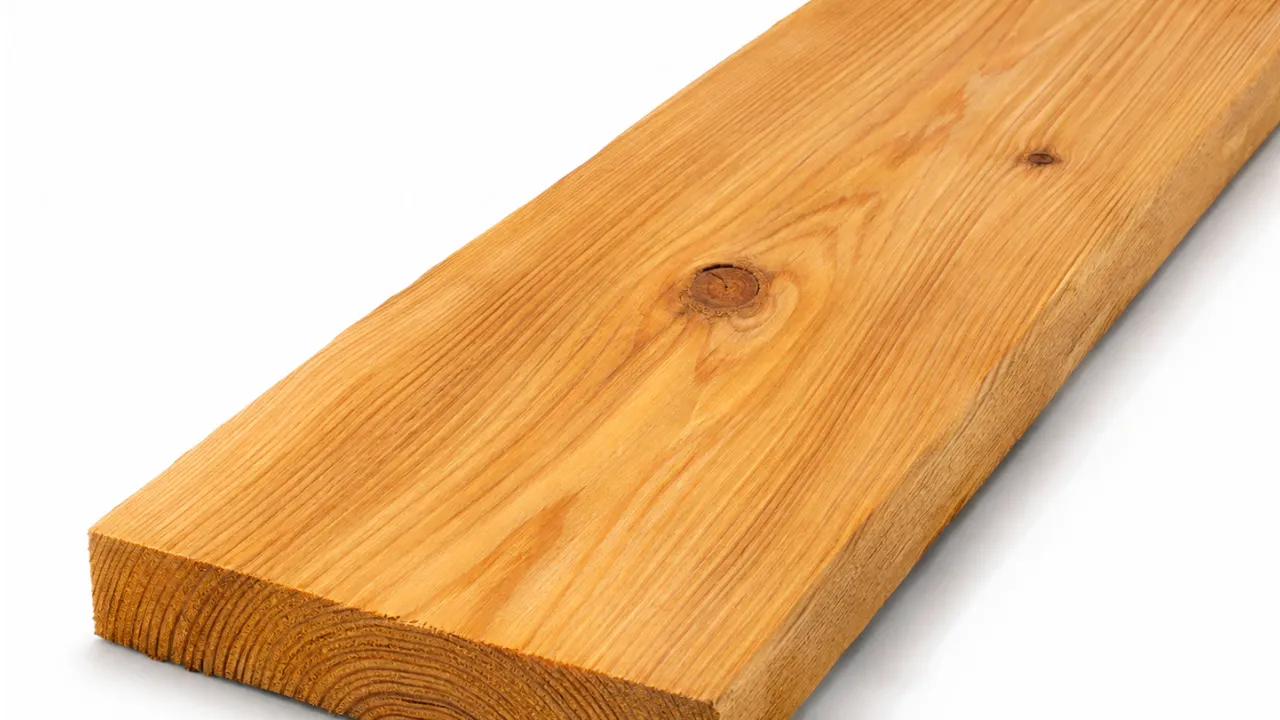
Larch wood does not always need treating. For some outdoor projects, such as properly installed cladding, suitable larch heartwood can be left untreated and allowed to weather naturally. However, treatment or a different material may be needed where the wood contains sapwood, stays damp for long periods, or comes into contact with the ground.
You may also choose to apply a finish if you want to slow the natural change in color. Untreated larch exposed to sunlight and rain will gradually weather to a silver-gray appearance.
The right choice depends on where the wood will be used, which part of the tree it comes from, and whether your goal is to prevent decay or maintain its appearance.
Is Larch Naturally Durable?
Larch heartwood has some natural resistance to fungal decay, which is one reason it is used for exterior cladding, fencing, and other outdoor projects.
However, its durability varies. A Forest Research report on larch wood describes the heartwood of the main larch species grown in Great Britain as ranging from moderately durable to slightly durable against fungi. The report also notes that durability can vary considerably between individual trees. cdn.forestresearch.gov.uk
That means larch can be a useful outdoor wood, but it is not waterproof or immune to rot. Good installation, drainage, and airflow remain important.
Heartwood vs. Sapwood: Why It Matters
When deciding whether larch needs treatment, it helps to understand the difference between heartwood and sapwood.
- Heartwood is the inner part of the tree. Larch heartwood has some natural resistance to decay.
- Sapwood is the outer part of the tree. Larch sapwood is not naturally durable and is more vulnerable to decay when exposed to moisture.
If you plan to leave larch untreated outdoors, ask your supplier how much sapwood is present and whether the timber is suitable for the intended application.
It is difficult to guarantee outdoor durability based on the name “larch” alone. Species, growing conditions, the proportion of heartwood, and the way the timber is installed all matter. cdn.forestresearch.gov.uk
Does Larch Wood Need Treating Outdoors?
Sometimes. Suitable larch heartwood can be left untreated outdoors in certain above-ground applications, especially when it is installed so that water drains away and the wood can dry.
Treatment or another material may be more appropriate when:
- The timber contains a significant amount of sapwood.
- It will be in contact with soil or standing water.
- It will stay damp or be difficult to inspect.
- The project requires a particular service life or warranty.
- The supplier or project specification requires treated wood.
For an important structural application, use timber specified for the required exposure and consult the project designer. A surface coating should not be assumed to make untreated larch suitable for every outdoor condition.
Does Larch Cladding Need Treating?
Larch cladding can be left untreated if the boards are suitable for the exposure and are installed correctly. In that case, the natural color will gradually weather to gray.
Untreated cladding relies on more than the wood itself. It should be detailed so that water can drain and the boards can dry. Important considerations include:
- Suitable heartwood content.
- An appropriate ventilation and drainage gap behind the cladding.
- Clearance from soil and splashback zones.
- Correct flashing around windows, doors, and other openings.
- Fasteners and installation details recommended for the product.
Guidance on timber construction in Scotland identifies larch heartwood as an option for untreated exterior cladding, while emphasizing that sapwood has lower natural durability. scotborders.gov.uk
If you want the boards to retain more of their original warm color, you can choose a suitable exterior finish. Be prepared to maintain that finish over time.
Does Untreated Larch Cladding Turn Gray?
Yes. When exposed to the weather, untreated larch generally changes from its original yellow, golden, or reddish-brown tones to a silver-gray or gray-brown color.
Weathering is often uneven. A sunny, exposed wall may change color differently from boards protected by a roof overhang. This variation is normal and does not necessarily mean the wood is rotting. Let’s Talk Waltham Forest
Does Larch Decking Need Treating?
Larch may be used for decking, but decking presents a more demanding environment than vertical cladding. Horizontal boards collect rain and debris, and areas around fixings or between boards can remain damp.
A suitable decking oil or exterior finish may help manage the appearance and reduce surface water absorption. However, it does not guarantee protection against rot, particularly where water is trapped.
For larch decking:
- Choose boards specified by the supplier for decking.
- Provide drainage and airflow around and beneath the boards.
- Keep leaves and dirt from accumulating between boards.
- Avoid direct contact with soil.
- Inspect the boards and substructure regularly.
- Follow the product instructions if applying a finish.
The supporting joists and posts need to be suitable for their own exposure conditions. A finish on the deck boards does not protect an unsuitable substructure.
Does Larch Fencing Need Treating?
Larch heartwood can be used for fence boards in some above-ground applications. Whether treatment is needed depends on the timber quality, exposure, and desired service life.
Fence posts in contact with the ground need special consideration. The area around ground level can stay damp and is particularly vulnerable to decay. Do not assume that untreated larch—or larch coated with an ordinary exterior oil—is suitable for a ground-contact post.
Choose posts with a verified treatment and rating for ground contact, or use another post material specified for that use. Ask the supplier about the intended service life and installation requirements.
Does Larch Wood Need Treating Indoors?
For most dry indoor uses, larch does not need preservative treatment against rot. However, a finish can make the surface easier to clean and help protect it from everyday stains and wear.
For example:
- Furniture: Oil, wax, or polyurethane may be chosen for appearance and protection.
- Wall paneling: A clear finish or no finish may be suitable, depending on the desired look.
- Shelves and trim: Paint, clear finish, or oil can be used according to the project.
For kitchens, bathrooms, or other areas exposed to moisture, choose a finish appropriate for the conditions and prevent water from sitting on the surface.
What Happens If Larch Is Left Untreated?
Untreated larch exposed outdoors will gradually weather. You may notice:
- Color change: The surface becomes gray or silver over time.
- Uneven weathering: Sheltered areas may retain their original color longer.
- Surface checking: Small surface cracks can develop as the wood expands and contracts.
- Raised grain: The surface may become rougher after repeated wetting and drying.
- Possible decay: Timber that stays damp or contains vulnerable sapwood can eventually rot.
Weathering and decay are different. A gray surface is often a normal result of exposure; soft, crumbling wood is more concerning and should be inspected.
What Is the Best Treatment for Larch Wood?
The best treatment depends on what you want to achieve. A decorative finish and a wood preservative do different jobs.
| Product Type | Main Purpose | What to Consider |
|---|---|---|
| Exterior wood oil | Helps maintain appearance and may reduce surface water absorption | Choose a product suitable for larch and the intended use; reapplication is needed |
| Exterior stain | Adds color and may offer UV protection | Pigmented products usually provide better UV protection than clear finishes |
| Exterior paint system | Provides a solid color and protective coating | Requires suitable preparation, compatible primer where specified, and maintenance |
| Water repellent | Helps reduce water uptake at the surface | Does not necessarily protect against fungal decay or UV damage |
| Wood preservative | Protects against specified biological threats when properly selected and applied | Check the product’s approved use, penetration, and treatment specifications |
| Pressure treatment | Industrial preservative treatment for certain service conditions | Effectiveness depends on the wood, process, penetration, and treatment standard |
A Note About Pressure-Treated Larch
Larch heartwood can be difficult to penetrate with preservatives. A label saying “pressure treated” does not by itself tell you whether the required penetration and protection have been achieved for a particular use.
Forest Research describes the heartwood of the main larch species grown in the UK as extremely difficult to treat with preservatives. For ground-contact or other demanding applications, ask the supplier for the treatment specification, intended use, and applicable warranty. cdn.forestresearch.gov.uk
Can You Oil Larch Wood?
Yes, larch can be oiled with a product suitable for the specific application. Exterior cladding, decking, and indoor furniture may each require a different finish.
Oil can enhance the wood’s color and appearance, but a clear oil should not be expected to stop outdoor graying indefinitely. For better color retention, consider a pigmented, UV-resistant product approved for the intended use.
Before applying oil:
- Check that the wood is clean and sufficiently dry according to the product instructions.
- Remove dirt and any loose or incompatible coating.
- Test the oil on an offcut or hidden area.
- Apply the recommended number of coats.
- Allow the finish to dry fully before use.
- Reapply when needed, following the manufacturer’s guidance.
Larch can contain resin, which may affect some coatings. Ask the finish manufacturer whether its product is suitable for your particular larch.
Can You Paint Larch Wood?
Yes, larch can be painted, but preparation and product compatibility matter.
Clean and dry the timber, then follow the paint manufacturer’s instructions for resinous wood and exterior exposure. Some paint systems require a suitable primer before the topcoats.
Keep in mind that paint forms a surface coating. If it cracks or peels, moisture can reach the wood, so painted surfaces should be inspected and maintained.
How Often Should You Treat Larch Wood?
There is no single schedule that works for every larch project. A finish exposed to strong sunlight, rain, or foot traffic may need attention sooner than one on a sheltered wall or indoor surface.
Follow the product manufacturer’s maintenance instructions and inspect the finish regularly. Reapplication may be needed when:
- The color has faded more than you want.
- Water no longer beads as the product instructions suggest.
- The coating looks worn, cracked, or patchy.
- High-traffic areas have lost their finish.
For untreated cladding, routine inspection and cleaning may still be useful even if you prefer the weathered appearance.
How to Maintain Larch Wood Outdoors
Whether larch is finished or left untreated, good maintenance helps you identify problems early.
1. Keep the Wood Clean
Remove leaves, soil, and debris that can trap moisture. Clean the surface gently using a method recommended by the timber or finish supplier.
2. Maintain Drainage and Airflow
Keep the area around the wood clear so it can dry after rain. Check that cladding ventilation gaps and decking spaces are not blocked.
3. Inspect for Damage
Look for loose boards, damaged fasteners, deep splits, soft spots, and areas that remain wet. Investigate recurring dampness rather than simply coating over it.
4. Maintain Applied Finishes
If you have applied oil, stain, or paint, inspect it periodically and recoat according to the manufacturer’s instructions.
5. Repair or Replace Damaged Wood
Replace severely decayed or structurally unsound boards. If a load-bearing component is affected, consult a qualified professional.
Frequently Asked Questions
Can larch be left untreated outside?
Yes, suitable larch heartwood can be left untreated in some above-ground outdoor applications, such as properly detailed cladding. Its suitability depends on the exposure, timber quality, installation, and required service life.
Does larch rot?
Yes. Larch can rot, especially if it stays damp, is in ground contact, or contains exposed sapwood. Its natural durability slows decay in suitable conditions but does not prevent it indefinitely.
Is larch waterproof?
No. Larch is not waterproof. It absorbs and releases moisture as conditions change, although finishes and water repellents can reduce surface water uptake.
Do you need to oil larch cladding?
Not necessarily. You can leave suitable larch cladding unfinished if you are happy for it to weather naturally. A compatible exterior finish is an option if you want to maintain more of its original color.
How long does untreated larch last outside?
There is no reliable lifespan that applies to every project. Species, heartwood content, climate, moisture exposure, installation, and maintenance can all affect how long it lasts. Ask the supplier about the intended use and any expected service life for the specific product.
Can you use larch in contact with the ground?
Do not assume untreated larch is suitable for ground contact. Select a product specifically rated or otherwise specified for that exposure, and follow the supplier’s installation guidance.
Does Siberian larch need treating?
As with other larch, the answer depends on the application, heartwood content, and exposure. Suitable heartwood may be left unfinished for some above-ground uses, while a finish can help maintain its color. Do not assume that the name “Siberian larch” guarantees a particular service life or makes the wood suitable for ground contact.
What is the difference between treating and finishing larch?
A preservative treatment is intended to protect wood against specified biological threats, such as decay or insects, when used correctly. A finish, such as an oil, stain, or paint, is generally selected for appearance and surface protection. Some products combine functions, so always read the label.
Final Thoughts
Larch does not always need treating. Suitable heartwood can be left untreated for certain above-ground outdoor uses, particularly when the timber is well detailed and allowed to dry. It will gradually weather to gray.
If you want to retain the original color, choose a compatible exterior finish and maintain it as needed. For ground contact, persistent dampness, or demanding structural applications, select a product specifically suitable for those conditions.