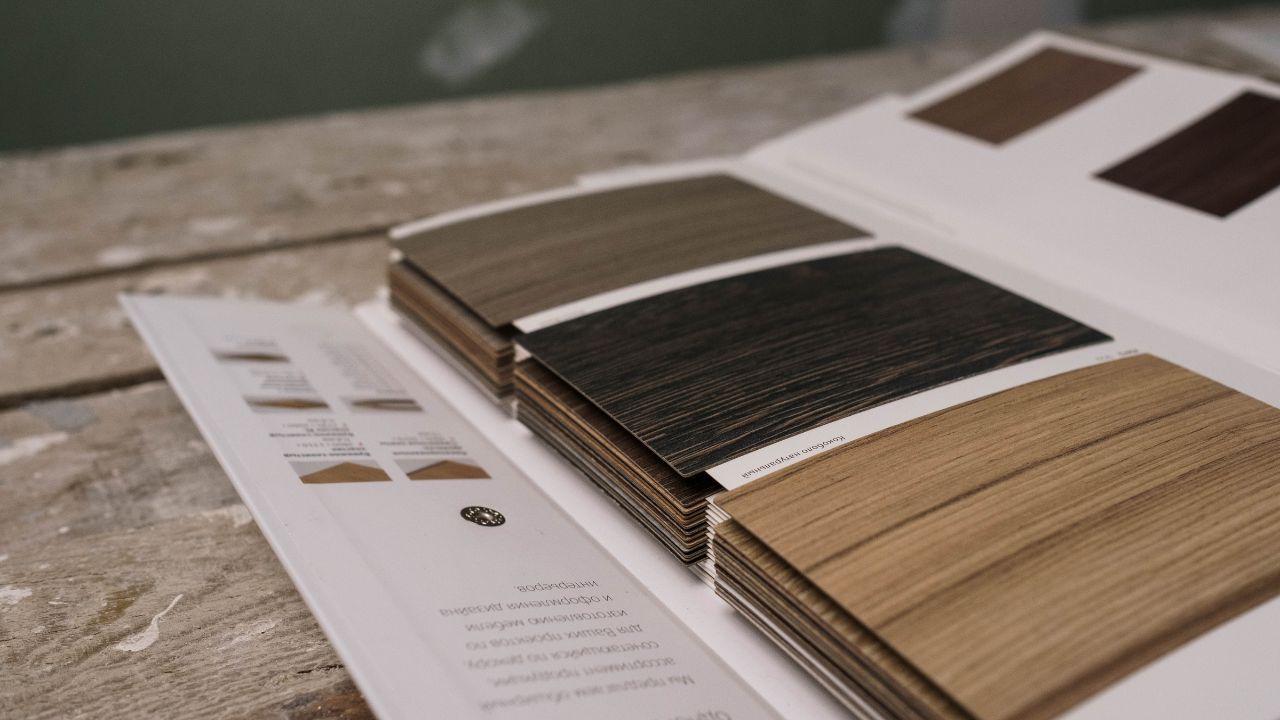
Wood veneer is a thin layer of real wood applied to another material, such as plywood, MDF, or particleboard. It provides the grain, color, and texture of natural timber while using less of the decorative wood species than a solid board.
You will find veneer on everything from affordable cabinets to carefully crafted furniture. Its quality depends on more than the visible surface: the backing material, adhesive, finish, and workmanship all affect how well it performs.
This guide explains what wood veneer is, how it is made, where it is used, and what to check before buying veneered furniture or sheets for a project.
What Is Wood Veneer?
Wood veneer is produced by slicing, peeling, or sawing timber into thin sheets. These sheets are usually bonded to a supporting material called a substrate.
For example, a walnut-veneered cabinet may have a genuine walnut surface over an MDF core. The walnut supplies the appearance, while the MDF provides most of the panel’s thickness and support.
Two terms are useful to understand:
- Veneer sheet: The thin wood layer, supplied either with or without a backing.
- Veneered panel: The completed board with veneer already bonded to its core.
Veneer is not a wood species. Oak, walnut, maple, birch, cherry, teak, and sapele can all be used to make it.
It is also not automatically an imitation material. Natural wood veneer is real wood, even when the panel beneath it is manufactured.
How Is Wood Veneer Made?
Manufacturers select and prepare logs, often conditioning them with heat and moisture before cutting. The cutting method determines much of the grain pattern.
After cutting, the sheets are dried, graded, and trimmed. They may be joined along their edges to create larger decorative faces, attached to backing material, or bonded directly to panels.
Common Veneer Cuts
| Cutting Method | How It Is Produced | Typical Appearance |
|---|---|---|
| Rotary-cut | A log rotates against a blade, producing a continuous sheet | Broad, varied grain patterns |
| Plain-sliced or crown-cut | Successive slices are taken across a prepared log section | Cathedral-shaped grain |
| Quarter-sliced | Slices are taken from quartered sections | Generally straighter grain; ray figure in some species |
| Rift-cut | Cutting angles are chosen to favor straight grain, particularly in oak | Relatively straight grain with reduced ray fleck |
Quarter-cut oak can display prominent decorative rays, while quarter-cut sapele may show ribbon-like stripes. The same species can therefore look quite different depending on its cut.
The Timber Veneer Association of Australia’s guide to veneer cuts illustrates how cutting direction changes the visible grain.
Types of Wood Veneer
Veneer can be described by its backing, manufacturing method, or appearance. These categories overlap: a natural oak veneer, for example, may also be paper-backed and quarter-sliced.
Raw Wood Veneer
Raw veneer has no added backing. It offers flexibility for custom layouts, decorative furniture, and marquetry.
However, unsupported sheets can be fragile, curled, or brittle. They require careful handling and suitable pressing methods.
Paper-Backed Veneer
Paper-backed veneer has a paper layer bonded to its reverse side. This makes large sheets easier to handle and helps hold joined veneer sections together.
It is commonly used for cabinet refacing, furniture surfaces, and interior panels. Some products can follow curves, but the permissible bend depends on the wood, backing, thickness, and grain direction.
Wood-Backed Veneer
Wood-backed products have a decorative face bonded to another thin wood layer. Depending on the product, the backing grain may run across the face grain.
This construction improves handling and can help reduce the visibility of minor substrate irregularities. It still needs a properly prepared surface underneath.
Peel-and-Stick Veneer
Also called pressure-sensitive adhesive veneer, this type comes with adhesive and a removable release liner.
It can be convenient for suitable refacing projects. However, the surface must meet the manufacturer’s requirements for smoothness, cleanliness, and sealing. Poor preparation can lead to weak adhesion.
Reconstituted Veneer
Reconstituted, or engineered, veneer is made by processing wood into a new block or assembly and slicing it again. Dyeing and controlled layering can create repeatable colors and grain patterns.
It contains real wood, but its decorative pattern is manufactured rather than preserved directly from a single natural log.
Burl and Figured Veneer
These terms describe appearance rather than backing. Burl, curly, quilted, and other figured veneers provide decorative patterns that can become the focal point of a piece.
They are often used on statement furniture, boxes, doors, and feature panels.
Main Properties of Wood Veneer
Thickness
Many decorative veneers are only fractions of a millimeter thick, with around 0.6 mm being a common nominal thickness. Thinner and substantially thicker products also exist.
Check whether a listed measurement describes the wood face alone or includes its backing. A thicker backing does not provide more wood for future sanding.
Natural Grain and Color
Natural veneer retains the characteristics of its species. Walnut tends to offer brown tones, maple is typically lighter, and sapele often has warm reddish-brown coloring.
Variation between sheets is normal. Stain, finish, lighting, and aging also affect the final appearance.
Hardness
The surface wood retains the hardness characteristics of its species, but a finished panel’s resistance to dents also depends on the supporting core and veneer thickness.
Scratch resistance depends heavily on the protective coating. A hard veneer beneath a soft or damaged finish can still show scratches readily.
Dimensional Stability
A well-designed veneered panel can move less with seasonal humidity changes than a wide solid-wood board.
This stability comes from the complete construction. Veneer itself still responds to moisture, and an unbalanced panel can warp.
Moisture Resistance
Ordinary decorative veneer is not waterproof. Water can affect the face, adhesive, or core, particularly at unprotected edges and joints.
Exterior suitability requires an appropriate complete panel system. Choosing a naturally durable face species alone does not make an interior veneered board suitable outdoors.
Strength and Weight
A decorative veneer face should not be treated as a structural board. Most of the panel’s load-carrying ability comes from its core and construction.
Likewise, veneered furniture is not necessarily lightweight. A thick MDF panel can be heavy despite its thin decorative surface.
What Is Wood Veneer Used For?
Furniture
Veneer is widely used on tabletops, desks, dressers, wardrobes, and shelving. It allows large surfaces to have coordinated grain without requiring equally large solid boards.
A piece may combine veneered panels with solid-wood legs, frames, or edges.
Kitchen Cabinets and Refacing
Veneer can cover cabinet doors, end panels, and face frames. Refacing sound cabinets can change their appearance while retaining the existing boxes.
The material still needs suitable protection around sinks, dishwashers, and other moisture sources.
Interior Doors and Wall Panels
Veneered doors and wall panels bring natural wood into interiors without requiring full-thickness decorative hardwood throughout.
Matching adjacent sheets can create a continuous design across doors, partitions, or feature walls.
Engineered Wood Flooring
Engineered flooring uses a real wood surface over supporting layers. The thickness of that surface varies significantly between products.
Flooring must be designed for foot traffic. Ordinary decorative furniture veneer should not be substituted for a flooring wear layer.
Plywood and Laminated Products
Veneers are also the building layers of plywood, where adjacent layers commonly have opposing grain directions.
Not all veneer is decorative: internal plies can provide structure while higher-grade face veneers provide appearance.
Decorative Work
Marquetry, inlays, jewelry boxes, speaker cabinets, and selected musical-instrument components use veneer for its grain and design possibilities.
Small pieces of contrasting species can create patterns that would be difficult to reproduce using thick boards.
Advantages of Wood Veneer
Real Wood Appearance
Veneer provides genuine grain rather than a printed imitation. It can deliver the depth and variation people want from natural timber.
Efficient Use of Decorative Timber
A log can cover more surface area when converted into thin veneer than when used as thick decorative boards.
This makes attractive grain available for more projects, although responsible sourcing still matters.
Potential Cost Savings
Veneer can make expensive species more accessible, especially on large surfaces.
However, rare figured veneer, elaborate matching, and skilled fabrication can be costly. Veneered furniture is not always cheaper than solid-wood furniture.
Attractive Grain Matching
Consecutive sheets can be arranged to create intentional patterns:
- Book matching: Adjacent sheets are opened like book pages.
- Slip matching: Sheets are placed side by side without alternating their faces.
- Random matching: Sheets are arranged for a less uniform appearance.
These options help designers coordinate large surfaces.
Useful for Broad Panels
A suitable engineered core can provide a stable foundation for cabinet doors, desktops, and wall panels.
Options for Curved Designs
Appropriate thin or backed veneers can follow curved substrates, making rounded furniture and architectural details possible.
Disadvantages of Wood Veneer
Limited Sanding Allowance
Thin veneer leaves little room for removing scratches or old finishes. Sanding through it exposes the backing or core.
Unlike a thick solid-wood surface, it cannot usually tolerate repeated heavy sanding.
Possible Peeling or Bubbling
Poor bonding, moisture, or unsuitable application methods can cause the face to lift.
These failures are not inevitable, but they show why adhesive selection and workmanship matter.
Vulnerable Edges
Unprotected edges may chip or expose the core. Well-made edging helps protect corners and gives the piece a more complete appearance.
Repairs Can Be Difficult to Hide
A small veneer patch may differ in grain, color, or light reflection. Repairing extensive damage can require replacing the entire face.
Quality Is Not Obvious From Appearance Alone
An attractive veneer can cover a poorly made panel. Inspect the core, joints, edges, and hardware as well as the visible grain.
Wood Veneer vs. Solid Wood vs. Laminate
Here, “laminate” refers to a manufactured decorative surface such as high-pressure laminate.
| Feature | Wood Veneer | Solid Wood | Decorative Laminate |
|---|---|---|---|
| Visible surface | Thin layer of real wood | Wood throughout the component | Manufactured decorative layer |
| Appearance | Natural grain and variation | Natural grain and variation | Printed or manufactured designs |
| Refinishing | Limited by face thickness | Usually offers more sanding allowance | Generally cannot be sanded and stained like wood |
| Moisture response | Depends on face, adhesive, and core | Can swell, shrink, or distort | Surface may resist spills; joints and core still matter |
| Cost | Ranges from economical to premium | Varies by species and construction | Also varies by product and grade |
| Common uses | Furniture, cabinets, panels | Furniture, joinery, flooring | Worktops, cabinets, commercial surfaces |
The best choice depends on the job. A veneered cabinet panel, solid-wood chair frame, and laminate worktop each solve different practical needs.
Can You Stain or Paint Wood Veneer?
Yes. Real wood veneer can generally be stained or painted if the surface is sound and correctly prepared.
Bare veneer can accept stain, but an existing coating may prevent penetration. Painting requires cleaning, suitable preparation, and a compatible primer where needed.
Sand gently and test the finish first. Do not assume that a stained patch can simply be sanded away without damaging the face.
How to Choose Good-Quality Veneer
Before buying, check the following:
- Species and appearance: View a sample large enough to show realistic grain variation.
- Face thickness: Confirm how much actual wood is present.
- Backing and core: Choose materials suitable for the intended use.
- Adhesive compatibility: Follow the veneer supplier’s application guidance.
- Edges and bonding: Look for chips, lifting, bubbles, and visible glue problems.
- Finish requirements: Confirm suitability for stains, coatings, and expected wear.
- Sourcing: Ask for verifiable certification or sourcing information where relevant.
Adhesives are not interchangeable. For example, VeneerSupplies advises against using contact cement with raw, unbacked veneer in its veneering application guidance.
For a DIY project, buying a ready-veneered panel may be simpler than bonding loose sheets yourself.
How to Care for Veneered Furniture
Dust with a soft cloth and use cleaners approved for the existing finish. If damp wiping is permitted, keep moisture minimal and dry the surface promptly.
Use coasters and heat-resistant mats, wipe up spills, and protect the finish from dragged objects. Avoid abrasive pads and steam cleaning.
Direct sunlight can change wood color. Position furniture thoughtfully or use window coverings to reduce uneven exposure.
If an edge begins to lift, address it before it catches on clothing or breaks away. Do not repeatedly soak or press a bubbling area without identifying the cause.
Is Wood Veneer a Good Choice?
Wood veneer is a good choice when you want natural grain, coordinated large surfaces, and efficient use of decorative timber. It belongs in both everyday furniture and high-quality custom work.
Choose it by looking at the complete construction—not just the species on the label. A well-bonded face, suitable core, protected edges, and appropriate finish are what turn an attractive veneer into a durable finished piece.