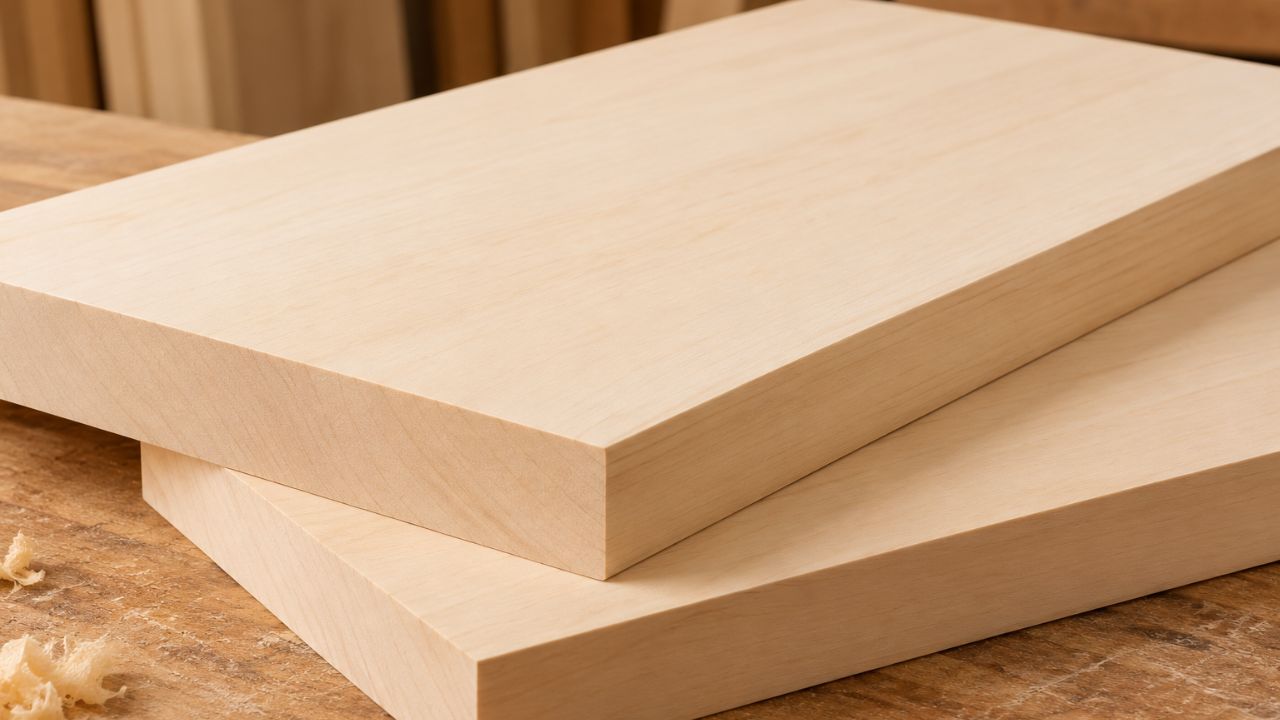
Yes, basswood is a hardwood, even though its wood is soft and easy to carve. It comes from a flowering tree in the genus Tilia. American basswood, commonly sold for woodworking in North America, is Tilia americana.
The confusion comes from the word “hardwood.” In woodworking, it identifies a botanical group—not a guarantee that the wood is physically hard.
Basswood is a good example: it belongs to the hardwood group, but its low resistance to denting makes it better suited to carving and decorative work than heavily used flooring.
Why Is Basswood Classified as a Hardwood?
Hardwoods come from flowering trees, also called angiosperms. Softwoods come from gymnosperms, most commonly conifers such as pine, spruce, and fir.
Basswood produces flowers and seeds enclosed in small fruits, placing it in the hardwood category.
Its seasonal leaf loss is not what determines the classification. Although many hardwood trees are deciduous, some are evergreen. Likewise, some softwood trees lose their needles.
| Term | What it tells you |
|---|---|
| Hardwood | The tree belongs to the flowering-plant group |
| Softwood | The tree belongs to the gymnosperm group |
| Wood hardness | How resistant the material is to indentation |
A soft hardwood is therefore not a contradiction. Botanical classification and physical hardness describe different things.
How Hard Is Basswood?
American basswood has a commonly reported Janka hardness of approximately 410 lbf, or about 1,820 newtons. This places it toward the softer end of commonly used woodworking hardwoods. NWH’s basswood species guide lists its hardness and working properties.
The Janka test measures the force required to embed a steel ball halfway into the wood. It helps compare resistance to indentation, but it does not measure every aspect of strength or durability.
For practical purposes, basswood’s softness means:
- Cutting and shaping generally require less effort.
- Concentrated pressure can leave dents.
- Thin details need careful handling.
- A protective finish will not make the underlying wood dent-proof.
Hardness values are typical reference figures. Individual boards vary with their condition and growing characteristics.
Why Is Basswood Popular for Carving?
Basswood’s softness is useful when the goal is to remove wood carefully and create small details.
Its relatively even texture allows a sharp carving tool to make controlled cuts. The pale color also makes pencil marks and carved shapes easy to see.
The USDA Forest Service describes American basswood as soft and light and notes its value for hand carving. USDA’s American basswood profile
For a beginner, it is a practical material for learning how grain direction affects a cut. However, easy cutting does not mean the grain can be ignored. Thin projections can still split or break.
Choose a dry, sound blank without cracks or troublesome knots. Keep tools sharp and take small cuts rather than forcing a dull edge through the wood.
Common Uses of Basswood
Basswood works best where easy shaping, low weight, or a smooth surface matters more than resistance to heavy wear.
Carvings and Decorative Details
Figurines, relief carvings, ornaments, and carved moldings are well suited to basswood. Its subdued grain allows the shape of the work to stand out.
Models and Craft Projects
Small models, prototypes, and craft components benefit from a material that is easy to cut and shape.
For delicate pieces, pay attention to grain orientation. A narrow part with grain running across it may break more easily than one with grain running along its length.
Interior Components
Basswood is also used for products such as blinds, shutters, and selected furniture components. Suitability depends on the component’s design and finish rather than the hardwood label alone.
Is Basswood Good for Furniture?
Basswood can be useful in furniture, particularly for carved details and components that receive limited wear.
It is less suitable when the priority is a surface that resists dents from daily use. A busy tabletop, chair edge, or frequently bumped corner may show damage relatively easily.
Before choosing it, consider what the component must do:
| Application | Main consideration |
|---|---|
| Carved decorative panel | Softness helps with detailed shaping |
| Light-duty interior component | Check the design, joints, and finish |
| Heavily used tabletop | Dent resistance may be insufficient |
| Flooring | Softness makes it a less practical choice for wear resistance |
Being a hardwood does not automatically make basswood suitable for every furniture part.
Is Basswood Suitable for Outdoor Use?
Basswood is not a naturally durable choice for prolonged outdoor exposure. It should not be selected for decking, fence posts, or exposed garden furniture simply because it is a hardwood.
For a small outdoor decoration, a suitable coating and sheltered placement may offer protection, but they do not turn the wood into a decay-resistant species. Keep it away from persistent moisture and inspect the finish regularly.
For demanding outdoor projects, choose material with properties appropriate to the exposure.
Can You Paint or Stain Basswood?
Yes. Basswood can be painted or stained, but preparation and testing are important.
For painted work, remove tool marks as needed, clean away dust, and use a compatible primer and paint system. Avoid excessive sanding that rounds over fine carved details.
For stain, test an offcut from the same piece. End grain and other areas may absorb color differently, so do not assume the finished result will be perfectly uniform.
Clear finishes are another option when you want to preserve its pale appearance. Check a sample first because some finishes add warmth or deepen the color.
Frequently Asked Questions
Is Basswood a Hardwood or Softwood?
Basswood is a hardwood. Its soft texture does not change its botanical classification.
Is Basswood the Same as Balsa?
No. Basswood and balsa come from different trees. Both are botanically hardwoods, but they have different properties and should not be treated as interchangeable.
Is Basswood the Same as Linden?
Basswood and linden are common names used for trees in the genus Tilia. American basswood is also called American linden. European carving wood sold as lime or linden may come from a different Tilia species.
Is Basswood Strong Because It Is a Hardwood?
Not necessarily. Hardness, strength, stiffness, and decay resistance are separate properties. The hardwood classification alone does not establish any of them.
Does Basswood Dent Easily?
Yes, compared with harder furniture woods. Use protective pads where appropriate and avoid clamping directly against an unprotected finished surface.
Is Basswood Good for Beginner Woodworkers?
It is especially useful for beginners learning carving and small craft work. Its softness makes controlled cuts easier, provided the tools are sharp and the work is held securely.