Paulownia — also known as the empress tree, princess tree, or royal paulownia — is one of the fastest-growing trees in the world. If you have one on your property or encounter a fallen specimen, the natural question is whether it’s worth burning. The answer is yes, but with real caveats that set it apart from almost every other firewood species you’ve likely used.
Yes, you can burn paulownia wood — but it’s a poor-quality firewood. It has a low BTU output, burns quickly, produces little lasting heat, and is naturally flame-resistant, requiring higher temperatures to ignite than most woods. It’s best used as a supplemental fuel mixed with better-burning hardwoods.
~14M BTU
Estimated BTU per cord
788°F
Temp required to ignite
30–90 days
Seasoning time (fast)
What makes paulownia unusual as firewood?
Paulownia is native to eastern Asia, where it has been cultivated for centuries in Japan and China — not for burning, but for its prized lightweight lumber. In Japan it is known as kiri and is considered among the finest cabinet and instrument woods available. In the eastern United States it now grows as an invasive species, spreading rapidly along roadsides, disturbed land, and forest edges.
As firewood, paulownia’s cellular structure sets it apart from virtually every other wood on your woodpile. Scientific analysis shows that paulownia wood has a very porous, honeycomb-like cell tissue structure. Since paulownia contains few lignins, it generates very little combustible gas when heated. Furthermore, the vessel structure is very large and independent, meaning oxygen is not sufficiently supplied — making it difficult to ignite, and it only carbonises when heated rather than burning freely.
The science behind paulownia’s flame resistance
Cell structure
Porous honeycomb pattern — limits oxygen supply to combustion zone
Lignin content
Very low — generates minimal combustible gas when heated
Ignition point
788°F (420°C) — far higher than most hardwoods at ~428°F
Thermal conductivity
Low — acts as an insulator, resisting heat transfer
The World Paulownia Institute notes that temperatures above 788 degrees Fahrenheit are necessary for paulownia wood to combust — compared to most common hardwood trees which tend to burn around 428 degrees Fahrenheit. It ranks low in thermal conductivity and acts as an insulator against both heat and cold.
This is actually why paulownia wardrobes have been used in Japan for centuries to protect silk kimonos from fire.
How does paulownia compare to other firewoods?
| Wood | BTU / cord | Heat output | Ease of ignition | Overall rating |
|---|---|---|---|---|
| Hickory | ~28M BTU | Excellent | Good | Top tier |
| White Oak | ~26M BTU | Excellent | Good | Top tier |
| Ash | ~23M BTU | Good | Very good | Great |
| Pine (mixed) | ~17M BTU | Low | Excellent | Moderate |
| ⚠️ Paulownia | ~14M BTU | Poor | Difficult | Poor |
| Elm | ~20M BTU | Moderate | Moderate | Moderate |
Paulownia sits at the bottom of any BTU comparison chart — its estimated heat output of around 14 million BTUs per cord is lower than most softwoods, let alone hardwoods. For context, hickory delivers roughly double the usable heat per cord. If your goal is efficient home heating, paulownia alone will leave you disappointed.
One major advantage: it dries incredibly fast
Most firewood species require 12 to 24 months of seasoning before they burn well. Paulownia is a remarkable exception. Rather than air-drying for 12 to 24 months like most species, paulownia wood can dry successfully in as little as 30 to 90 days if the air is warm and dry. Once paulownia wood dries to 20 to 30 percent moisture levels it is cured and ready for use as firewood.
This is genuinely useful if you need firewood quickly. Cut it in early summer and you could have usable fuel before autumn — something that simply isn’t possible with oak, hickory, or maple. Cutting logs into quartered or smaller sections increases the surface area and speeds drying even further.
How to burn paulownia effectively
Given its high ignition temperature and low BTU output, paulownia needs a different approach than standard hardwoods. Here’s how to get the best results from it:
1. Season thoroughly first
Split paulownia into smaller pieces than you would with other hardwoods. Stack with good airflow in a sunny location. Even 60–90 days can be enough in warm, dry weather — but fully dry wood is essential. Damp paulownia barely smoulders and produces heavy smoke.
2. Never use paulownia as a fire starter
Do not start a fire with paulownia wood. Instead, begin the fire with faster-burning softwoods such as fir or pine. Get a strong, established fire going first before introducing paulownia logs.
3. Add paulownia to an already-roaring fire
Add smaller, split pieces of paulownia to the roaring softwood fire to get it to ignite better. Once your firebox is already running hot (above 788°F), paulownia will catch and contribute heat — just not as much or as long as denser hardwoods.
4. Stack for maximum airflow
Stack the wood pieces so ample air feeds the flames. Do not stack wood in parallel configuration because it limits airflow and the temperature of the fire. Paulownia’s combustion depends more than most woods on generous oxygen supply.
5. Mix with better-burning hardwoods
The most practical use of paulownia firewood is as a bulk filler mixed with higher-BTU hardwoods like oak, hickory, or ash. Alternate layers in your firebox — let the hardwood carry the heat load while paulownia contributes what it can without demanding it works alone.
Don’t rely on paulownia as a primary heat source. Its low BTU output and high ignition temperature make it unsuitable for heating a home through a cold winter on its own. If you’re in a cold climate and burning wood for heat, use paulownia only as a supplement to quality hardwoods.
Pros and cons of burning paulownia
✓ Advantages
- ✓ Dries in just 30–90 days — far faster than any other species
- ✓ Easy to split when freshly cut
- ✓ Widely available as an invasive species (free removal)
- ✓ Low smoke output once fully seasoned
- ✓ Useful as supplemental fuel mixed with hardwoods
- ✓ Grows back quickly after cutting (coppices well)
✗ Disadvantages
- ✗ Very low BTU output (~14M per cord)
- ✗ Naturally flame-resistant — difficult to ignite
- ✗ Burns fast with little lasting heat
- ✗ Cannot be used as a fire starter
- ✗ Not suitable as a primary heating fuel
- ✗ Burns poorly in low-temperature fires
Should you burn paulownia or use it as lumber?
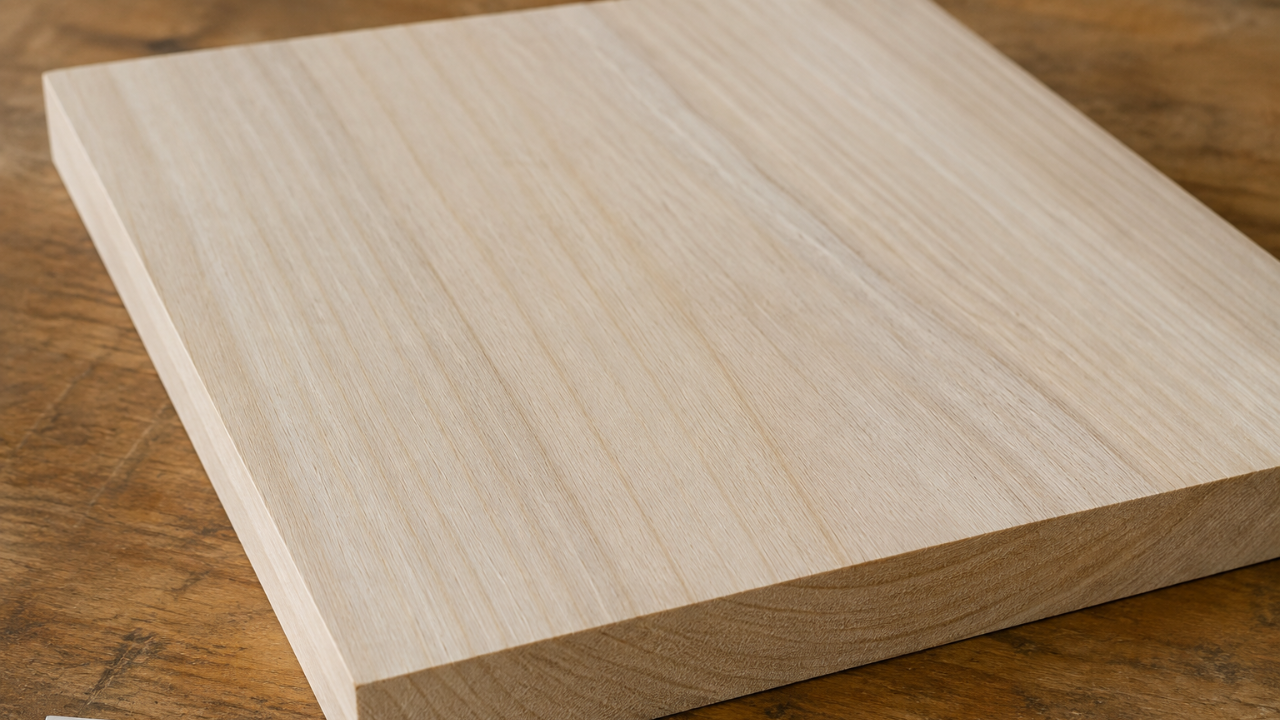
This is the real question. The literature on past and current fields of application for paulownia wood suggests that it is generally much more prone to provide high-end timber rather than domestic firewood. As lumber, paulownia is genuinely valuable — lightweight, strong for its weight, beautiful grain, and prized for furniture, musical instruments, and decorative panelling.
If you have a paulownia tree that’s been felled, the highest-value option is almost always to have the best logs milled into lumber rather than split for firewood. Save the offcuts, twisted sections, and branch wood for the woodpile.
🪑 Furniture & cabinetry
Paulownia’s lightweight, attractive grain makes it prized for furniture and cabinet-making — far more valuable than firewood.
🎸 Musical instruments
Used in guitar bodies and traditional Japanese instruments (shamisen) for its resonance and light weight.
🏄 Surfboards & sporting goods
Its strength-to-weight ratio makes it a growing choice for surfboard cores, paddle boards, and lightweight sporting equipment.
🔥 Supplemental firewood
Offcuts and branch wood can be used as supplemental fuel — best mixed with denser hardwoods in an already-hot firebox.
The verdict
Can you burn paulownia wood? Yes — but you should go in with realistic expectations. Its natural flame resistance means it needs a hot, established fire before it will catch, and its low BTU output means it won’t heat your home the way oak or hickory would. Where it genuinely shines is in its astonishing drying speed — 30 to 90 days versus one to two years for most hardwoods — and its easy splitting. If you have paulownia and need firewood quickly, it can fill a gap in a mixed firewood stack. But if you have quality logs and access to a sawmill, milling it into lumber is almost always the smarter, higher-value choice.