
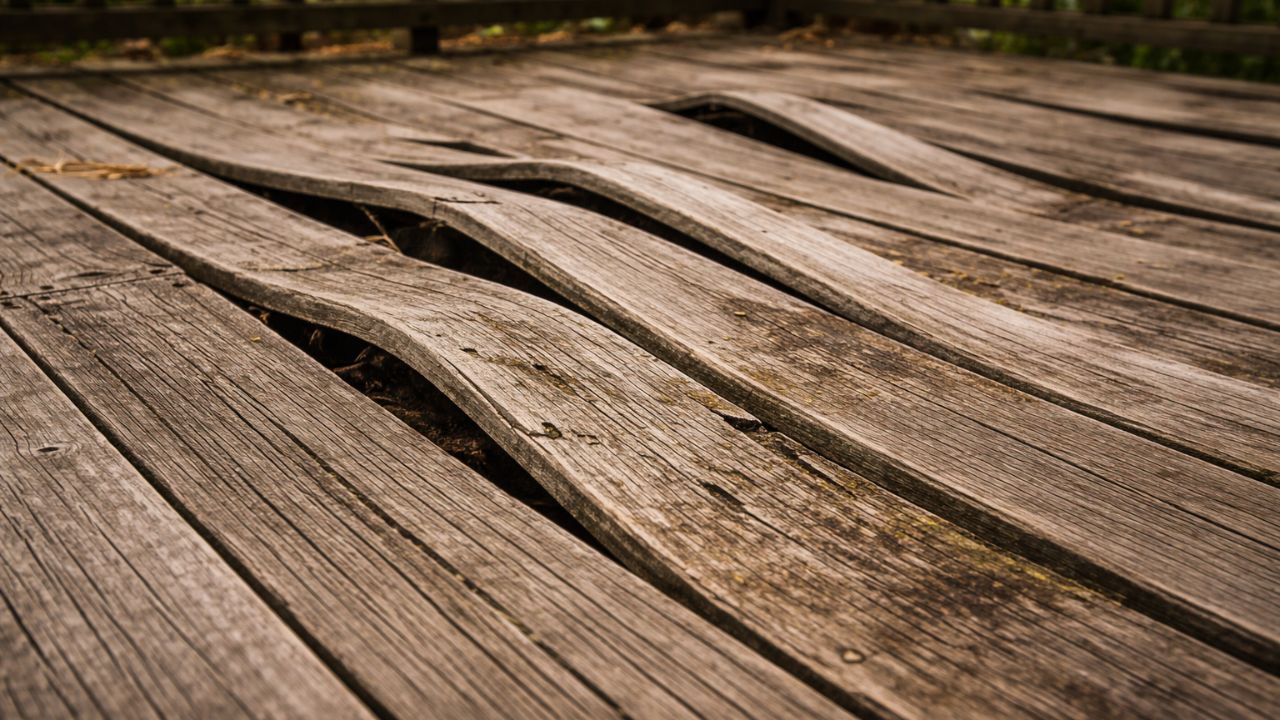
You spend hours — maybe days — building a beautiful tabletop, a set of cabinet doors, or a deck. Then you come back a few weeks later and find the boards have bowed, twisted, or cupped. It’s one of the most frustrating experiences in woodworking, and it happens to beginners and seasoned professionals alike.
Here’s the good news: wood warping is largely preventable. It’s not random bad luck. Warp happens for specific, well-understood reasons — and once you know what those reasons are, you can take practical steps to stop it from ruining your projects.
This guide covers everything: why wood warps, the five types of warp to recognize, and a thorough set of proven prevention methods for every stage — from buying lumber to finishing and installation.
Why Does Wood Warp? The Root Cause
Before you can prevent warping, you need to understand what’s actually happening inside the wood.
Wood is a hygroscopic material, meaning it naturally absorbs and releases moisture from the air around it. When wood gains moisture, it expands. When it loses moisture, it shrinks. That much is expected. The problem starts when this process happens unevenly — when one face, one edge, or one end of a board dries or absorbs moisture at a different rate than the rest of the piece.
That uneven movement creates internal stress. The drier side shrinks and pulls; the wetter side stays put. The result is a board that bends, cups, or twists to relieve that stress.
The two biggest factors driving uneven moisture exchange are:
Humidity fluctuations — Seasonal changes in the US are particularly hard on wood. Humid summers cause wood to swell as it absorbs moisture from the air. Cold, dry winters cause it to shrink. This expansion-contraction cycle, repeated year after year, is what gradually distorts boards that aren’t properly sealed or stored.
Uneven exposure — When one face of a board is exposed to air, sunlight, or a heat source while the other face is shielded, the exposed side dries faster. This differential causes the board to curve toward the drier side.
Understanding these two mechanisms is the foundation of every effective warping prevention strategy.
The 5 Types of Wood Warp (And What Causes Each One)
Not all warping looks the same. Identifying the type of warp helps you understand what went wrong and how to avoid it next time.
1. Cup
The most common type. The edges of a board rise while the center stays low (or vice versa), creating a concave or convex shape across the width of the board. Cupping typically happens when one face dries faster than the other — most often when flat-sawn boards are stored with one face against the ground or a wall.
2. Bow
The board curves along its length, like a slight arch from end to end when viewed along the flat face. Bowing usually occurs when a long board isn’t properly supported along its length during storage, allowing it to sag under its own weight as moisture shifts.
3. Crook (or Spring)
The board curves along its length along the edge, not the face — so when you look down the edge of the board, it curves left or right instead of running straight. Crook is often caused by irregular grain, knots, or uneven drying in the wood’s core.
4. Twist (or Wind)
The board’s two ends rotate in opposite directions, so if you lay the board on a flat surface, it rocks diagonally. Twist is particularly tricky because it’s caused by spiral or diagonal grain in the original log — meaning it can be present in a board before you even start working with it.
5. Kink
A sharp, localized bend rather than a gradual curve — usually caused by a knot or defect in the wood that dried at a different rate than the surrounding wood fibers.
10 Proven Ways to Prevent Wood from Warping
1. Start With the Right Lumber
Prevention begins at the lumber yard. The boards you select have a major influence on how much they’ll move.
Choose kiln-dried (KD) lumber. Kiln-dried lumber has had most of its moisture removed in a controlled drying environment before it reaches the store. This means the wood has already gone through most of its initial shrinkage and is far more stable than green (undried) lumber. Always look for the KD or KDAT (kiln-dried after treatment) designation, especially for furniture and cabinet projects.
Check the moisture content. Professional woodworkers use a moisture meter to verify lumber before purchase. For indoor furniture and cabinetry, the target moisture content is 6–9%. Lumber above 12–15% will continue to dry and move significantly after you build with it. A basic moisture meter costs $20–$50 and is one of the best investments you can make as a woodworker.
Avoid boards with obvious grain problems. Look down the length of each board before you buy. Avoid boards with spiral grain, prominent knots near the center, or any visible twist already present. Boards with tight, straight grain lines (approximately 1/32-inch spacing) are far more stable than those with wild, irregular grain.
Favor heartwood over sapwood. The dense, older heartwood at the center of a log is generally more stable and resistant to warping than the lighter sapwood near the outside of the tree.
2. Choose Quarter-Sawn Lumber When Stability Matters
The way a log is cut into boards has a dramatic effect on how stable the resulting lumber is.
Flat-sawn (plain-sawn) lumber — the most common and least expensive type — is cut tangentially to the growth rings. This creates the familiar cathedral grain patterns, but it also makes these boards prone to cupping, because the growth rings curve across the width of the board and pull unevenly as moisture changes.
Quarter-sawn lumber is cut radially, with the growth rings running nearly perpendicular to the face of the board. This orientation means that as the wood expands and contracts, the movement is more uniform across the board’s width. Quarter-sawn boards are significantly more stable and less prone to cupping and warping.
The trade-off: quarter-sawn lumber costs more and is harder to find. But for projects where dimensional stability is critical — cabinet doors, tabletops, drawer fronts — it’s often worth the premium. Look for it at specialty hardwood dealers rather than big-box stores.
3. Acclimate Your Lumber Before You Build
This step is skipped by more beginners than almost any other, and it causes more warping problems than almost anything else.
When you bring new lumber into your shop or home, it needs time to adjust to the humidity and temperature of its new environment before you cut or assemble it. This process is called acclimation, and it’s non-negotiable for high-quality work.
Here’s how to do it correctly:
- Stack the boards flat in the room or space where the finished project will live — not in your garage or shop if those conditions are very different from the installation environment
- Sticker the stack — place thin, narrow strips of wood (called stickers) between every board to allow air to circulate on all faces equally
- Allow 48 hours to 2 weeks, depending on the wood species, the thickness of the boards, and how different the new environment is from the lumber yard’s conditions
- Check moisture content at the start and end of acclimation with a moisture meter. The lumber is ready when the reading stabilizes
For US homes, ambient indoor conditions are typically 30–50% relative humidity and 60–75°F. Most wood products are manufactured to a moisture content of 6–9% to match these conditions. Bringing wood from a humid warehouse into a dry, heated home without acclimation is a recipe for warping.
4. Store Lumber Properly
Improper storage before and between projects is one of the leading causes of warped lumber. Good storage is straightforward — it just needs to be done consistently.
The golden rules of lumber storage:
- Always store flat, never vertical. Leaning boards against a wall allows them to sag and bow under their own weight over time. Always store lumber horizontally.
- Use a flat, level surface. Uneven support is one of the fastest ways to introduce bow and twist into straight boards.
- Sticker every layer. Use stickers (typically 3/4-inch square strips) spaced every 12–16 inches along the length of the stack to allow air to circulate evenly on all faces.
- Keep stickers vertically aligned. When stacking multiple layers, place each sticker directly above the one below to distribute weight evenly and prevent sagging.
- Keep wood off the ground. Store lumber on a rack or on a platform, never directly on a concrete floor. Concrete can wick moisture unevenly into the bottom boards.
- Store in a dry, well-ventilated space. Garages, sheds, and unheated basements can have highly variable humidity. If possible, store fine hardwood lumber in a climate-controlled space.
- Protect from direct sunlight. UV exposure and heat from direct sun cause rapid, uneven surface drying. Use a cover or store lumber away from windows and doors that receive direct light.
5. Seal All Surfaces — Including the Ends
Sealing is one of the most effective and underused weapons against warping, particularly for wood that’s already been milled and is being stored or installed.
Wood absorbs and releases moisture primarily through its end grain, which is far more porous than the face grain. If the ends of your boards are left uncoated while the faces are sealed, the ends will dry out much faster — creating the differential moisture content that leads to cracking and warping.
End grain sealing: Apply a dedicated end grain sealer, paste wax, or even a thick coat of PVA glue to the ends of freshly cut or stored boards. This dramatically slows moisture exchange at the most vulnerable points.
Full surface sealing: Finishing a completed woodworking project with paint, varnish, polyurethane, oil, or lacquer seals all faces of the wood and acts as a moisture barrier, dramatically slowing the rate at which the wood can absorb or lose moisture. Critically, you need to finish all faces — top, bottom, inside, and outside. If you seal only the visible surface of a tabletop and leave the underside bare, the two faces will exchange moisture at different rates, and the top can cup or bow over time.
For outdoor wood: Exterior sealers, deck stains, and waterproofing treatments need to be reapplied periodically (typically every 1–3 years depending on the product and your climate) to maintain their protective effect.
6. Control Humidity in Your Home and Shop
If you live in a climate with extreme seasonal humidity swings — the humid Southeast, the Great Lakes region, or anywhere with hot, wet summers and cold, dry winters — this is especially important.
The ideal indoor relative humidity range for wood stability is 35–55% RH. Significant or rapid changes outside this range are what causes wood to move.
In your workshop: A combination of a good hygrometer (to measure humidity) and either a humidifier or dehumidifier (depending on your climate and season) gives you real control. Many professional woodworkers maintain their shops within a tight humidity range year-round to prevent in-progress projects from moving between sessions.
In your home: Central HVAC systems help, but dry winters are hard on wood furniture and floors throughout the US. A whole-house humidifier connected to your furnace is the most effective solution. Stand-alone humidifiers for individual rooms are a more affordable alternative. Target 40–45% RH for the best balance of wood stability and comfort.
For seasonal climates: Accept that some minor seasonal movement in solid wood furniture and flooring is normal and unavoidable. Design for it — avoid rigidly gluing wide panels across the grain, allow floating panels in cabinet frames to expand and contract, and choose finishes that flex slightly rather than ones that crack under wood movement.
7. Apply Finish Evenly on All Surfaces
This is a common but fixable mistake. Many people finish the top and visible faces of a project but leave the undersides and hidden surfaces bare. The result: the sealed face exchanges moisture slowly while the unfinished face exchanges it quickly, creating a differential that causes the whole piece to cup toward the sealed side.
The fix is simple: always apply the same number of finish coats to every surface of a wood panel or board. Both sides of a tabletop. Inside and outside of a cabinet door. Front and back of a shelf panel. This balances the rate of moisture exchange on all faces and keeps the board from moving unevenly.
8. Use Proper Joinery and Construction Techniques
How you build something matters as much as what wood you use. Thoughtful joinery and construction significantly reduce warping in finished pieces.
Use breadboard ends on wide tabletops. A breadboard end — a shorter board running perpendicular to the main panels across the ends of a table — helps hold a wide tabletop flat by mechanically resisting cupping. The key detail: attach breadboard ends with elongated slots and a single central fastener so the tabletop can still expand and contract seasonally without cracking.
Alternate growth ring orientation in glue-ups. When edge-gluing multiple boards into a wide panel, alternate the orientation of the growth rings (cup up, cup down, cup up) in adjacent boards. This way, if individual boards cup slightly, they counteract each other rather than all cupping in the same direction.
Allow for wood movement in frame-and-panel construction. Traditional cabinet construction uses floating panels inside a surrounding frame precisely to accommodate wood movement. The panel sits in a groove and is never glued in place, allowing it to expand and contract without stressing the surrounding frame.
Fasten wide boards at regular intervals. When screwing or nailing wide boards — like deck boards or floorboards — attach them every 12 inches to minimize the opportunity for individual boards to bow or cup between fastening points.
9. Don’t Let Wood Sit Unfinished for Long
Once you’ve milled or surfaced lumber to its final dimensions, don’t leave it sitting in your shop for weeks before assembling or finishing it. Freshly milled surfaces exchange moisture faster than sealed ones, and boards left stickered in a shop for too long can start to move before they even make it into the project.
As a practical rule: mill your parts close to assembly time. Once the project is assembled and finished, it becomes much more dimensionally stable because the geometry of the joints and the surface finish both resist movement.
10. Choose More Warp-Resistant Wood Species
Some wood species are inherently more stable than others, and choosing the right species for your application is one of the most underrated prevention strategies.
Most stable species for indoor use:
- Teak — exceptionally stable due to natural oils; low movement even in humid conditions
- White oak — quartersawn white oak is among the most stable domestic hardwoods available
- Hard maple — tight grain and consistent density make it very stable for furniture and cabinets
- Cherry — good dimensional stability with sealed surfaces; widely used in American fine furniture
- Western red cedar — naturally stable for outdoor use; resists moisture absorption
Species more prone to movement:
- Pine — especially flat-sawn pine; moves significantly with humidity changes
- Douglas fir — great structural wood but prone to surface checking and movement
- Beech — beautiful wood but notable shrinkage rates; requires careful moisture management
- Ash — open grain makes it more susceptible to moisture exchange
For outdoor projects specifically, choose naturally rot-resistant and stable species like teak, ipe, cedar, or redwood. These woods contain natural oils and extractives that slow moisture absorption and make them far more resistant to the warping caused by outdoor weather cycles.
Can You Fix Warped Wood?
Prevention is always easier than repair, but if you’re already dealing with warped boards, here are the main options:
Re-wetting and clamping: Lightly dampen the concave (hollow) side of a cupped board with a wet cloth, then clamp it face-down on a flat surface and allow it to dry over 24–48 hours. The moisture causes the concave side to expand and the board to flatten as it dries under pressure. This works best on thin boards and mild cupping.
Steam and heat: Place a damp towel on the concave face and apply a household iron (set to steam) to relax the wood fibers. Once the wood is warm and pliable, clamp it flat and allow it to dry completely before releasing. This is more effective than re-wetting alone for moderate warp.
Weighting under sunlight: For wide panels with mild bowing or cupping, wrapping the board in damp towels and placing it concave-side-up in direct sunlight for two to three days allows the sun’s warmth and the trapped moisture to gradually relax the fibers back toward flat. Clamp immediately once flat and allow to fully dry.
Jointing or planing: For boards with surface warp that can’t be corrected by moisture methods, running them through a jointer and planer removes the high spots and gives you a flat, square board — at the cost of some thickness. This is often the fastest solution for workshop warp in construction lumber.
Important note: Re-flattened wood that hasn’t had its underlying moisture issue addressed will simply warp again. Always seal and finish the corrected board on all faces to stabilize it.
Quick Reference: Warp Prevention Checklist
Use this before every project to keep your wood stable:
- Verified moisture content is 6–9% with a moisture meter
- Lumber is kiln-dried, not green
- Wood has been acclimated in the project’s final environment for at least 48 hours
- Boards are stored flat, stickered, and supported at 12–16 inch intervals
- Storage area has stable, moderate humidity (35–55% RH)
- All wood surfaces will be finished with equal coats on every face
- Construction allows for seasonal wood movement (floating panels, elongated slots, etc.)
- End grain is sealed before long-term storage
Frequently Asked Questions
Does sealing wood prevent warping? Yes, significantly. Sealing wood with paint, varnish, polyurethane, or oil slows the rate at which wood absorbs and releases moisture from the air. This doesn’t make wood completely immune to movement — no finish does — but it dramatically reduces the speed and degree of moisture exchange, which reduces warping. The key is to seal all surfaces equally, including ends and backs.
What wood is least likely to warp? Quarter-sawn hardwoods — especially white oak, teak, and hard maple — are among the most warp-resistant options. Kiln-dried lumber with tight, straight grain is also significantly more stable than flat-sawn or green lumber. For outdoor use, teak, ipe, and Western red cedar are your most warp-resistant choices.
How do I keep lumber from warping in storage? Store it flat on a level surface, supported at regular intervals with stickers between each layer for air circulation. Keep it in a dry space away from concrete floors, direct sunlight, and moisture. Maintain stable humidity if possible.
What humidity level prevents wood warping? Most wood products are manufactured for indoor conditions of 35–55% relative humidity. Keeping your home or workshop within this range minimizes the expansion-contraction cycles that cause warping. A hygrometer to monitor your space costs about $15–$20 and is well worth having.
Can warped wood be straightened? Yes, in many cases — especially for mild cupping or bowing. Techniques involving moisture, heat, and clamping can flatten most warped boards. However, severe twist or kink from structural grain issues is much harder to correct and may require replaning to remove.
Final Thoughts
Wood warping isn’t a sign of bad luck or inferior material — it’s a natural consequence of wood’s hygroscopic nature. Every board will move to some degree throughout its life. The goal isn’t to stop all movement; it’s to manage it so that your projects stay flat, functional, and beautiful for the long term.
The strategies in this guide — starting with properly dried and acclimated lumber, storing it correctly, sealing all surfaces, and designing with wood movement in mind — address warping at every stage. Apply them consistently and you’ll find that warped wood goes from a frequent frustration to a rare exception in your work.