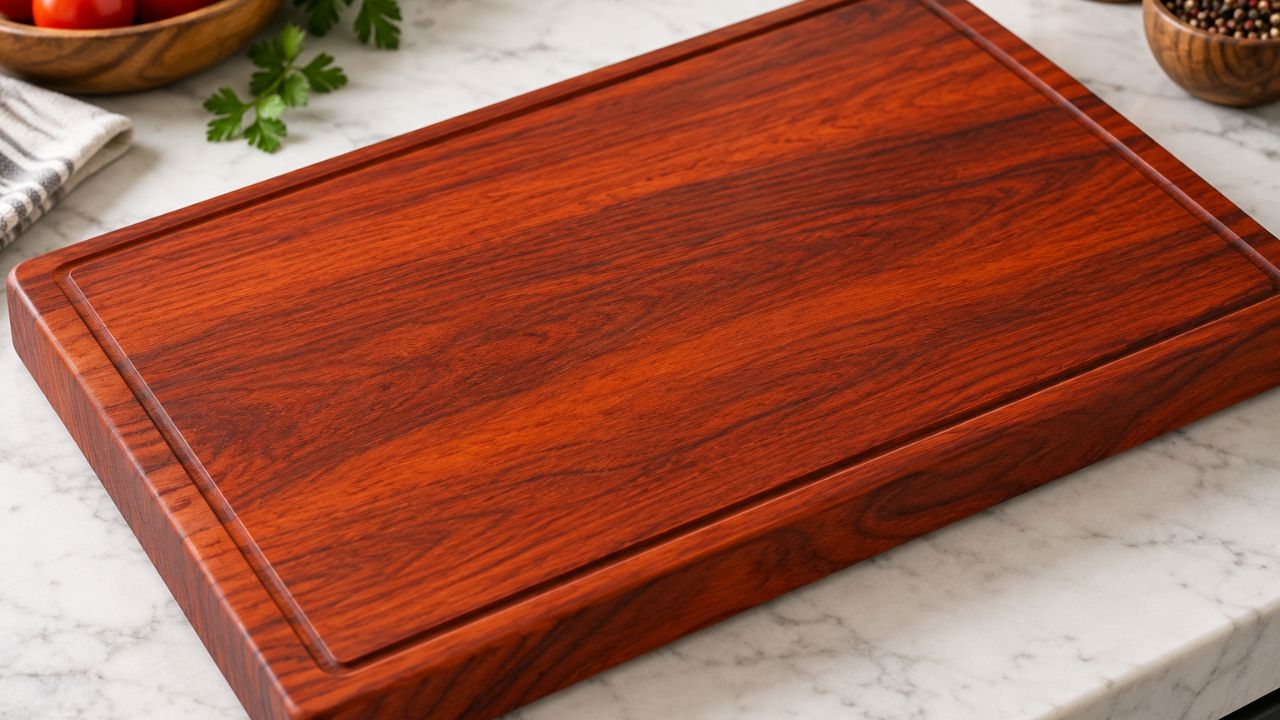
Padauk is attractive and hard, but it would not be my first choice for an everyday cutting board. Its relatively open grain and the need to establish suitability for food contact make it a less straightforward choice than hard maple.
That does not mean every padauk board is dangerous. It means hardness, appearance, and a coating labeled “food-safe” are not enough to establish that a finished board is appropriate for repeated chopping and washing.
If you want a dependable kitchen work surface, prioritize suitable materials, sound construction, and easy cleaning over decorative color.
Why Do Woodworkers Use Padauk in Cutting Boards?
African padauk, commonly identified as Pterocarpus soyauxii, is known for its vivid orange-red heartwood. It creates a striking contrast when combined with pale woods.
Its hardness is another attraction. However, resistance to indentation does not tell you everything about a cutting board’s performance.
A useful board must also tolerate washing, remain free of failing joints, and provide a surface that can be cleaned effectively. Those requirements deserve as much attention as appearance.
Padauk Cutting Boards: Advantages and Limitations
| Consideration | What it means for a cutting board |
|---|---|
| Distinctive color | Attractive for patterned designs, but changes with age |
| Hardness | Resists indentation but does not prevent knife marks |
| Relatively open grain | Requires consideration beyond hardness alone |
| Mixed-wood construction | Each species, adhesive, and joint needs to suit the application |
| Protective finish | Must be appropriate for cutting-board use; cannot resolve every material concern |
Does Padauk’s Open Grain Make It Unsuitable?
Padauk has a relatively coarse texture and visible pores. This makes it different from the close-grained woods commonly specified for cutting surfaces.
The FDA Food Code, Section 4-101.17, permits hard maple or equivalently hard, close-grained wood for cutting boards and certain utensils. This is a model code for retail and food-service settings, not a blanket rule for every home kitchen.
The provision does not specifically approve padauk. Nor does it establish that every open-grained wooden board is unsafe.
The practical takeaway is narrower: being hard is not enough to demonstrate that padauk meets the same criteria as hard maple. Avoid presenting it as an equally established choice without supporting evidence.
Is Padauk Toxic or Food-Safe?
There is no sound basis for declaring every padauk cutting board either completely safe or inherently poisonous from its wood name alone.
Separate two questions:
- What exposure occurs while someone cuts or sands the wood?
- Is the completed product suitable for its intended food contact?
Wood-dust concerns do not automatically establish that a finished board contaminates food. Equally, the absence of an immediate reaction does not prove suitability.
Ask the maker what species, adhesive, and finish were used and whether the product was designed for repeated food preparation. A decorative woodworking project is not automatically a kitchen utensil.
Can Mineral Oil Make Padauk Safe?
Mineral oil cannot establish the food-contact suitability of the underlying wood.
A product intended for cutting-board maintenance may help condition a suitable board, but it is not a permanent barrier between the wood and food. Knives continue to contact and mark the surface.
The same reasoning applies to wax blends. Choosing an appropriate finish matters, but it does not replace selecting appropriate materials.
Do not assume that varnish, polyurethane, or epoxy solves the problem either. Follow the coating manufacturer’s instructions for the specific use, including direct cutting, rather than relying on a general food-contact claim.
Can You Use Padauk as an Accent Strip?
A narrow strip still contacts food and knives when it forms part of the working surface. Using less padauk does not remove the need to assess its suitability.
For a mixed-wood board, consider the whole assembly: species, grain orientation, drying, adhesive, and joint quality.
If the goal is purely visual, a separate decorative stand or display item avoids making padauk part of the food-preparation surface.
Serving boards also need assessment. Calling an item a “charcuterie board” does not eliminate food contact.
What Is a Better Alternative?
Hard maple is the more straightforward recommendation for an everyday wooden cutting board. It is specifically named in the FDA guidance and offers a familiar starting point for material selection.
That does not make every maple board well constructed. Look for:
- A smooth, sound surface.
- Tight joints without gaps.
- Materials and adhesive appropriate for the intended use.
- Clear cleaning and maintenance instructions.
- A size you can comfortably wash and dry.
For convenience, a manufactured plastic board intended for food preparation is another option.
What If You Already Own a Padauk Board?
You do not need to assume it is hazardous simply because it contains padauk. Start by asking the maker about its intended use and materials.
If those details cannot be established, use a different board for routine food preparation rather than relying on an uncertain finish or species claim.
For any suitable cutting board, the USDA recommends washing after use with hot, soapy water, rinsing, and drying. Use separate boards for raw animal foods and ready-to-eat foods, and replace boards with excessive wear or hard-to-clean grooves.
Cleaning remains necessary regardless of the wood’s natural durability.
Frequently Asked Questions
Does End-Grain Construction Make Padauk Food-Safe?
No. Changing grain orientation does not establish food-contact suitability. Material selection and construction still matter.
Will Padauk Stay Bright Red?
Usually not. Its orange-red appearance generally darkens and becomes browner with age. Do not choose it expecting permanent bright contrast.
Is Padauk Scratchproof?
No. Hardness does not prevent knife marks or surface wear.
Would You Recommend Padauk for a First Cutting-Board Project?
I would choose hard maple instead. It offers a more established starting point, allowing you to focus on accurate joints, suitable adhesive, and a cleanable finished surface.