
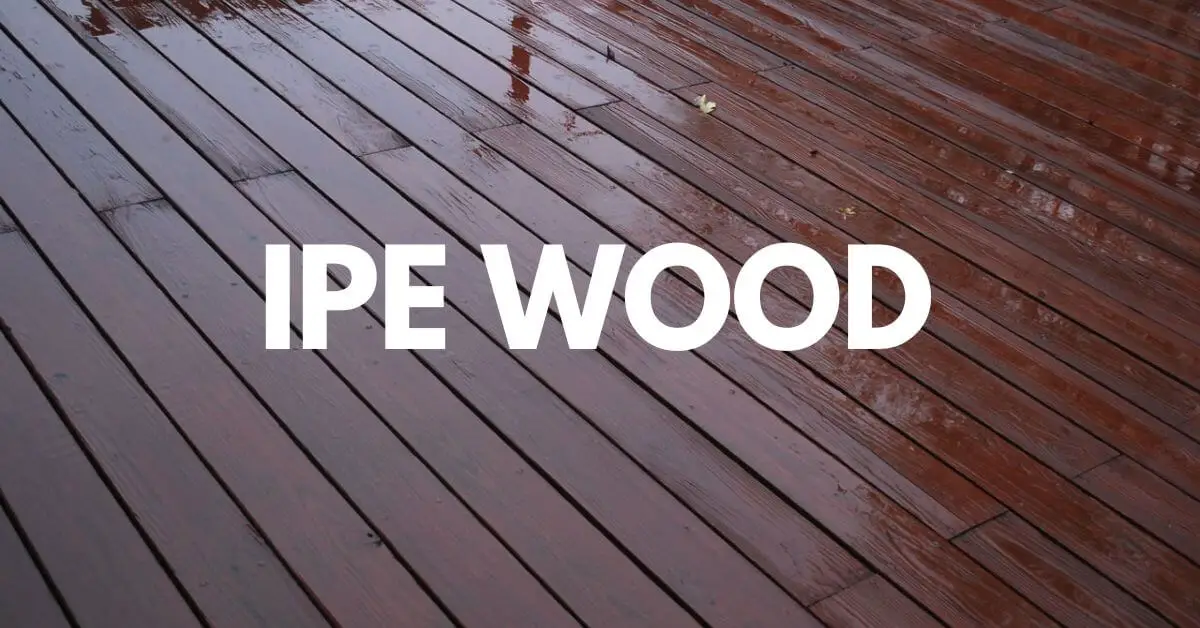
What is Ipe Wood?
Ipe wood is an extremely hard, durable, and rot-resistant hardwood that is native to Central and South America. It is known for its rich appearance, durability, and strength.
Ipe wood is incredibly versatile and widely used for making decks and fences. It is one of the best decking materials on the market today and is readily available.
Ipe wood comes from large deciduous, flowering trees that mainly grow in full sunlight. The tree grows to 100–130 ft (30–40 m) and has rough, scaly bark.
| Property | Value |
|---|---|
| Scientific name | Handroanthus spp. (formerly placed in the Tabebuia genus) |
| Dried Weight | 69 lbs/ft³ (1,100 kg/m³) |
| Modulus of Rupture | 25,660 lbf/in² (177.0 MPa) |
| Elastic Modulus | 3,200,000 lbf/in² (22.07 GPa) |
| Crushing Strength | 13,600 lbf/in² (93.8 MPa) |
| Odor | Mild scent |
| Wood Type | Hardwood |
Ipe Wood Uses
Ipe wood is often used in construction, furniture making, decks, patios, fences, flooring, and tool handles. It can be used in applications where durability and strength are required.
Ipe wood can be used for outdoor purposes such as siding and outdoor furniture because it is more resistant to insects and rot than many other hardwoods.
Ipe wood is most commonly used to make durable decking and flooring because it has a high density and natural rot-resistant properties. It is one of the finest wood species for decking.
Ipe wood is highly shock-resistant, so it is also used for tool handles.
What Color Is Ipe Wood?
The heartwood can vary in color from rich brown to yellowish olive-brown or amber hues, while its sapwood is yellowish-white and easily distinguished. The wood may have dark brown or black stripe patterns, which create a great visual appeal.
Ipe wood has a medium texture, and its grain may be irregular and interlocked, with medium to large pores.
Advantages of Ipe Wood
Ipe wood is a wonderful wood species, but we know that each wood species has limitations in terms of uses and properties. Ipe wood also has many advantages and disadvantages that you should be aware of before using it.
1. Rot- and Insect-Resistant
Ipe wood is naturally rot- and insect-resistant, and it does not require any additional treatment.
When we are looking for wood for outdoor furniture, decks, fences, and other outdoor structures, the first requirement is that the wood should be rot- and insect-resistant. So, Ipe is one of the best choices for all these purposes.
2. Durable and Stable
Ipe wood is known for its durability and stability. Whereas other hardwoods may last only for one or two decades, Ipe wood can survive for many decades and, under suitable conditions, much longer.
3. Appearance
Ipe wood is beautiful in appearance. Its reddish-brown or darker blackish-brown color makes it different from other hardwoods. By the way, many color variations are available in Ipe wood. After finishing, it gives excellent results.
Disadvantages of Ipe Wood
1. Ipe Wood Is Too Hard to Work With
Ipe wood is extremely hard and dense, which creates a blunting effect on the cutting edges during sawing. So, working with it can be challenging. Its grain is also interlocked and irregular, which makes it difficult to finish.
Ipe wood is heavy, which requires expertise and specialized equipment.
2. Expensive
Ipe wood is more expensive than many hardwoods because it is one of the rare and highly sought-after woods for making decks. A-grade Ipe wood can cost $3.20 to $4.50 per linear foot.
3. Warping
Ipe wood contains a lot of moisture, which can cause the wood to warp after drying.
Working With Ipe Wood
Working with Ipe wood is not easy. The wood is strong and dense but also has a smooth, grainy texture. It is beautiful to look at, but it is also very durable and resistant to decay.
Ipe is a hardwood that is native to South America. It is typically used for furniture, flooring, and other wood products. It is a popular choice because of its unique look and feel.
When working with Ipe, it is important to take care to avoid any damage. The wood is very strong, but if it is not handled correctly, it can easily fracture. To avoid damage, use a suitable saw and specialized equipment.
FAQ About Ipe Wood
Is Ipe Wood Durable?
Ipe wood is incredibly durable and stable. It can last up to 75 years and, with regular maintenance, can last even longer.
How Hard Is Ipe Wood?
Ipe wood is extremely hard. It is about two times harder than Sapele and Honey Locust. Ipe has a Janka hardness rating of 3,510 lbf (15,620 N).
The Janka scale determines the relative hardness of a particular domestic or exotic wood species.
Here are the Janka hardness ratings of other popular wood types compared to Ipe wood to give you an idea of how hard Ipe wood is.
| Wood Species | Janka Hardness |
|---|---|
| Desert Ironwood | 3,260 lbf (14,500 N) |
| Brazilian Teak | 3,330 lbf (14,800 N) |
| Kingwood | 3,340 lbf (14,900 N) |
| Ipe wood | 3,510 lbf (15,620 N) |
| Patagonian Rosewood (Curupay) | 3,630 lbf (16,150 N) |
| African Blackwood | 3,670 lbf (16,320 N) |
| Snakewood | 3,800 lbf (16,900 N) |
| Quebracho | 4,570 lbf (20,340 N) |
Is Ipe Wood Rot-Resistant?
Ipe wood is highly resistant to insects and rot. It is also fire- and mold-resistant. Ipe has chemical compounds that have evolved to protect the wood against decay.
This species contains oils and acids that protect the wood from rotting. The surface of the wood has an oily appearance that can be felt.
Is Ipe Wood Sustainable?
Ipe wood is considered sustainable. It is not listed in the CITES Appendices or on the IUCN Red List of Threatened Species. Ipe trees are harvested in a way that can support healthy and sustainable growth.
It is one of the more environmentally friendly woods available when sourced responsibly. Ipe can be harvested from managed forests.
Is Ipe Wood Good for Decking?
If you are looking for a durable and long-lasting wood for your deck, Ipe wood is a great option. Ipe hardwood is naturally resistant to rot and decay, making it a low-maintenance material for your deck.
Ipe wood is also one of the densest woods available, so it is very strong and less prone to scratches and dents. It can withstand moisture and weather exposure. The wood has a beautiful natural grain that adds a touch of elegance to your deck.
What Is the Best Finish for Ipe Decking?
Penofin Oil Finish works well on Ipe wood because it is designed for dense hardwoods. It penetrates dense Ipe wood well, whereas water-based finishes may not. Ipe Oil and WiseCoat are other good choices for Ipe wood.
Ipe needs to be coated regularly because these oils do not last very long. That is why most people are concerned about finishing Ipe and other dense hardwoods, as their characteristics are slightly different from those of other hardwoods.
Does Ipe Wood Decking Need to Be Sealed?
Usually not, but sealing it can be beneficial. Due to continuous exposure to UV rays and moisture, the grain of the wood can be affected, and the wood can also become discolored.
Wood sealer creates a protective layer on the wood that protects it from UV rays and helps minimize surface checking on your deck.
Ipe wood is highly water- and weather-resistant but is not completely waterproof. It can withstand more moisture than many other hardwoods for several decades or even longer.
Read Also: Ipe vs Cumaru | Which is the Best Wood for Outdoor Decks?
Conclusion
Ipe wood is an excellent choice for anyone looking for a beautiful, durable, and environmentally friendly wood. You may have to pay a higher price for the properties of Ipe wood, but its performance can justify the cost.
However, regular maintenance is required to keep Ipe wood looking its best and to help maintain its durability over time.