White Spruce
White spruce (Picea glauca) is one of the famous large coniferous evergreen trees. It is also known as Canadian spruce, skunk spruce, cat spruce, Black Hills spruce, western white spruce, Alberta white spruce, and Porsild spruce.
Picea glauca is a softwood. Softwood simply denotes wood that is soft. Its density is lower than hardwood.
Black Spruce
Black Spruce (Picea mariana) is native to Northern North America and is widespread across Canada. It is a small, upright evergreen coniferous tree. Its height is less than white spruce, so it does not produce large lumber.
Picea mariana is an excellent choice for cold northern climates and is tolerant of wet sites.
White and black spruce both play an important role in the Canadian economy. They are widely cultivated in Canada.
White Spruce vs Black Spruce Uses
White Spruce Uses
Christmas tree: White spruce trees are cone-shaped. They are widely used as Christmas trees because of their short, stiff needles and evenly spaced branches.
Go board: It is used to make Go or Weiqi boards. It is a board game for two players in which the aim is to surround more territory than the opponent. This game is very popular in Japan.
Wild food: White Spruce (Picea glauca) is a good source of wild food.
Black Spruce Uses
Fuelwood: It can be used as firewood. However, its BTU value is not very high, so it does not produce much heat during burning.
Common Uses
Both White Spruce and Black Spruce are very similar. The wood is lightweight, soft, and moderately strong.
There are some common uses of these woods, which are as follows.
Paper (pulpwood): White Spruce and Black Spruce are used in the paper industry. The paper industry uses wood as raw material to produce pulp and paper. Depending on the quality of the paper, different types of wood are used.
For example, pine is used for cardboard, and maple and oak wood are used for making toilet paper.
Construction lumber: This wood is moderately strong, so it is used for making cross-laminated timber. Cross-laminated timber provides high strength due to its cross-layered structure.
Millwork: They can be used for millwork because of their great workability, lightweight nature, and low density.
Crates: To make quality boxes and crates, the wood should be light and strong. So, White Spruce and Black Spruce are good choices for making crates and boxes.
White Spruce vs Black Spruce Tree
White Spruce Tree
Tree: White spruce has a narrow crown. It grows to 30–34 m (100–110 ft) tall, with a trunk diameter of up to 2–3 ft (0.6–1.0 m). It generally grows in well-drained soils.
They require little care and grow in a variety of colors, such as yellow and silvery blue. The color depends on their environment.
Bark: Younger trees have thin, gray bark, while mature bark is loose, scaly, and grayish-brown.
It can be easily peeled off by hand.
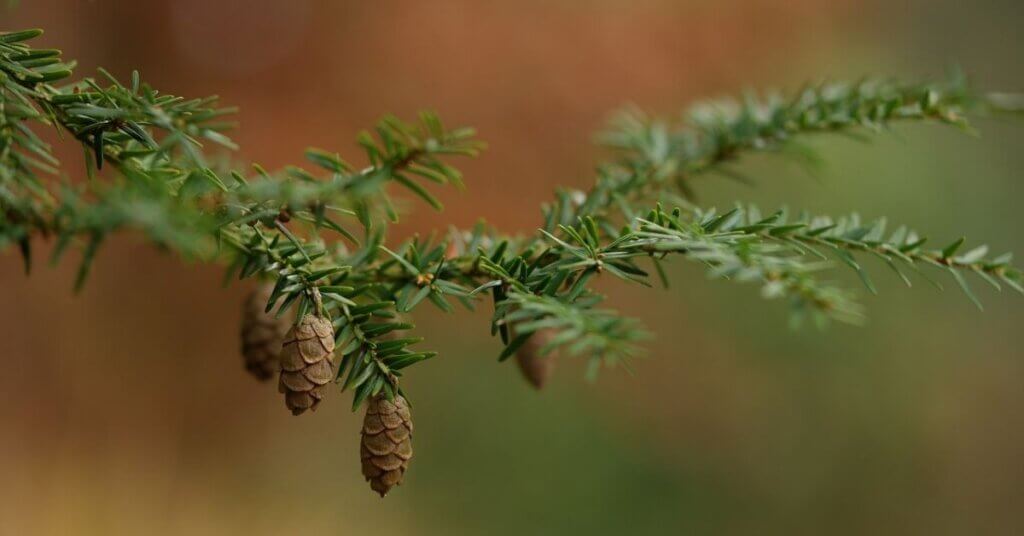
Needles: Needles are four-sided, stiff, and attached individually to the branches. Needle tips are pointed but not sharp. They are 12 to 20 mm long and silver-green in color.
Young needles are whitish-green and not pleasant-smelling. As they mature, they emit a pleasant scent.
Cones: Young cones are green or reddish, maturing to pale brown 4 to 8 months after pollination. They hang from the upper branches.
Trees can begin producing seeds at 4 years of age. The seeds remain on the tree for about 12 to 18 months. Cones can be 1 inch (2.5 cm) to 2½ inches (6 cm) long.
Black Spruce Tree
Tree: Black spruce trees do not grow very tall, reaching 5–15 m (15–50 ft) in height, with a trunk diameter of up to 1–1.5 ft (0.3–0.5 m).
These trees have a straight trunk, a narrow pointed crown, and compact, drooping branches with upturned tips.
Bark: Young trees have smooth, reddish-brown bark, but as they age, it becomes dark grayish-brown with thin, irregular scales.
Needles: The leaves are needle-like and attached individually to the branches. A branch is 1.5–4 cm long and 1–2 cm broad, while the needles are 6–15 mm long.
The needles are dark bluish-green on the upper side and paler glaucous green below.
Cones: It is a cone-producing tree. The cones of Black Spruce are among the smallest of all spruce species, measuring 1.5–4 cm long and 1–2 cm broad.
They are egg-shaped to nearly round, dark purple when young, and ripen to red-brown, eventually becoming dark brown. Cones are produced in dense clusters in the upper crown.
Wood Color
The wood of White Spruce has a fine, uniform texture. It is creamy white with a yellowish tone, straight-grained, soft, and lightweight.
Black spruce wood is similar to white spruce. There is not much difference in texture. The wood is creamy white or straw-colored, with a fine, even texture and straight grain.
Work with White Spruce and Black Spruce
White Spruce and Black Spruce are easy to work with. Both are soft and have straight grain patterns, with fewer knots. They are easy to work with both hand and machine tools and glue and finish well.
White Spruce vs Black Spruce Growth Rates
White Spruce trees grow at a medium to fast rate, with height increases of 12–24 inches (1 to 2 ft) per year. In good soil, the tree can grow over 8 ft tall in 5 years.
Black Spruce grows slowly. It grows about 6 to 12 inches (1/2 to 1 ft) per year. The ideal soil for black spruce is loose loam or sandy loam.