
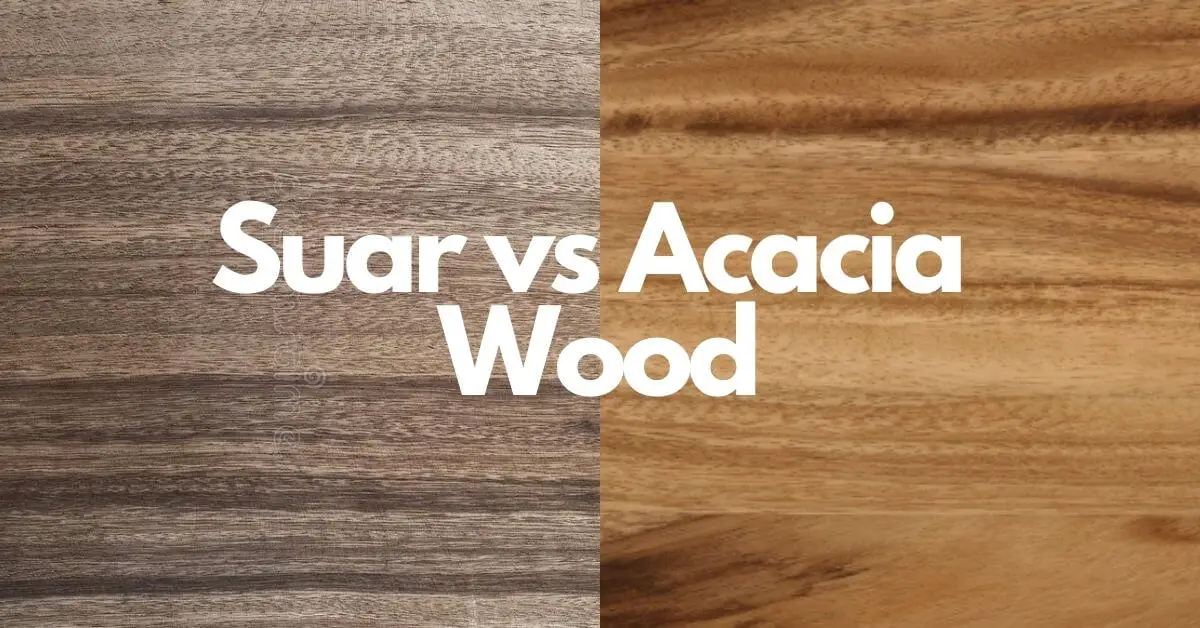
Acacia wood is more versatile and durable than Suar wood. Acacia wood is naturally resistant to moisture and water, while Suar wood is highly resistant to decay and dry-wood termites.
Suar Wood
Suar wood (Scientific Name: Albizia saman), also known as Monkeypod, Monkey Pod, Rain Tree, and Mimosa, is native to Central and South America.
Suar (Monkeypod) is a medium-hard, durable, extremely strong, rot-resistant, and decay-resistant hardwood. It is a versatile wood used for making all types of indoor and outdoor furniture.
Due to its crisscrossed, interlocking grain, it is resistant to cracking and splitting.
Acacia Wood
Acacia wood is a durable, stable, and attractive hardwood. It is widely used for making quality furniture, flooring, serving bowls, and many other products.
Acacia wood is known for its strength and deep, rich color. It typically has a chocolate-brown or reddish-brown appearance.
Acacia wood has many natural properties that distinguish it from other hardwoods. It is extremely hard and heavy, yet easy to work with both hand and power tools.
There are about 1,350 species of Acacia. Around 1,000 species are found in Australia, while the remaining species are native to Asia, Africa, and other regions.
Some well-known Acacia species include:
- Acacia Koa (Acacia koa)
- Creeping Wattle (Acacia saligna)
- Box Leaf Wattle (Acacia buxifolia)
- Coastal Wattle (Acacia longifolia)
- Flax-Leaf Wattle (Acacia linifolia)
- Green Wattle (Acacia decurrens)
- And many more
| Property | Suar Wood | Acacia Wood |
|---|---|---|
| Scientific Name | Albizia saman (syn. Samanea saman, Pithecellobium saman) | Acacia |
| Family | Fabaceae | Fabaceae |
| Wood Color | Golden to dark brown | Rich reddish-brown to dark brown |
| Tree Height | 15–25 m (49–82 ft) tall, with a 3–4 ft (1–1.2 m) trunk diameter | 15–30 m (49–98 ft) tall, with up to a 12 m (39 ft) crown spread |
| Workability | Easy to work with both hand and machine tools | Easy to work with both hand and power tools |
| Finishing | Glues and finishes well | Glues and finishes well |
| Rot Resistance | Resistant to rot and decay | Naturally rot-resistant |
| Availability | Easily available | Easily available in Australia and Asia |
| Type | Hardwood | Hardwood |
| Uses | Veneer, plywood, millwork/trim, carving, cabinetry, furniture, musical instruments, and decorative wood items | Furniture, flooring, kitchen accessories, decorative items, and more |
Color/Appearance
Suar Wood Color
The heartwood of Suar wood ranges from golden to dark brown, sometimes with darker streaks. The sapwood is yellowish-white.
The grain is usually straight but can also be interlocked or wavy. It has a medium texture, large open pores, and a medium natural luster.
Acacia Wood Color
Acacia wood has a deep, rich reddish-brown color. It has long been valued for its beautiful appearance.
Its grain may be straight or slightly wavy, depending on the species.
Uses
Suar Wood Uses
Suar wood is an excellent choice for making quality furniture and cabinetry. Its durability means furniture requires relatively little maintenance.
Besides furniture, Suar wood is also used for:
- Veneer
- Plywood
- Millwork and trim
- Carving
It is also considered a tonewood, making it suitable for musical instruments such as guitars and ukuleles.
Acacia Wood Uses
Acacia is a hard, strong, durable, rot-resistant, and moisture-resistant hardwood that is used in a wide variety of applications.
Its excellent stability makes it an outstanding choice for furniture and flooring.
Because Acacia has dense grain, it absorbs very little moisture, making it highly suitable for durable flooring.
Its natural antibacterial and water-resistant properties also make it popular for kitchen accessories such as:
- Cutting boards
- Serving bowls
- Food bowls
Working with Suar and Acacia Wood
Suar Wood
Suar wood is generally easy to work with both hand and power tools.
Interlocked or irregular grain may occasionally produce fuzzy surfaces during planing operations. However, it glues and finishes well.
Suar wood also accepts stains and paint easily.
Acacia Wood
Acacia wood is also easy to work with. Its generally straight grain makes it easy to shape and machine.
It holds glue, nails, and screws well.
Acacia wood is denser and heavier than Suar wood, so its weight can sometimes make it more difficult to handle during large projects.
Acacia wood also accepts stains well because of its dense, even grain.
Which Hardwood Is More Sustainable? Suar Wood vs Acacia Wood
Both Suar and Acacia are considered sustainable hardwoods because they grow relatively quickly and can thrive in a wide range of soil conditions.
These trees require comparatively little maintenance after establishment.
Neither Suar (Albizia saman) nor Acacia species are currently listed in the CITES Appendices or on the IUCN Red List of Threatened Species.
Which Wood Is Best?
Both Suar and Acacia are excellent hardwoods that can be used for a wide variety of woodworking projects.
If you need a harder, stronger wood for flooring or heavy-use furniture, Acacia wood is generally the better choice.
If you’re looking for an attractive hardwood for furniture, live-edge tables, cabinetry, or decorative woodworking, Suar (Monkeypod) is an excellent option because of its beautiful grain patterns and natural durability.