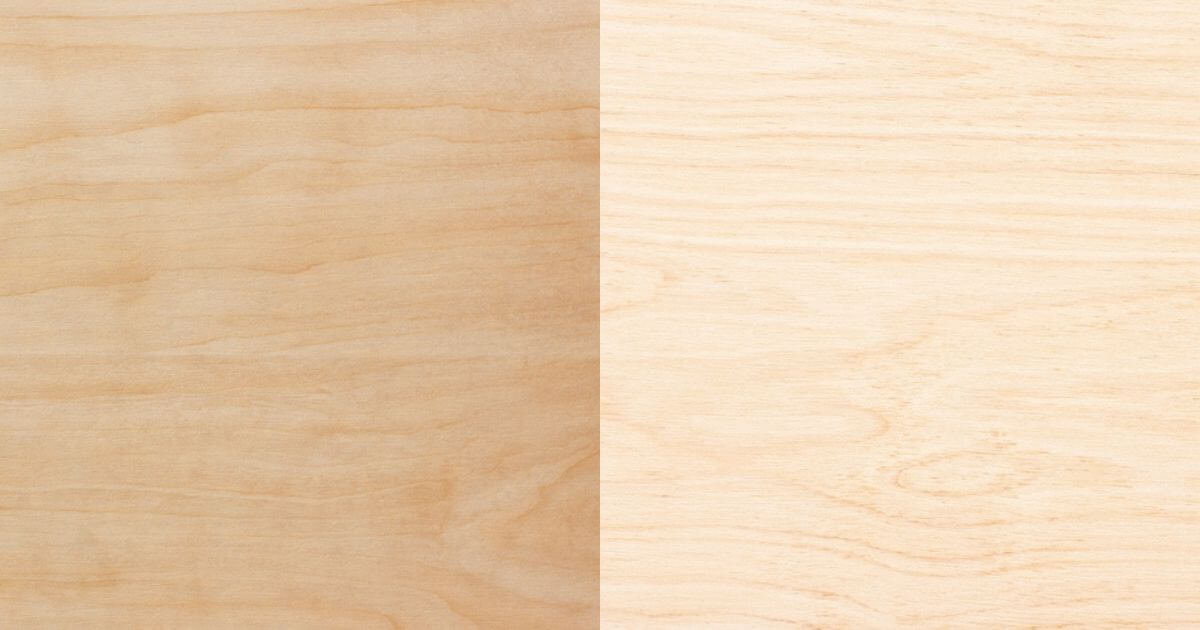
Maple and birch plywood are both good choices for cabinets. They offer light-colored wood surfaces that work well in kitchens, bathrooms, and built-in furniture. However, neither is automatically stronger, more moisture-resistant, or better value simply because of its name.
Choose maple plywood when its appearance matches your cabinet doors and trim. Choose birch plywood when it provides the appearance and panel quality you need at a better price. For cabinet strength, prioritize the core, thickness, and construction over the face species.
The most important distinction is that “maple plywood” and “birch plywood” often describe the visible veneer—not every layer inside the panel.
What Is Maple Plywood?
Maple plywood is a decorative hardwood panel with maple face veneer. Depending on the product, the core may consist of wood veneers, MDF, particleboard, or a combination of materials.
In veneer-core panels, adjacent wood layers generally run at right angles to improve stability. MDF-core panels have a different internal construction, despite also being sold as hardwood plywood.
Maple faces commonly range from creamy white to pale yellow, sometimes with warmer brown areas. Maple is not typically a uniformly dark reddish-brown wood.
Its fine grain makes it useful for cabinet sides, shelving, furniture, and panels intended to coordinate with solid maple components.
What Is Birch Plywood?
Birch plywood has birch face veneer, but its internal construction varies.
Two products sold under the birch name can be quite different:
- Birch-faced plywood: Birch veneer over another type of core.
- All-birch plywood: Birch veneers throughout the panel.
Birch usually has a light cream to pale yellow appearance, although reddish-brown heartwood and color variation may be present.
It is widely used for cabinetry, drawer components, furniture, and workshop projects. For example, WISA-Birch is an all-birch product intended for several applications, including furniture. Its specifications should not be assumed to apply to every birch-faced panel.
Maple vs Birch Plywood: Quick Comparison
| Feature | Maple plywood | Birch plywood |
|---|---|---|
| Typical appearance | Creamy white to pale yellow, with possible brown variation | Cream to pale yellow, sometimes with reddish-brown areas |
| Grain | Usually fine and relatively subtle | Usually fine; figure varies with veneer selection |
| Core construction | Veneer, MDF, particleboard, or combination core | Birch veneer core, other veneer cores, MDF, or other constructions |
| Cabinet strength | Depends mainly on panel construction and thickness | Depends mainly on panel construction and thickness |
| Painting | Suitable with proper preparation | Suitable with proper preparation |
| Staining | Can develop uneven color | Can also develop uneven color |
| Moisture resistance | Depends on the specified panel | Depends on the specified panel |
| Cost | Varies by grade, core, and finish | Varies; premium all-birch can cost more than maple-faced panels |
| Main buying consideration | Matching visible maple components | Choosing between birch-faced and all-birch construction |
Which Is Better for Cabinets?
Both can make durable cabinets when the panels are well manufactured and correctly assembled.
A useful approach is to choose separately for the visible surfaces and the cabinet structure. You may want maple on exposed ends to match maple doors, while using another suitable panel for concealed components.
For a painted cabinet, the face species may matter less than flatness, surface quality, and how much preparation the panel requires.
For cabinet boxes, look closely at:
- Core quality and internal gaps.
- Thickness consistency.
- Screw-holding performance.
- Panel flatness.
- Shelf support and joinery.
- The suitability of the finish.
A well-made birch panel can be a better cabinet material than a poorly made maple panel, and the reverse is equally true.
Strength and Durability
Does Maple Plywood Have Better Dent Resistance?
Not necessarily. Comparing the hardness of solid maple and birch does not establish the performance of two plywood sheets.
Maple and birch each include different species. In addition, plywood has a relatively thin face veneer supported by a core. Veneer thickness, the underlying material, and the finish all affect how the surface responds to impact.
Scratches and dents are also different problems. A scratch may affect only the coating, while a dent compresses the wood underneath.
Avoid paying extra for maple solely because a seller describes it as “harder.”
Which Is Better for Cabinet Shelves?
The panel’s stiffness, thickness, span, and load are more important than the face species.
A short shelf holding cups has different requirements from a long shelf supporting dishes or books. Either plywood can sag if the shelf is too thin or insufficiently supported.
Choose the panel and shelf design together. Add intermediate support or a properly designed stiffening edge where needed.
Why the Plywood Core Matters
The core influences weight, machining, flatness, and fastening.
| Core type | Cabinet-making consideration |
|---|---|
| Veneer core | Often offers a useful balance of weight, strength, and screw holding |
| MDF core | Provides a smooth, consistent substrate but is generally heavier |
| Combination core | Combines materials to balance surface smoothness and structural properties |
| All-birch veneer core | Can provide consistent layered edges and useful machining performance; check the actual specification |
Manufacturers can place different decorative faces over the same core. Columbia Forest Products’ core guide explains these construction options.
This is why comparing two sheets by face species alone can be misleading.
Appearance: Maple vs Birch Plywood
Maple and birch can look similar, especially under a light clear finish. The final appearance depends on the veneer cut, color selection, and finish.
Rotary-cut veneer may show broader, more varied patterns, while sliced veneer can produce a different grain arrangement. Ask to see the actual sheets rather than choosing from a small sample alone.
For cabinets with exposed sides or several matching doors, select panels together. Also test the plywood beside any solid-wood trim. Even when both are maple—or both birch—they may absorb stain differently.
Painting and Staining
For Painted Cabinets
Both materials can accept paint well after suitable preparation.
Choose a smooth face with minimal visible repairs, fill imperfections where appropriate, and use a compatible primer. Protect the thin face veneer when sanding.
For an especially smooth painted surface, a panel with a smooth engineered substrate may be worth considering. The quality of the finished surface matters more than whether the face is maple or birch.
For Stained Cabinets
Neither species should be described as automatically easy to stain. Uneven absorption can produce blotchy areas, particularly with darker colors.
Test the complete finishing process on an offcut from the actual sheet. Include any matching solid-wood edging in the test.
Use a stain, conditioner, dye, or toner system according to the coating manufacturer’s instructions. One preparation method does not suit every finish.
For Clear-Finished Cabinets
A clear finish is useful when you want to retain the light color and natural grain.
Check a finished sample before committing. Some coatings add noticeable warmth, while others preserve a paler appearance.
Prefinished panels may also reduce finishing work for cabinet interiors. Check which faces are coated and how cut edges should be completed.
Moisture Resistance and Outdoor Use
Neither maple nor birch face veneer makes a panel waterproof.
Ordinary decorative cabinet plywood is generally intended for interior use. A kitchen or bathroom application still requires appropriate panel selection, protected edges, and prompt attention to leaks.
For sink cabinets, pay particular attention to plumbing cutouts and the cabinet bottom. An accessible leak tray can help contain small spills, but it does not replace repairing a leak.
Outdoor furniture needs a panel specifically rated for the exposure. Do not assume that a cabinet-grade sheet becomes suitable outdoors after painting.
Price: Is Birch Plywood Cheaper Than Maple?
Birch-faced plywood may cost less than comparable maple-faced plywood at some suppliers, but there is no universal price order.
Premium all-birch panels can cost more than standard maple-faced sheets. Other factors include:
- Face and back grades.
- Core construction.
- Sheet dimensions and thickness.
- Color matching.
- Factory-applied finish.
- Local availability and delivery.
Compare equivalent products. A prefinished sheet may have a higher purchase price but save finishing time and materials.
Working with Maple and Birch Plywood
Both can be cut and machined with ordinary woodworking equipment, but thin face veneers need care.
Use a sharp blade suited to plywood and support the sheet during cutting. A zero-clearance support or suitable guide system can help reduce splintering.
Measure the actual panel thickness before cutting grooves or dadoes. Material sold under the same nominal thickness may not fit the same joint perfectly.
For visible edges, use matching edge banding or solid-wood edging. If you want exposed layered edges, inspect the core for gaps and appearance before purchasing.
Maple Plywood Pros and Cons
Pros
- Useful for coordinating with solid maple cabinet doors and trim.
- Fine grain suits clear finishes and painted work.
- Available with different cores and factory finishes.
- Suitable for cabinet boxes, shelves, and furniture when correctly specified.
Cons
- Selected, color-matched faces can increase the price.
- Dark stains may develop unevenly.
- Thin face veneers limit sanding and refinishing.
- The maple name does not guarantee a high-quality or moisture-resistant core.
Birch Plywood Pros and Cons
Pros
- Light appearance works well in many cabinet styles.
- Available as both decorative birch-faced and all-birch panels.
- Can offer good value for cabinet interiors and general furniture.
- Suitable all-birch products can work well for exposed-edge designs.
Cons
- Birch-faced and all-birch products can differ substantially in quality.
- Face repairs and color variation may affect visible surfaces.
- Staining can produce uneven results.
- Standard interior products are unsuitable for prolonged wet exposure.
Birch plywood is not inherently prone to warping. Either material can distort because of poor storage, moisture imbalance, manufacturing issues, or unsuitable construction.
Which One Should You Choose?
| Your priority | What to choose |
|---|---|
| Matching maple doors and trim | Maple-faced plywood with a tested finish match |
| Matching birch components | Birch-faced plywood selected for compatible color and grain |
| Painted cabinets | The flatter, smoother panel with the appropriate core |
| Exposed plywood edges | A panel with an attractive, consistent core |
| Strong cabinet boxes | Suitable construction, thickness, and joinery in either species |
| Lower total cost | Compare equivalent grades, including finishing expenses |
For most cabinets, the best choice is the sheet that combines an appropriate core with the appearance you want. Inspect the actual panels, test the finish, and spend on construction quality before paying for a species name.