Dogwood
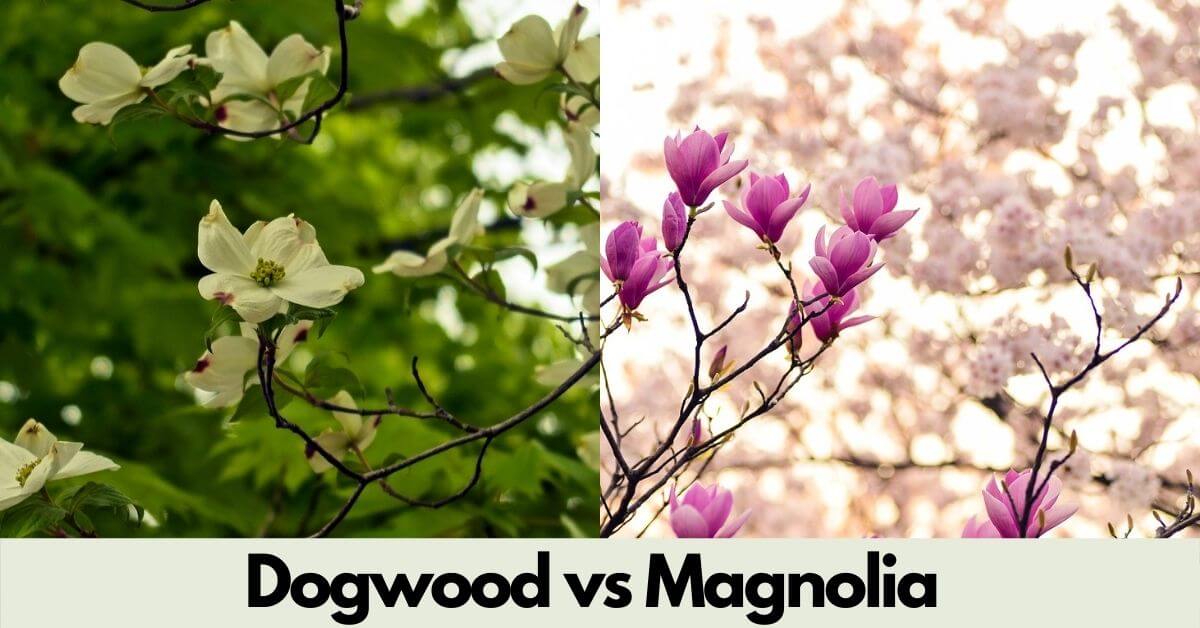
Dogwood (Cornus florida) is a genus of about 30–60 species. It is native to eastern North America and northern Mexico. Some common flowering species are Kousa dogwood, Pacific dogwood, and many more. Some of these are deciduous woody species or shrubs. Dogwoods have a lifespan of 70 to 80 years.
Magnolia
Magnolia is known as a flowering tree or shrub. It has about 210 species. Some are large trees and shrubs, native to North and South America, the Himalayas, and East Asia. Some common species are Anise Magnolia (Magnolia salicifolia), Bigleaf Magnolia (Magnolia macrophylla), Ashe’s Magnolia (Magnolia ashei), Cucumber Tree (Magnolia acuminata), etc.
Comparison Table
| Dogwood | Magnolia (Southern Magnolia) | |
|---|---|---|
| Scientific name: | Cornus florida | Magnolia grandiflora |
| Native to: | Eastern North America | North and South America, the Himalayas, and East Asia |
| Tree Size | 30–40 ft (9–12 m) tall, 1–1.3 ft (0.3–0.4 m) trunk diameter | 50–80 ft (15–24 m) tall, 2–3 ft (0.6–1 m) trunk diameter |
| Janka Hardness | 2,150 lbf (9,560 N) | 1,020 lbf (4,540 N) |
| Rot Resistant | No, susceptible to insect attack | No, susceptible to insect attack |
| Workability | Working can be a bit difficult | Easy to work |
| Color/Appearance | Pale pinkish to reddish-brown | Creamy white to grayish |
| Uses | Ornamental tree, medical treatment, golf club heads, textile shuttles, bows (archery), mallets, pulleys, and turned objects | Veneer, plywood, interior trim, furniture frames, and medicine |
Dogwood vs Magnolia Uses
Dogwood Tree and Wood Use
Wood uses: Dogwood is an extremely dense and stable hardwood. It is a great option for making sporting equipment such as golf club heads and bows (archery). It is also converted into charcoal for gunpowder.
As an ornamental tree: Dogwood is a small flowering tree. It is planted as an ornamental tree. In native areas, it is often seen along roadsides, parks, and residential areas. It is easily propagated by seeds.
In treatment: Native Americans use American dogwood to treat headaches, fatigue, fever, and diarrhea. Do not confuse American dogwood with Jamaican dogwood, as Jamaican dogwood can be harmful. It is not recommended for human use.
Magnolia Uses
Furniture: Some large species of magnolia, such as southern magnolia, are mainly used for making furniture.
Due to its straight grain and fine, uniform texture, it is a great option for veneer, plywood, and interior trim.
In treatment: Many species of magnolia are used in medicine. For example, Houpo magnolia, commonly known as “magnolia bark,” is native to China. The bark, leaves, and flowers are used in traditional medicine to treat anxiety, depression, and other conditions.
Dogwood vs Magnolia Identification
Dogwood Identification
It can generally be identified by its blossoms, berries, and distinctive bark. It is an ornamental tree commonly found in the United States. Dogwood species include shrubs, deciduous trees, and evergreens.
Dogwoods grow well in moist, well-drained, slightly acidic soil that contains organic matter.
Magnolia Identification
Magnolia sizes range from 15-ft shrubs to 80-ft massive trees. Large trees can have a spread of up to 40 ft. Magnolia trees and shrubs grow well in well-drained soil.
There are two types of magnolia trees: evergreen and deciduous. Evergreen species are suited for warm climates, while deciduous species grow well in colder climates.
Dogwood vs Magnolia Leaves
| Dogwood Leaves | Magnolia Leaves |
|---|---|
| 1. Dogwood leaves have an oval shape, visible curved veins, smooth edges, and a glossy look. | 1. Magnolia leaves are large, leathery, and visually striking. |
| 2. Leaves are 2” to 4” (5–10 cm) long. | 2. Leaves are 4 to 8 inches (10–20 cm) long and about 5″ (12 cm) wide. |
| 3. Green above and slightly paler below | 3. Some species like sweetbay and yellow magnolia have smaller leaves, about 4 to 6 inches long. |
| 4. American dogwood leaves turn a reddish color in autumn | 4. The upper surface is dark green, and the underside is lighter green |
| 5. Leaves are alternately arranged |
Dogwood vs Magnolia Flowers
Dogwood Flowers
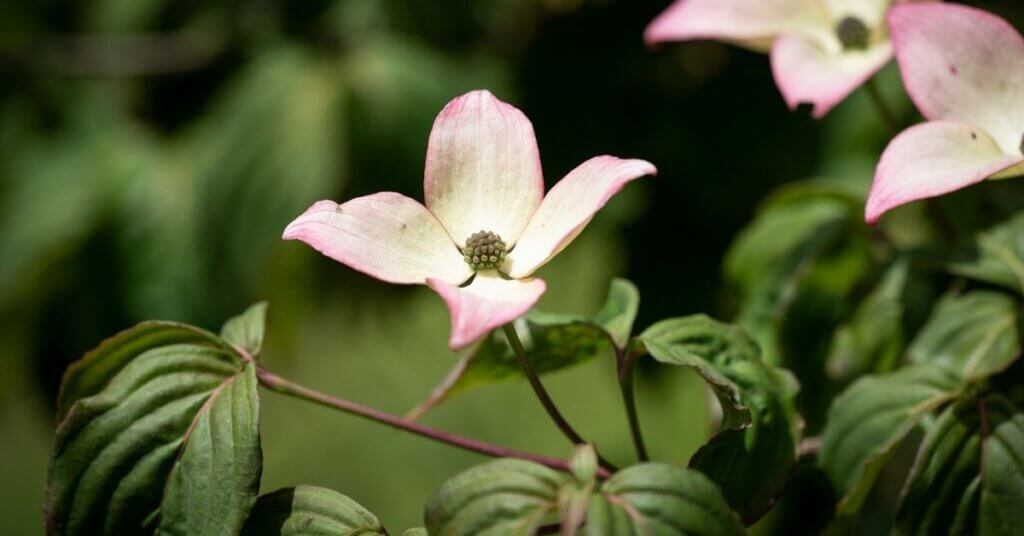
- Dogwood flowers are usually white, but some species produce pink, yellow, or yellow-green flowers depending on the species.
- Dogwood is monoecious, meaning male and female flowers grow on the same tree.
- Flowers bloom in clusters from mid-March to May.
Magnolia Flowers
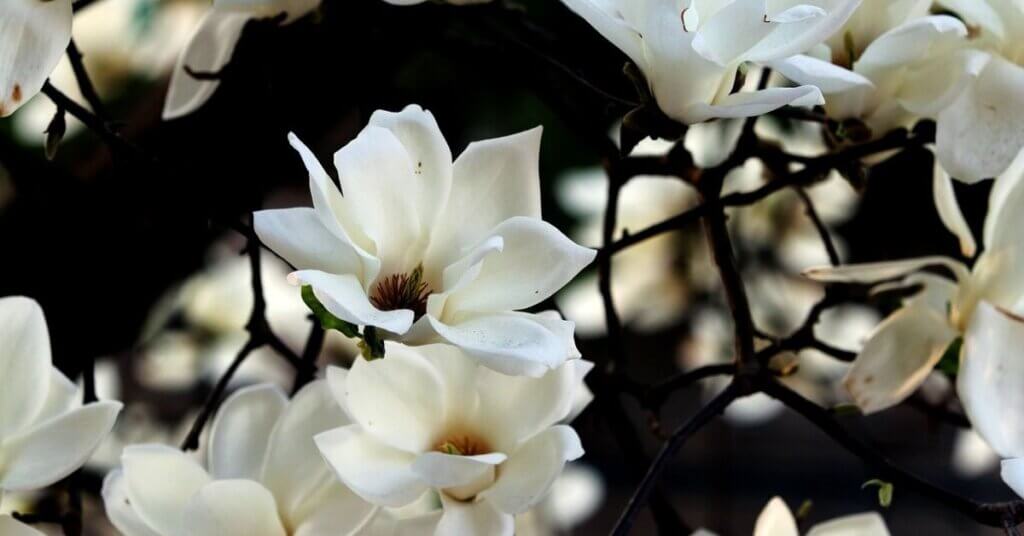
- Magnolia species have a wide variety of beautiful and distinctive flowers.
- Flowers can be purple, green, yellow, white, or pink, depending on the species.
- Magnolia flowers are star-shaped or bowl-shaped and can grow up to 12 to 15 inches across.
Dogwood vs Magnolia Bark
| Dogwood Bark | Magnolia Bark |
|---|---|
| 1. Dogwood bark is dark brown or gray | 1. Young trees have thin, smooth bark |
| 2. Young trees have smooth bark, becoming scaly or blocky with age | 2. With age, the bark becomes thicker with small cracks |
| 3. The bark is relatively easy to peel | 3. Southern magnolia bark is typically gray |
Wood Color Difference Between Dogwood and Magnolia
| Dogwood Wood Color | Magnolia Wood Color |
|---|---|
| Dogwood heartwood is reddish-brown, and sapwood is cream to pale pinkish | Magnolia heartwood ranges from medium to dark brown, sometimes with green, purple, or black streaks; sapwood is creamy white to grayish |
Dogwood vs Magnolia Workability
Dogwood is hard and dense. Its Janka hardness is 2,150 lbf (9,560 N), and its crushing strength is 8,740 lbf/in² (60.3 MPa). It is difficult to work with because of its high density and interlocking grain. However, it glues and finishes well.
Southern magnolia is easier to work with because it has lower density than dogwood. Its Janka hardness is 1,020 lbf (4,540 N), and its crushing strength is 5,460 lbf/in² (37.7 MPa). It turns, glues, stains, and finishes well.
Dogwood vs Magnolia Rot Resistance
Dogwood and magnolia are both rated as non-durable in terms of decay resistance and are susceptible to insect attack. Both types of wood do not perform well in harsh environmental conditions and are not suitable for outdoor use.
Dogwood vs Magnolia Allergies/Toxicity
Magnolia wood dust has been reported to cause asthma-like symptoms and a runny nose. There are no major health concerns reported with dogwood, but all wood dust can be harmful, especially for people with asthma.
Therefore, before working with any type of wood, protect your eyes and exposed skin, even if you are healthy.