
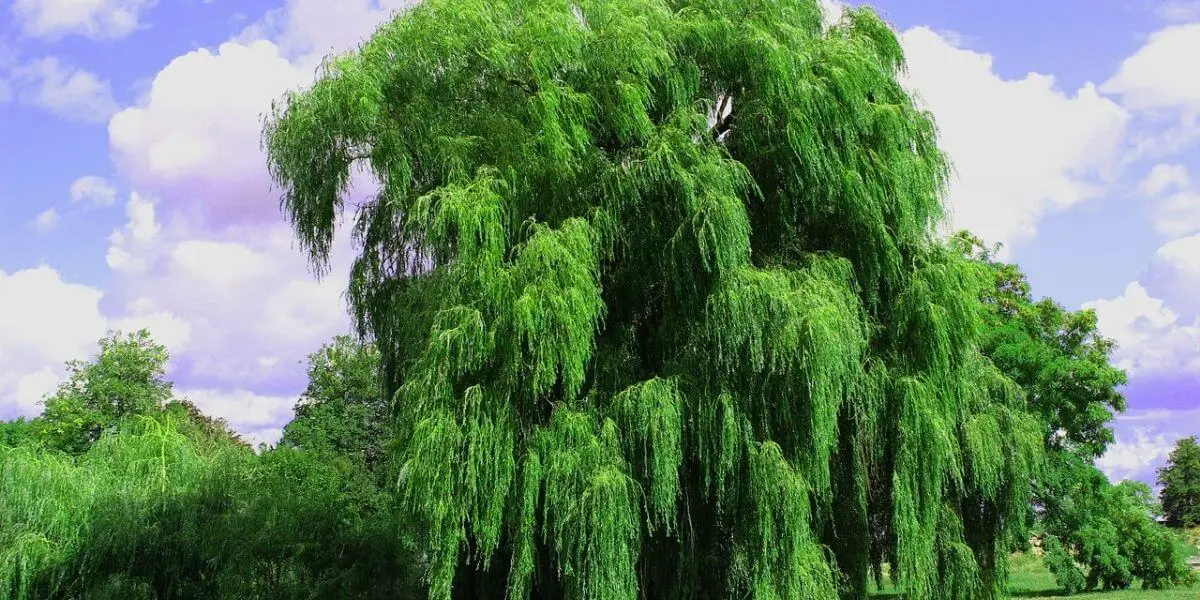
Willow oak (Quercus phellos) is native to the eastern and central United States. It is a deciduous tree widely planted in parks, streets, and residential yards because it provides excellent shade and an attractive landscape appearance. Willow oak is often found near lakes, ponds, and moist lowlands because it grows best in soils with good moisture.
Pin oak (Quercus palustris) is also native to North America and is one of the most commonly planted oak trees for landscaping. Its wood has properties similar to red oak. Pin oak grows quickly, develops beautiful fall colors, and provides dense shade, making it a popular choice for urban landscapes and large yards.
Both trees belong to the oak family and share many similar characteristics, but they differ in growth pattern, wood properties, and common uses.
Willow Oak vs Pin Oak Comparison
| Feature | Willow Oak | Pin Oak |
|---|---|---|
| Scientific Name | Quercus phellos | Quercus palustris |
| Tree Height | 65–100 ft (20–30 m) | 50–75 ft (15–23 m) |
| Trunk Diameter | 3–5 ft (1–1.5 m) | 2–4 ft (0.6–1.2 m) |
| Dried Weight | 48 lbs/ft³ (770 kg/m³) | 44 lbs/ft³ (705 kg/m³) |
| Janka Hardness | 1,460 lbf (6,490 N) | 1,500 lbf (6,650 N) |
| Common Uses | Furniture, cabinetry, landscaping | Furniture, cabinetry, landscaping |
| Workability | Good | Good |
| Availability | Easily available | Easily available |
| Color | Light to medium reddish-brown | Light to medium reddish-brown |
Willow Oak vs Pin Oak Uses
Willow Oak Uses
Willow oak is widely used as an ornamental and landscaping tree because of its attractive shape and dense shade. It is commonly planted in parks, residential yards, shopping centers, and along streets.
The wood of willow oak is also used for:
- Lumber and construction
- Railroad crossties
- Furniture and cabinetry
- Pulpwood production
Historically, willow bark has been used to make salicin, a compound similar to aspirin. Some people use willow bark extracts as a natural remedy for pain relief.
Pin Oak Uses
Pin oak is also popular in landscaping due to its fast growth and attractive fall colors. Its wood properties are similar to red oak, making it suitable for many woodworking applications.
Common uses of pin oak include:
- Landscaping and shade trees
- Furniture and cabinetry
- Firewood
- Flooring and interior woodwork
Pin oak has a Janka hardness of 1,500 lbf, which is slightly higher than willow oak. Because of this hardness, it can perform well in flooring and other projects where resistance to dents and scratches is important.
Willow Oak vs Pin Oak Workability
When it comes to woodworking, there is not a major difference between willow oak and pin oak. Both species are relatively easy to:
- Glue
- Stain
- Finish
- Machine
However, these trees tend to have many branches, which means the lumber can contain more knots. In some cases, knots can make woodworking slightly more difficult.
Willow Oak vs Pin Oak Firewood
Willow oak is not considered the best firewood compared with other hardwoods. It produces less heat than pin oak and may be more difficult to split. In addition, willow oak wood contains more moisture and should be seasoned for one to two years before burning.
Pin oak, on the other hand, is often considered better firewood. It is harder and heavier than willow oak and has excellent coaling properties. Pin oak produces about 25.9 million BTUs per cord, meaning it can generate more heat during burning.
Difference Between Willow Oak and Pin Oak Trees
Tree Size and Growth Rate
Willow oak typically grows 65–100 feet tall with a trunk diameter of 3–5 feet. It has a fast growth rate, often growing about 2 feet per year under good conditions.
Pin oak usually grows 50–75 feet tall with a trunk diameter of 2–4 feet. Like willow oak, it also grows relatively fast, making it popular for landscaping projects where quick shade is desired.
Leaves
One of the easiest ways to identify willow oak is by its long, narrow leaves, which resemble the leaves of willow trees. The leaf edges are smooth, and in autumn they turn red or orange before falling.
Pin oak leaves are lobed and broader, typical of many oak species. They usually turn deep red or bronze in fall, adding strong seasonal color to landscapes.
Bark
The bark of willow oak is smooth and light gray when young, gradually becoming darker and more cracked as the tree matures.
Pin oak bark starts out smooth and light greenish-gray, later turning dark gray and rough with age. Mature trees develop a distinctive branching pattern and spreading canopy.
Which Is Better: Willow Oak or Pin Oak?
It is difficult to say that one tree is completely better than the other. Both species belong to the oak family and share many characteristics similar to red oak.
However, there are some differences:
- Pin oak is generally better for firewood because it burns hotter.
- Willow oak is often preferred for ornamental planting and landscaping.
In the end, the better choice depends on how you plan to use the tree or its wood.
- Choose pin oak if you want better firewood or slightly harder wood.
- Choose willow oak for landscaping and shade.
Comments are closed.