
Mahogany is a hardwood valued for its reddish-brown color, attractive grain, good workability, and dimensional stability. It is widely used for furniture, cabinetry, musical instruments, veneers, and selected boatbuilding applications.
However, “mahogany” does not always describe the same wood. Genuine mahogany comes from the genus Swietenia, while African mahogany and several other commercially named woods belong to different genera.
Understanding the species helps you compare hardness, durability, price, and suitability for your project.
What Is Mahogany Wood?
Genuine mahogany comes from Swietenia trees in the family Meliaceae. These trees are native to parts of the Americas, including Mexico, Central America, South America, the Caribbean, and southern Florida, depending on the species.
Some species are also grown in plantations outside their native range.
Mahogany generally ranges from pale pinkish-brown to a richer reddish-brown. Its color often deepens with age and exposure to light.
Three species are commonly recognized as genuine mahogany:
- Swietenia macrophylla — bigleaf or Honduran mahogany.
- Swietenia mahagoni — West Indian or Cuban mahogany.
- Swietenia humilis — Pacific Coast mahogany.
The FAO’s overview of Swietenia distinguishes these three species and their natural hybrids.
Mahogany Wood Properties
| Property | General Description |
|---|---|
| Botanical genus | Swietenia for genuine mahogany |
| Wood classification | Hardwood |
| Tree size | Varies by species; large bigleaf mahogany trees can reach approximately 100–200 feet |
| Color | Pale pinkish-brown to reddish-brown |
| Grain | Straight, interlocked, wavy, or figured |
| Texture | Generally medium and relatively even |
| Hardness | Moderate; varies by species |
| Dimensional stability | Generally good when properly dried |
| Natural decay resistance | Varies by species and heartwood quality |
| Common uses | Furniture, cabinetry, instruments, veneer, and boatbuilding |
These characteristics should not be applied automatically to every timber sold with “mahogany” in its name.
Mahogany Wood Uses
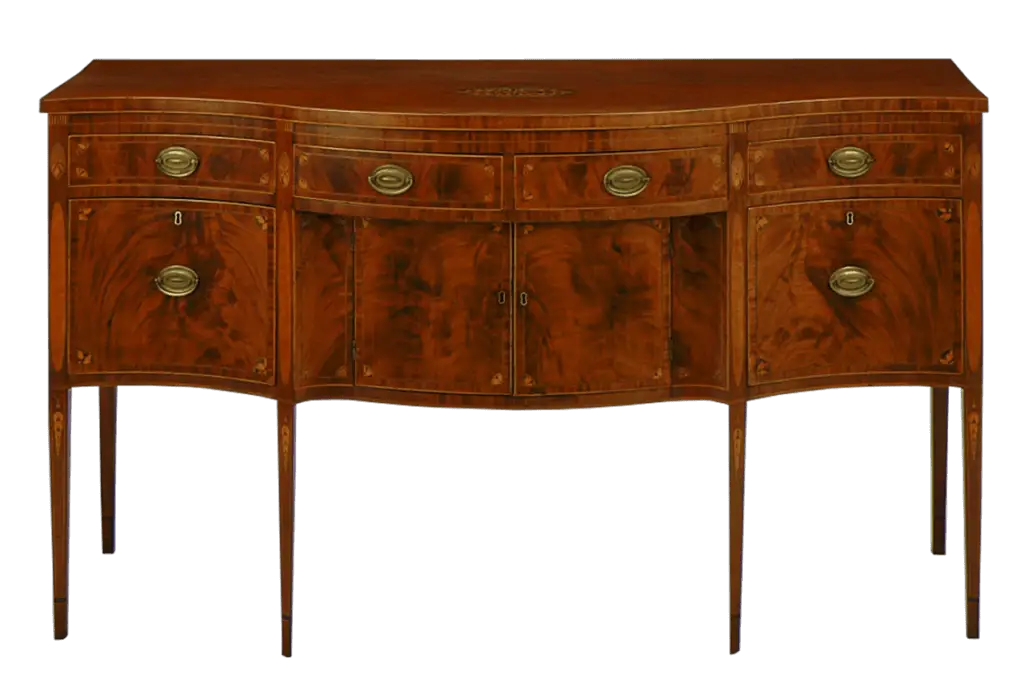
Mahogany has a long history in furniture making and decorative woodworking. Its combination of appearance, workability, and stability makes it useful for both visible surfaces and carefully fitted components.
1. Flooring
Mahogany is used for flooring where its warm color and grain are desirable.
However, genuine Honduran mahogany is softer than common red oak and white oak, so it should not be described as universally more resistant to dents.
Flooring performance depends on the species, finish, construction, and maintenance. Some harder woods marketed with “mahogany” in their names are botanically different from genuine mahogany.
Dark flooring can also show dust and scratches, so color should be chosen for appearance rather than assumed cleanliness.
2. Plywood and Veneers
Mahogany veneer is used on furniture, cabinetry, wall panels, and plywood products. It provides an attractive surface while using less premium timber than a comparable solid-wood panel.
A mahogany-faced plywood panel may contain other species in its core.
Its strength and moisture performance depend on the core, adhesive bond, grade, thickness, and direction of loading. It is not automatically stronger than solid wood of the same thickness, nor does a mahogany face make plywood marine-grade.
3. Boats and Marine Joinery
Selected mahogany has a long history in boatbuilding, including planking, trim, and interior joinery.
Its workability and dimensional stability are valuable, but boat construction requires more than a durable species. Suitable material selection, fastening, sealing, drainage, and maintenance all contribute to performance.
Mahogany is not waterproof or immune to decay during prolonged wet exposure.
4. Furniture
Mahogany is highly valued for furniture because it combines an attractive appearance with generally good working properties.
Common applications include:
- Dining tables and desks.
- Cabinets and sideboards.
- Beds and wardrobes.
- Chairs and occasional tables.
- Drawer fronts and decorative panels.
- Reproduction and traditional-style furniture.
Clear boards suit understated designs, while figured veneer can create more decorative surfaces.
5. Musical Instruments
Mahogany is widely used for guitar bodies, necks, backs, and sides, as well as other instrument components.
The exact species and construction influence performance. A guitar marketed as “mahogany” may use genuine mahogany, African mahogany, or another named alternative, so check the specification.
6. Doors, Trim, and Decorative Items
Mahogany is also used for doors, architectural joinery, moldings, turned objects, and carvings.
Suitable exterior applications require the correct species, grade, protective system, and construction details.
Mahogany Wood Appearance
Mahogany can range from pale pinkish-brown to deep reddish-brown. Color varies between species and individual boards.
The wood often becomes darker or warmer with age. A finish may slow some changes, but it cannot permanently freeze the original color.
Grain may be straight, interlocked, irregular, or wavy. Some boards display ribbon-like figuring, while decorative veneers may show more elaborate patterns.
Although mahogany can feel smooth after preparation, it still has visible pores. A grain filler may be useful when a completely level, high-gloss finish is desired.
Working with Mahogany Wood
Genuine mahogany generally works well with hand and machine tools. Straight-grained stock is particularly pleasant to cut, shape, and fit.
Interlocked or figured grain can produce tear-out during planing or routing. Sharp cutters and controlled cuts help preserve the surface.
Cutting and Shaping
Support the work securely and use sharp blades. Test the cutting direction on an offcut when working with figured stock.
Sanding
Progress through appropriate grits and remove scratches left by the previous abrasive. On ordinary flat surfaces, final sanding with the grain helps reduce visible scratches.
Gluing and Fastening
Mahogany generally glues well and holds fasteners satisfactorily. Pilot holes are useful near board ends, in narrow components, and when using larger screws.
Finishing
Clear finishes can emphasize the wood’s natural color. Stain can help achieve a particular appearance or improve color consistency, but testing is essential.
Choose a finish appropriate for the intended environment rather than assuming an indoor furniture coating will suit exterior joinery.
Is Mahogany Rot-Resistant?
Some mahogany heartwood has useful natural decay resistance, but performance varies by species, source, and growing conditions.
Sapwood generally does not offer the same protection as heartwood.
Natural extractives contribute to durability, but they do not prevent all moisture absorption or guarantee resistance to every insect. Mahogany should not be described as protected by a universal substance called “mahogany oil.”
For exterior work, avoid trapped water and maintain the required coatings. A finish can reduce weathering and moisture uptake, but it does not turn unsuitable wood into a rot-proof material.
How Hard Is Mahogany Wood?
Mahogany is botanically a hardwood, but genuine mahogany is not among the hardest woodworking timbers.
The USDA Forest Products Laboratory’s Honduran mahogany technical sheet reports a dry Janka side-hardness value of approximately 800 lbf (3,560 N) for Swietenia macrophylla.
For comparison:
| Wood | Approximate Janka Hardness |
|---|---|
| Douglas-fir | 660 lbf |
| Honduran mahogany | 800 lbf |
| Northern red oak | 1,290 lbf |
| White oak | 1,360 lbf |
Janka hardness measures resistance to indentation. It does not directly measure scratch resistance, structural strength, or durability outdoors.
Very high hardness figures advertised for other “mahogany” woods may refer to unrelated species.
Mahogany Wood Advantages
1. Attractive Appearance
Its warm color and distinctive grain suit furniture, interiors, and decorative woodworking.
The wood can look appealing under a clear finish, and figured material offers additional visual interest.
2. Useful Exterior Performance in Suitable Material
Selected mahogany heartwood can be used in exterior joinery and marine components.
Its suitability depends on the species and application. Good drainage and maintenance remain necessary.
3. Good Dimensional Stability
Properly dried genuine mahogany is valued for relatively low movement compared with many other furniture woods.
However, it still expands and contracts as moisture conditions change. Wide tabletops, doors, and panels need construction methods that accommodate this movement.
4. Good Workability
Mahogany generally cuts, carves, drills, turns, glues, and finishes well.
This combination makes it useful for detailed furniture work and carefully fitted joinery.
5. Available in Several Product Forms
Depending on the supplier, mahogany is available as solid lumber, veneer, instrument blanks, and finished products.
Availability varies considerably by species. Some alternatives are easier to source than genuine mahogany in particular sizes.
Mahogany Wood Disadvantages
1. Cost
Clear, well-dried genuine mahogany can be expensive compared with common softwoods and some domestic hardwoods.
Price depends on species, grade, dimensions, origin, transport, and local demand. Large projects can require a substantial material budget.
2. Weight Varies
Large mahogany furniture can be heavy, but genuine mahogany is not uniformly an exceptionally dense timber. Some common furniture hardwoods are heavier.
Consider the actual species and finished dimensions rather than assuming every mahogany product has the same weight.
3. Dents and Surface Wear
Moderate hardness means that impacts can leave dents. Flooring and tabletops still benefit from furniture pads, suitable finishes, and careful use.
4. Color Changes
Mahogany often darkens with age and light exposure. Objects left on a surface can create uneven exposure, causing temporary differences in color.
5. Confusing Commercial Names
Not all products labeled “mahogany” contain genuine Swietenia wood.
This can make comparisons difficult, particularly when a product description omits the botanical species.
Types of Mahogany
1. Honduran or Bigleaf Mahogany — Swietenia macrophylla
Honduran mahogany and bigleaf mahogany are names for the same species. The name “Honduran” does not necessarily mean a particular board was grown in Honduras.
Its native range extends from Mexico through Central America into parts of South America. It is also cultivated elsewhere.
The wood commonly ranges from pinkish-brown to reddish-brown and is valued for its workability.
Uses: Furniture, cabinetry, veneer, instruments, doors, boat components, turned objects, carving, and decorative products, including coffins in some markets.
The tree has large compound leaves and upright woody fruit capsules sometimes called “sky fruit.”
2. Cuban or West Indian Mahogany — Swietenia mahagoni
Also known as small-leaf mahogany, this species is native to southern Florida and parts of the Caribbean, including the Bahamas, Cuba, Jamaica, and Hispaniola.
It has a long history in fine furniture and interior woodwork. Commercial availability can be limited, so verify the source and identity of material offered for sale.
Uses: Fine furniture, cabinetry, decorative joinery, veneers, and restoration work when suitable material is available.
3. Pacific Coast Mahogany — Swietenia humilis
This species is associated with seasonally dry areas of Mexico and Central America.
It should not be confused with Swietenia macrophylla, the species commonly called Honduran mahogany.
Uses: Regional furniture, cabinetry, and other woodwork where legally sourced, suitable timber is available.
Other Woods Sold as Mahogany
| Commercial Name | Botanical Identity | Important Difference |
|---|---|---|
| African mahogany | Khaya species | Related to Swietenia, but a different genus |
| Philippine mahogany | Commonly various lauan or meranti timbers | A broad trade name with variable properties |
| Sapele | Entandrophragma cylindricum | A related timber often offered as a mahogany alternative |
| Santos or Bolivian rosewood | Usually Machaerium species | Neither genuine mahogany nor a Dalbergia rosewood |
Santos rosewood is included here as an example of why trade names require care, rather than as a mahogany type.
For any purchase, the botanical name is more informative than a color description or an unfamiliar marketing name.
What to Check Before Buying Mahogany
Ask the supplier for:
- The botanical species.
- The country of origin.
- Whether the product is solid wood or veneer.
- The lumber grade and drying condition.
- Suitability for the intended environment.
- Documentation supporting legal and responsible sourcing.
Compare equivalent materials. A mahogany-colored finish on another wood is different from mahogany veneer, which is different again from solid mahogany.
How to Care for Mahogany Furniture
Dust regularly with a soft cloth and wipe up spills promptly.
Use coasters and protective pads, avoid prolonged contact with damp objects, and keep furniture away from direct heat. Strong sunlight can change the wood’s color over time.
Follow the finish manufacturer’s cleaning instructions. Frequent oiling or polishing is not automatically necessary and may be unsuitable for some coatings.
Frequently Asked Questions
Is Mahogany Wood Expensive?
Genuine mahogany can be expensive, especially in clear, wide, or thick boards. However, prices vary, and some commercially named alternatives cost less.
Confirm the species before deciding whether a quotation offers good value.
Is Mahogany Termite-Resistant?
Resistance varies by species, heartwood content, and the insects involved. Do not treat mahogany as termite-proof.
Where termites are a concern, use a suitable building protection strategy rather than relying on the wood’s name or a surface coating.
Is Mahogany Hardwood or Softwood?
Mahogany is a hardwood because it comes from a flowering tree. The classification does not mean it is harder than every softwood or other hardwood.
Is Mahogany Good for Outdoor Furniture?
Selected mahogany can be suitable, but species, grade, construction, drainage, and maintenance determine performance.
Confirm that the material is recommended for exterior use.
Is Mahogany Waterproof?
No. Mahogany can absorb moisture, move, and deteriorate under unsuitable conditions. A finish improves protection but does not make it completely waterproof.
Does Mahogany Get Darker with Age?
It often develops a deeper or warmer color. The amount of change depends on species, light exposure, and finish.
Is Mahogany a Good Choice?
Mahogany is a useful choice for furniture, cabinetry, instruments, and decorative joinery when appearance, workability, and stability are priorities.
Choose the exact species and grade for the job. Genuine mahogany’s reputation is well established, but its name alone does not guarantee hardness, exterior durability, or responsible sourcing.
Comments are closed.