
Introduction
The process of making lumber begins with harvesting forest trees. Hardwood living trees have about 75% to 80% moisture, which is not suitable for burning, furniture, or any projects. Wood with 7% to 9% moisture content is suitable for making furniture, and below 20% moisture content is suitable for firewood.
When wood begins to dry, it shrinks, changing its width, thickness, and other physical properties. This can cause joints to open and twist. So, we cannot use wet wood for construction without drying it. Always use well-dried wood.
There are several methods of removing moisture from wood, such as air drying (air-seasoning) and kiln drying. The main purpose of all these methods is to evaporate the moisture present in the wood. Each method has its own advantages and disadvantages and is used based on project needs.
So in this blog, we will understand the difference between air drying and kiln drying and their advantages and disadvantages.
Comparison Table
| Air Drying | Kiln Drying | |
|---|---|---|
| Time | Slow process, can take up to 8–16 months | Fast process, usually takes 6–8 weeks |
| Cost | Less | Expensive |
| Space Requirement | Requires more space | Requires less space compared to air drying |
| Temperature | Depends on atmospheric temperature | 120 to 190°F |
| Control | No control in this process | Temperature, humidity, and air circulation are controlled |
| Is the color affected? | No | Yes, color fades |
| Do insects die? | No | Yes |
| Uses | Outdoor furniture, fencing, decking | Furniture, cabinets, flooring |
The Air Dried vs Kiln Dried
Air Drying Lumber
Air drying is the most basic, natural, and least expensive method to dry wood. This method does not require many resources and relies on natural conditions.
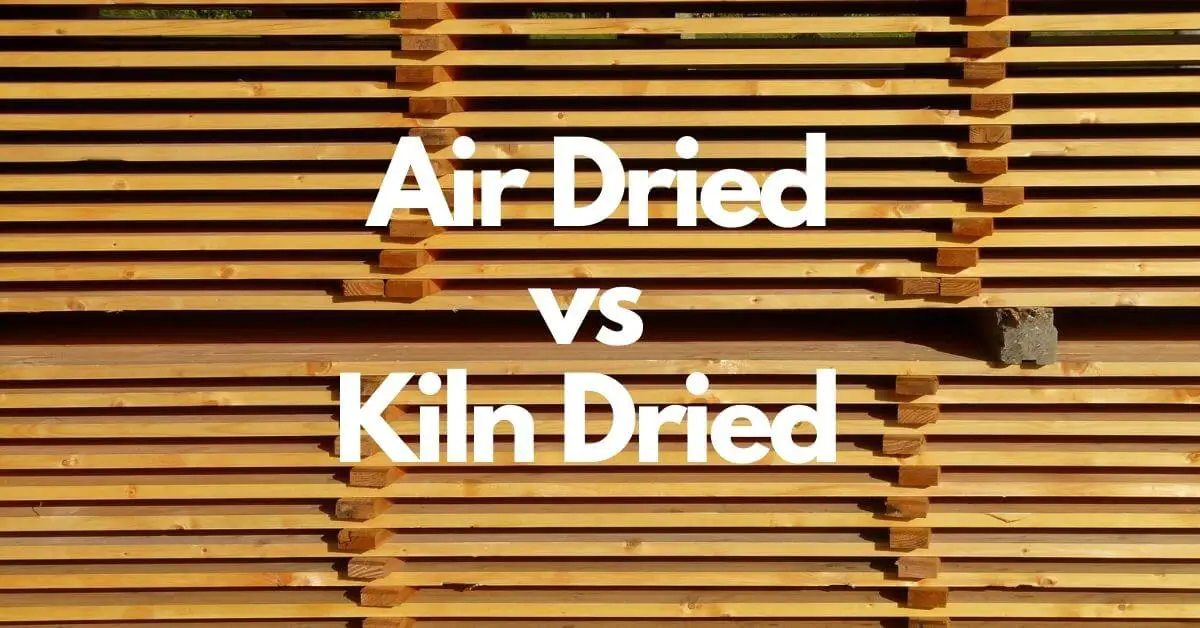
To air dry, lumber is arranged in layers. Small wooden blocks (stickers) are used to maintain gaps (at least 1 inch) between each layer so that air can pass through easily.
Air drying is done in open spaces with good airflow. The wood layers are kept under shade to protect them from weather damage.
It is a slow process and can take more than one year. To speed it up, multiple fans can be used.
How long does it take to air dry?
It depends on the species, thickness, and climate. It may take 3 to 12 months to dry 4/4 lumber. Drying is faster in summer and slower in winter.
Use of Air Dried Wood
When low moisture content is not required, air-dried wood is a good option. It is used for outdoor furniture, barns, pole sheds, fencing, decking, and garages.
Advantages of Air Drying
- Low capital cost: Air drying is less expensive than other methods. It only requires a shaded space. Moisture can be measured using a digital moisture meter. Most of the process is manual.
- Less chance of mold and decay: Air-dried wood is generally less prone to mold and insects.
- Less chance of cracks
Air-dried wood dries evenly, reducing stress in the grain and lowering the chances of cracking. - Natural color remains: Wood retains its natural color during air drying. In kiln drying, color fading is more noticeable, especially in hardwoods.
Disadvantages of Air Drying
- Slow process: Air drying depends on climate conditions, so it takes longer than kiln drying. A general rule is to air dry wood for one year per inch of thickness. This method cannot meet high demand.
- No control: There is no control over temperature or humidity. The process slows down during rainy or humid conditions.
Kiln Drying Lumber
Kiln drying is another method to remove moisture from wood. In this method, wood is placed in a closed chamber (kiln), where temperature, humidity, and airflow are controlled.
The wood is arranged in layers, and air is circulated using fans. Fan speed is adjusted as needed.
Kiln drying is faster and more efficient than air drying. The temperature ranges from 120 to 190°F. Softwoods dry faster, while dense hardwoods require higher temperatures and more time.
How long does it take to kiln dry wood?
It takes about 6 to 8 weeks to dry 1-inch-thick lumber. A 2.25-inch slab may take about 3 months. Time depends on wood type and moisture content.
Use of Kiln Dried Wood
When low moisture content is required, kiln-dried wood is the best option. It is used for furniture, cabinets, and flooring.
Advantages of Kiln Drying
- Fast process
Kiln drying speeds up the drying process significantly. Most mills use this method to reach desired moisture levels quickly. - Control
Temperature, humidity, and airflow can be fully controlled. - Dries well
High temperatures allow wood to dry more effectively than air drying. It is ideal for indoor use.
Kiln-dried wood typically has a moisture content of 6% to 8%, making it lightweight and easy to work with.
- Kills bugs
High temperatures kill insects, larvae, mold, and fungi, increasing durability. - Requires less space
Kiln drying needs less space compared to air drying, as layers can be stacked closer together.
Disadvantages of Kiln Drying
- Expensive
Kiln drying plants are costly to build and operate. Kiln-dried wood is usually 15% to 20% more expensive. - Requires skilled operators
Operating a kiln requires technical knowledge. Skilled workers are needed to control temperature based on wood type. - Color fades
Kiln drying can fade wood color by around 20% compared to air drying. - Internal tension
The process can create internal stress in the wood, making it more prone to cracking during use. - Absorbs moisture quickly
After drying, kiln-dried wood can absorb moisture quickly if not stored properly. It should be kept in a controlled environment.
Cooking with Air Dried vs Kiln Dried

Air-dried wood is better for barbeque because it dries naturally and burns well, producing proper heat.
Air Dried vs Kiln Dried | Which one is better?
Which is better is a matter of debate. Some prefer air-dried wood because it retains its natural color. Others prefer kiln-dried wood because it dries faster and more thoroughly.
Personally, I believe air-dried lumber is better because it is more natural and stable. It is not forced to dry under high temperatures or artificial conditions.